His Highness Yaduveer Krishnadatta Chamaraja Wadiyar, Member of Parliament and Custodian of the Royal House of Mysore, unveiled a bust of his ancestor, His Highness Jayachamarajendra Wadiyar, at the New HAL Management Academy (HMA) Campus.
HAL’s 86th Foundation Day
It took 86 years, but perhaps better late than never. At Hindustan Aeronautics Limited’s 86th Foundation Day celebrations in Bengaluru on December 23, 2025, a historical oversight began to be corrected—though not without revealing how deep the erasure had been.
His Highness Yaduveer Krishnadatta Chamaraja Wadiyar, Member of Parliament and Custodian of the Royal House of Mysore, unveiled a bust of his ancestor, His Highness Jayachamarajendra Wadiyar, at the New HAL Management Academy (HMA) Campus. It was a moment of profound significance: the man who, at the remarkably young age of 21, laid the foundation for HAL’s birth in India was finally being commemorated at the very institution he helped create.
History has been kinder to some founders than others. While industrialist Walchand Hirachand is rightly remembered for bringing the aircraft manufacturing project to India in 1940, and Sir M. Visvesvaraya’s role in bringing HAL to Bangalore is acknowledged, it was the young Maharaja Jayachamarajendra Wadiyar who acted with remarkable speed and vision to get it implemented. The Maharaja provided crucial land, infrastructure support, and the enabling environment that transformed the vision into reality. Yet, over the decades, while others remained in HAL’s founding narrative, Jayachamarajendra Wadiyar’s pivotal role gradually faded into obscurity.
Yet the irony was inescapable and almost painful to witness. The master of ceremonies referred to the founder as “Krishnarajendra Wadiyar”—confusing him with his predecessor. The dignitary delivering the welcome speech visibly struggled to even pronounce “Jayachamarajendra Wadiyar”—stumbling over the very name of the man being honored. If there were any starker illustration of how thoroughly Sri Jayachamarajendra Wadiyar had been written out of HAL’s founding narrative, this was it—honored in statue, misidentified and fumbled over in speech at his own commemorative event.
The present Wadiyar, in his gracious remarks, outlined the rich legacy of the Mysore state and his ancestor’s visionary contributions to Indian aerospace. “HAL remains at the new forefront in aerospace and defence. We are forging ahead, and HAL is showing the way,” he said, choosing to look forward rather than dwell on decades of historical amnesia.
Dr. D K Sunil, Chairman & Managing Director of HAL, spoke of the company’s transformation journey, emphasizing IT and AI integration, operational excellence, capacity expansion, and the establishment of an R&D Centre for space. He highlighted HAL’s new entry into the space sector with SSLV (Small Satellite Launch Vehicle) manufacturing—a significant leap from the company’s earlier role of providing only structures for space programs. “Institutions are shaped not only by technology but by leadership that builds capabilities,” he noted—words that ring with particular resonance when considering the young Maharaja who gave HAL its very foundation. Dr. Sunil urged all stakeholders to focus on consistent execution across all domains by raising operational excellence and deepening indigenisation. He assured stakeholders of timely deliveries and consistent quality by employing Industry 4.0 technologies.
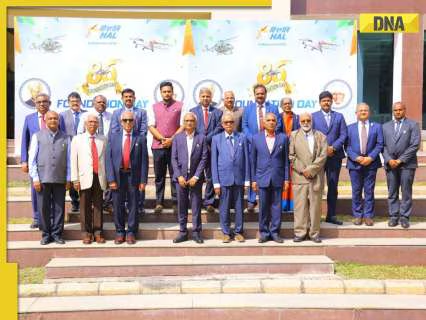
The event, attended by HAL’s Board members, Chief Executive Officers, Executive Directors, former CMDs, and employees, also saw the unveiling of a HAL book by Amar Chitra Katha and a commemorative HAL Mystamp—small but significant efforts to document and celebrate a history that has too often been simplified or forgotten.
As HAL showcases its global aspirations and positions itself as a leading player in aerospace and defence, this belated recognition raises uncomfortable questions. How many other foundational contributors have been obscured in the rush to craft a more convenient narrative? What does it say about institutional memory when a founder’s name becomes difficult to pronounce—indeed, when it’s confused with someone else entirely—by the very organization he helped birth?
Perhaps the 86th year will mark not just a celebration of HAL’s achievements, but the beginning of a more honest reckoning with its complete history—one where all founders, regardless of their royal lineage or regional roots, receive the recognition they deserve from day one, not as an afterthought nearly nine decades later.
The bust now stands at the New HMA Campus. One hopes the name—the correct name—will stand equally firm in the institutional consciousness going forward.
True ‘Atmanirbharta’ (self-reliance) is not just about manufacturing indigenous jets, but about owning the indigenous history that made those jets possible.
(Disclaimer: The views expressed above are the author’s own and do not reflect those of DNA)
(Girish Linganna is an award-winning science communicator and a Defence, Aerospace & Geopolitical Analyst. He is the Managing Director of ADD Engineering Components India Pvt. Ltd., a subsidiary of ADD Engineering GmbH, Germany.)