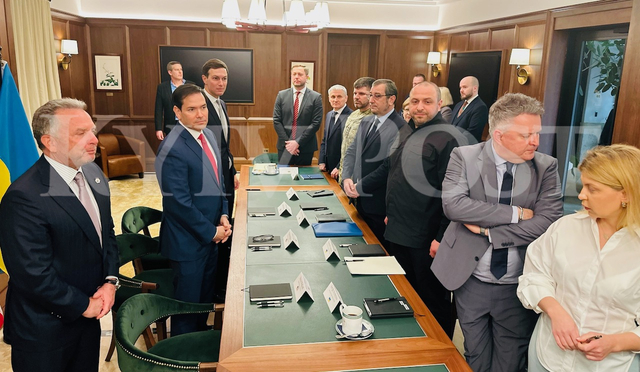
WASHINGTON DC – The official line coming out of last week’s US-European talks on Ukraine peace was one of resolve: allies unified – despite how aggressively Russia is trying to split the West – pressure on Moscow sustained, and support for Kyiv undiminished.
But as diplomats packed up and headed home from Miami, American voters appeared to take away a more complicated message – one that underscores a growing gap between Washington’s posture and public patience.
JOIN US ON TELEGRAM
Follow our coverage of the war on the @Kyivpost_official.
A fresh Economist/YouGov survey conducted Dec. 20–22, just after US and European officials wrapped up the Miami meetings, finds that Americans remain broadly aligned on who the enemy is in Russia’s war in Ukraine.
What’s far less clear, however, is how the conflict ends – or whether the people running it know the answer.
The poll, conducted among roughly 1,592 US adult citizens, offers a snapshot of public opinion at a moment when the administration is working to reinforce allied unity abroad while steadying increasingly fragile support at home.
It shows durable backing for Ukraine and hardened hostility toward Moscow – alongside rising skepticism about leadership, strategy, and the war’s direction.
Put differently: the coalition hasn’t collapsed. But it’s uneasy.
A war Americans see as stuck
On the most basic question – who is winning – Americans see little momentum.
Other Topics of Interest
Calls for Wartime Elections in Ukraine Have Always Been a Trojan Horse
Elections under fire are not a democracy. They are a weapon – and right now, they are aimed directly at Ukraine’s legitimacy.
Just 9% say Ukraine is winning the war. 26% believe Russia is winning. The largest share, 43%, say neither side is winning, while another 22% say they aren’t sure.
The result is a public that increasingly views the conflict not as a march toward victory, but as a grinding stalemate – a perception that hangs over nearly every other finding in the survey.
That sense of drift is particularly striking given the administration’s effort in Miami to project unity and resolve.
Voters may believe Washington is committed. They are far less convinced it is making progress.
Support for Ukraine holds
Despite that pessimism, a slim majority of Americans still support continued US military assistance to Kyiv.
A combined 53% say the US should either increase (33%) or maintain (20%) military aid to Ukraine.
But that majority is fragile: 27% now favor decreasing or stopping aid altogether, while another 21% say they’re undecided.
The coalition is holding – but it is thinner than it once was.
The divide is sharply partisan. Democratic voters remain firmly in Ukraine’s corner, with 57% favoring increased aid.
Among Trump voters, just 16% support increasing assistance, while 43% favor reducing or ending it outright. Independents sit uneasily in between, supportive but wary.
One senior Democratic congressional aide, granted anonymity to speak candidly, told Kyiv Post on Tuesday the numbers mirror what lawmakers are hearing back home.
“Members still support Ukraine, but the questions are changing,” the aide said, adding, “It’s no longer ‘why are we helping?’ It’s ‘what’s the plan, and how long does this last?’ That’s a harder conversation.”
Russia: no ambiguity, just hostility
If Americans are conflicted about strategy, they are not conflicted about the adversary.
Nearly half of respondents – 49% – now describe Russia as an enemy of the US, with another 28% calling it unfriendly. Just 9% see Russia as friendly or an ally, making it one of the most negatively viewed countries in the entire survey.
The data reflects a hardened public consensus after nearly four years of war – and little appetite for rethinking Moscow’s role.
Ukraine, by contrast, is viewed far more favorably. 27% of respondents call it an ally, and 37% describe it as friendly. Only 15% view Ukraine as unfriendly or an enemy.
The public may be losing confidence in the war’s direction – but not in who deserves blame or sympathy.
Leadership divides sharpen
Those same fault lines show up in views of leadership, particularly Donald Trump’s handling of the Russia-Ukraine conflict.
Overall, Americans are net negative: 31% approve of Trump’s approach, 49% disapprove, and 20% say they aren’t sure. But the topline masks an almost total partisan split.
Among Trump voters, approval stands at 69%. Among Harris voters, it drops to just 7%, with more than three-quarters disapproving.
The result is a country aligned on the threat posed by Russia – but deeply divided over who should be managing the response, and how.
A Republican congressional aide told Kyiv Post the disconnect poses a growing political challenge.
“There’s agreement that Russia is the bad actor,” the aide said, adding, “What’s missing is a shared understanding of what winning looks like – and voters are starting to notice that.”
Miami’s message – and the public’s takeaway
The Miami talks were designed to signal coordination, endurance, and allied resolve. But the poll suggests Americans heard something else as well: determination without clarity.
Voters still support Ukraine. They still see Russia as an enemy. But fewer believe the war is moving decisively in any direction – and fewer are willing to back what looks like an open-ended commitment without a clearer explanation of what success looks like.
For now, the political foundation for supporting Ukraine remains intact.
What’s eroding is patience – and confidence that Washington knows how, or when, this war ends.
And that, more than any display of unity in Miami, may be the challenge that defines the next phase of the debate.