It was a gray November day. The hundreds of police officers gathered in a large congress hall in the city of Wiesbaden fell silent. The fall conference of Germany’s Federal Criminal Police Office (BKA) had convened to discuss the domestic security situation: Drone attacks, hybrid warfare and digital disinformation campaigns.
On the podium was Alena Buyx, a medical ethicist who was for many years the president of the German Ethics Council, which advises politicians and civil society on fundamental questions: When does life begin? What are the arguments for and against mandatory vaccination? Where are the ethical limits of research?
At the BKA conference, she was discussing democracy in Germany.
“At dinners with perfectly ordinary colleagues and friends who love their country, I often hear them say after the second glass of wine, that they’re considering whether they should leave the country,” Buyx said.
“Should leave,” meaning they don’t want to. Buyx didn’t name the particular threat. But every police officer in the room knows who she’s talking about: the far-right Alternative for Germany (AfD) party.
How dangerous are TikTok & Co. for democracy?
To view this video please enable JavaScript, and consider upgrading to a web browser that supports HTML5 video
‘Friendly face of National Socialism’
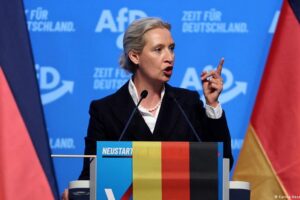
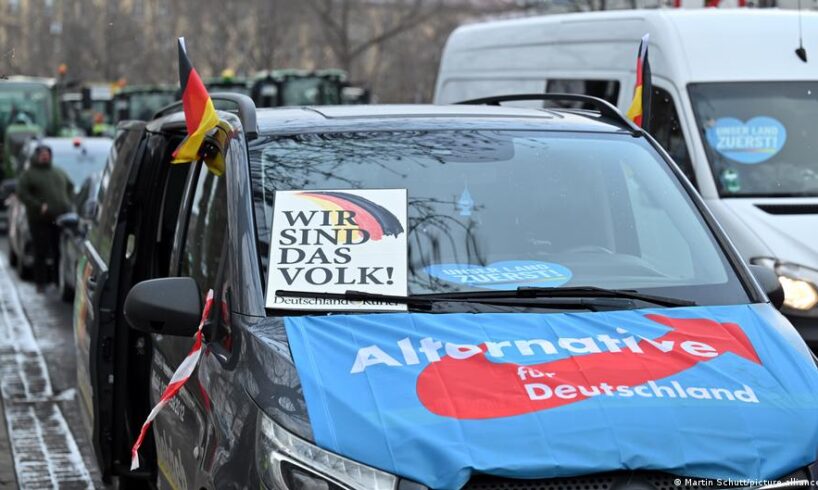
The AfD has been on the rise for years. In eastern Germany, it has become the strongest force. The party is also becoming increasingly openly extremist. AfD officials use Nazi slogans, pose with their hands on their hearts in front of Adolf Hitler’s bunker, wear clothing from the mail-order catalog of Germany’s largest neo-Nazi organization, and call themselves the “friendly face of National Socialism.” These are not mere accusations — these incidents are self-publicized.
AfD politicians are increasingly openly opposed to the fundamental values of the German constitution: namely, that no one may be discriminated against on account of their origin, religion, culture or race. There are a growing number of court rulings that attest to the unconstitutional nature of factions of the AfD. And the security authorities are gathering increasing evidence of the AfD’s aggressive fight against fundamental democratic values .
Is Germany no longer safe for all? Or will it soon no longer be safe if the AfD comes to power? Education Minister Karin Prien, of the conservative Christian Democrats (CDU), announced in October that she would leave Germany should the AfD ever become part of the federal government. Prien’s Jewish great-grandmother was murdered by the Nazis.
Such power in government at the federal level doesn’t yet seem within reach for the AfD. But in individual states the situation is different.
Young, far-right and radical? Meet the AfD’s future leaders
To view this video please enable JavaScript, and consider upgrading to a web browser that supports HTML5 video
AfD aims to transform state of Saxony-Anhalt
Elections will be held in four states in 2026: two in eastern Germany, Saxony-Anhalt and Mecklenburg-Western Pomerania, and two in western Germany, Baden-Württemberg and Rhineland-Palatinate. In the eastern German states, the AfD is by far the strongest party and aims to take power.
Its goal is not coalitions with other parties, but overall control.
That was stated by Hans-Thomas Tillschneider, deputy parliamentary group leader of the AfD in Saxony-Anhalt, in a written response to DW. He and his party have clear ideas about what they want to do with political power.
Tillschneider says projects that promote democracy are “indoctrination programs,” and they will no longer receive funding. He’d like to scrap the “School Without Racism” project and abolish public broadcasting in its current form. Tillschneider and the AfD are focusing on nationalism: “Being German should once again evoke a positive feeling,” he wrote to DW. He is fighting against everything that he doesn’t consider “German.” For example, he considers pop songs “meaningless, lacking in tradition, international.”
Tillschneider takes inspiration from US President Donald Trump and Hungarian Prime Minister Viktor Orbán.
Above all, the AfD wants one thing: to deport people from Germany. Tillschneider is calling for a “deportation offensive” as a “first political measure” in the event of an AfD government. Within the party, the demand is phrased as the “remigration of millions.”
But, as there aren’t millions of people in Germany who are legally obligated to leave the country, the question arises: Whom exactly does the AfD want to deport?
Could ‘remigration’ blow up the AfD’s plan for power?
To view this video please enable JavaScript, and consider upgrading to a web browser that supports HTML5 video
“I assume that an AfD in government would further establish and professionalize its radicalism,” Matthias Quent, from the Institute for Democratic Culture at Magdeburg-Stendal University, told DW. “Especially in Saxony-Anhalt, which has one of the most far-right state branches. There are no forces there that would want a different course.”
Quent expects that, if the AfD comes into government, it would try to install its extremist supporters into the civil service. “Then it will become clear whether a resilient democracy can still function when the government includes at least some far-right participation,” Quent said.
The question of the resilience of democracy also troubles Germany’s security services. The AfD’s Saxony-Anhalt branch has been deemed “definitely right-wing extremist” and a threat by that state’s security authorities. An AfD-led government would be responsible for combating extremism.
But it would not only have influence over a small state in eastern Germany: The AfD government of Saxony-Anhalt would be represented on all national committees for police and intelligence work and the passing of federal laws, as well as the Federal Council.
The German authorities are now discussing how they need to change their organizational and established practices to be prepared for potential extremist attacks from within.
In Germany, the judiciary — the theoretical guarantor of normative values in a functioning democracy — also appears vulnerable. The justice system is often criticized by members and factions of the AfD. In the state of Thuringia, the party has already wielded its political power to block the appointment of new judges to key positions.
Success in the state elections in 2026 in Germany would be a stepping stone for the AfD, David Begrich, of the association Miteinander (Together) in Saxony-Anhalt, told DW. The organization advocates for a democratic and cosmopolitan Germany. “It is very clear that the party sees the eastern German states as a political laboratory to test how far it can go in challenging democratic culture,” Begrich said. The goal, he said, is to challenge the federal government.
Fundamental democratic consensus still exists
The AfD also benefits from the constant stress to which German society is exposed by the coronavirus pandemic, economic challenges and Russia’s attack on Ukraine, among other issues. “We are experiencing an ever-increasing frequency of crises, and this leads to a sense of insecurity that extends far beyond the core area of political action available to the governing parties,” Begrich said. He said politicians must take seriously concerns such as people’s experiences of powerlessness over the past few years.
Begrich said there was still a fundamental democratic consensus in Germany. “In my consulting work, my experience is that people are indeed willing to reach out to one another and work together for the common good,” he said, “and this transcends differences in their everyday lives.”
Theresa Donner shares this view. She is a dedicated bookseller and citizen of the eastern city of Halle an der Saale in Saxony-Anhalt. She, too, fears an AfD victory in the state elections. In polarized and heated times, there need to be more opportunities for common ground and exchange, transcending political camps, Donner said. “For example, we could organize a crime-fiction reading again,”
she said. “Such events used to be the classic local pub gathering. The AfD has been very good at filling the void in rural areas where everything seems to have fallen apart.”
Donner urges her fellow Germans to take action rather than ceding these gaps to the far right.
This article was originally written in German.
Where do Europe’s far-right parties differ?
To view this video please enable JavaScript, and consider upgrading to a web browser that supports HTML5 video
While you’re here: Every Tuesday, DW editors round up what is happening in German politics and society. You can sign up here for the weekly email newsletter, Berlin Briefing.