A ping-pong movie shouldn’t feel like a crime thriller. And yet Jewish director Josh Safdie turns “Marty Supreme” into a pressure-cooker story about a Lower East Side striver who treats table tennis like a hustle, a stage, and a way out.
Safdie’s latest is two-and-a-half hours of momentum: sharp, vulgar, funny, and frequently uncomfortable, set between 1952 New York and London. It’s the kind of film where people are always trying to win the room, win the deal, win the moment, and where “winning” rarely looks like peace.
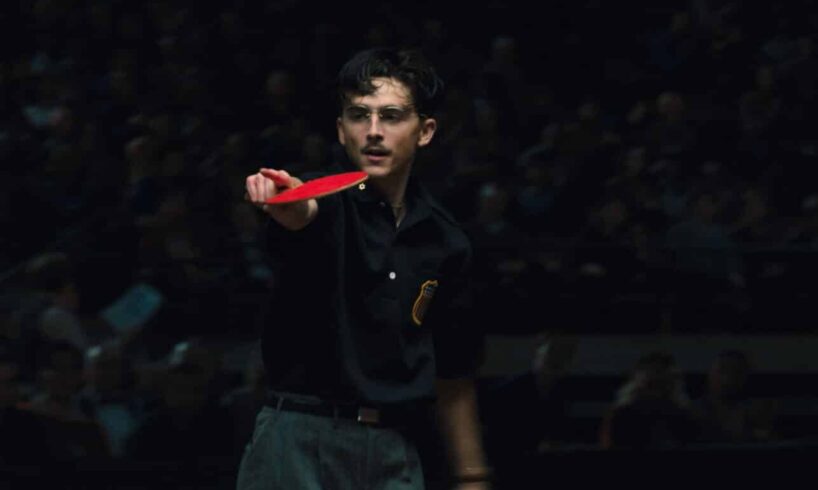
“Marty Supreme” is loosely inspired by Jewish table tennis hustler and champion Marty Reisman, but it isn’t interested in behaving like a respectful biopic. Jewish actor Timothée Chalamet stars as Marty Mauser, a kid with a dream no one takes seriously, who responds by turning everything into a wager, including his own life.
Timothée Chalamet’s charm shines through in “Marty Supreme”
Chalamet’s Marty is persuasive in a way that’s hard to resist and harder to defend. He can talk himself into better treatment, better access, a better story, even when he clearly doesn’t deserve any of it. He isn’t likable so much as watchable: you keep expecting him to stop, and he never does.
The film opens with Marty in the Lower East Side, working a shoe-store job and chasing money on the side through ping-pong hustles and backroom games. He’s also sleeping with Rachel Mizler (Jewish actress Odessa A’zion), a married neighborhood friend. Their affair kicks off the movie’s first major statement: Marty doesn’t separate desire, ego, and ambition. For him, it’s all the same impulse.
From there, the plot clicks into place. Marty’s obsession is the British Open in London, where he’s convinced he’ll topple reigning champ Bela Kletzki and force America to pay attention to table tennis. When his uncle won’t hand over back pay Marty believes he’s owed, Marty returns after closing and pulls a revolver on his cousin to open the safe. The movie doesn’t treat it like a clean “crime” so much as a glimpse into Marty’s internal logic: if the world won’t give him what he’s “earned,” he’ll take it.
That logic powers almost everything that comes next. “Marty Supreme” lets Marty be charismatic without asking you to pretend he’s good. The film keeps one eye on how intoxicating he is, and another on what he ruins along the way.
“Marty Supreme” is a test of how far some will go to succeed
London is where Marty’s ego really inflates. He bullies his way into better accommodations, antagonizes the table tennis leadership (especially the ITTA head, Sethi), performs for reporters, and forces himself into Kay Stone’s world. Kay (Jewish actress Gwyneth Paltrow) is a wealthy retired actress with money, boredom, and a taste for chaos. Marty seduces her, then nudges himself into the orbit of her husband, tycoon Milton Rockwell (Kevin O’Leary), who recognizes Marty as both a potential asset and a very loud liability.
On the table, Marty looks unstoppable until he meets Koto Endo, a Japanese player whose style throws him off. Marty beats Kletzki, then gets dismantled by Endo. The loss changes the temperature of the film. Marty can handle being underestimated. He can’t handle being exposed.
Timothée Chalamet in “Marty Supreme” (A24)
Back in New York, the movie turns into a spiral. Marty is broke, fined, and trying to claw his way toward a rematch in Tokyo. There’s a detour where he’s reduced to doing crowd-pleasing “tricks,” forced to turn himself into a novelty act. Safdie shoots it with just enough bite to make the humiliation land, without letting Marty play it as heroic suffering.
Then the film veers into its most Safdie-ish subplot: the dog scheme. A gangster named Ezra Mishkin (Abel Ferrara) has a dog, Moses, and Marty gets tangled in a ransom swindle connected to it. Rachel, tired of being treated like collateral damage, tries to run her own parallel move with a lookalike dog. It backfires. She’s kidnapped. Marty leads Mishkin’s crew to a house in New Jersey, where a shootout wipes out nearly everyone except Marty and Rachel. Rachel takes a stray pellet, goes into labor, and Marty drops her at a hospital so he can still make his flight to Tokyo. It’s the movie at its cruelest and clearest: when Marty says greatness comes first, he means it.
Tokyo is where the film pulls off its strangest balancing act. Marty tries to pay his fine and make peace with Sethi, only to learn he still won’t be allowed into the World Championship. He’s put into an exhibition match that’s effectively staged, loses the way he’s “supposed” to, and then breaks the script in front of the crowd, begging Endo for a real rematch. Under pressure from the rich men hovering around the sport and the humiliation of being treated like entertainment, Marty somehow pulls out a narrow win and collapses, sobbing.
He returns to New York on a military flight, walks into the maternity ward, meets his newborn son, and breaks down again. The ending is tender, but not tidy. The movie doesn’t pretend Marty has earned softness. It argues, instead, that he’s capable of it, even after everything.
Anchored by a stellar supporting cast
Chalamet carries the film, but “Marty Supreme” wouldn’t work without the people around him pushing back, absorbing damage, and complicating the story.
A’zion gives Rachel real voltage. She isn’t just “the girlfriend” or “the one back home.” She’s funny, tense, increasingly furious, and you can watch her patience burn down scene by scene. Her relationship with Marty doesn’t simply “fall apart.” It corrodes.
Odessa A’Zion in “Marty Supreme (A24)
Paltrow, meanwhile, makes Kay Stone more than a rich diversion. She plays Kay as a woman drawn to danger partly out of boredom and partly out of appetite. Her scenes with Chalamet have a jittery push-pull, not just chemistry but calculation. Kay and Rachel are both schemers in their own ways, and that matters because Marty only fully recognizes people when they start playing his game back at him.
That said, the film still treats the women primarily as stress tests for Marty. Rachel’s anger, Kay’s restlessness, even the ways they push back, often function as plot accelerants, complications that fling Marty into the next crisis, the next city, the next self-myth. They’re vivid, but the narrative keeps snapping them back into Marty’s gravity.
Ferrara is the other major jolt. He brings old-New-York menace without overplaying it, and smaller turns (Fran Drescher among them) add texture instead of filler. The world feels populated, not assembled.
Jewishness and “Marty Supreme”
The film doesn’t stop to underline its Jewishness, and that’s part of why it works. The Lower East Side texture is doing constant quiet work in the background: the ambition, the survival instincts, the postwar edge, the sense of people trying to reinvent themselves without asking permission.
But Marty’s relationship to that identity is complicated, and not especially noble. He wields it the way he wields everything, as leverage.
In London, he orders like a prince at the Ritz, refers to himself as “the chosen one” for the press, and talks in apocalyptic boasts that are meant to stun the room into making space for him. That includes his most jaw-dropping line before a match, when he claims he’s going to do to Bela Kletzki what Auschwitz couldn’t, then quickly tries to justify it with: he’s Jewish, so he can say it. It’s not wisdom. It’s a performance, a young guy trying to turn inherited history into a permission slip for whatever he wants next.
Timothée Chalamet and Josh Safdie shooting “Marty Supreme” (A24)
The film complicates that bravado by placing real proximity to the Holocaust elsewhere on screen. When the story pivots into heavier terrain, it does it through a supporting character whose memories are bluntly physical: bomb disposal near the camp, hunger so extreme that stolen honey becomes sustenance. In those moments, Marty’s swagger stops sounding “provocative” and starts sounding hollow, like exactly what it is: someone borrowing the weight of horror he never lived through to inflate his own legend.
That tension may be the point. Marty is a post-Shoah striver who calls himself the “ultimate product of Hitler’s defeat,” treats redemption like a birthright, and sees poverty as an insult he refuses to inherit. He wants to float above the shoe-clerk life and the immigrant grind, and he builds a myth of self-invention so loud it can drown out other people’s pain.
Safdie said his own connection to the story comes from memories of “eccentric Jewish immigrant Lower East Side characters” around the sport. On screen, that sensibility shows up in the details, including period nods like the Forward delivery truck and the use of the building facade, the kind of blink-and-it’s-gone authenticity that quietly roots the movie in a specifically Jewish New York.
Still, the movie is playing with live wires. Holocaust language isn’t neutral, and “Marty Supreme” sometimes flirts with using it for impact the same way Marty does. If you read those moments as the film exposing Marty’s ugliness, they land. If you read them as the film enjoying the provocation a little too much, they can feel thin, borrowing gravity without fully earning it.
What wasn’t so supreme
Safdie’s movies thrive on moral grime. Here, that grime sometimes turns into blur. The film is so committed to Marty’s momentum that it occasionally softens the consequences. Marty does truly appalling things, and the story keeps snapping back to his wounded-kid core, as if pain automatically converts into permission. That push-pull can be compelling, but at times it feels like the movie can’t resist its own protagonist.
The tone also wobbles. One minute “Marty Supreme” is a hustle-comedy. The next, it’s tragedy. Then it’s back to sports-movie catharsis. The pivots are intentional, but not all of them are clean. The film wants to be many things, and sometimes it doesn’t build a bridge between them.
Finally, the story is stuffed, sometimes to its detriment. London, the gangster detour, the dog scheme, Tokyo, the birth, the comeback. Each piece is watchable, often electric, but the accumulation can make it feel like the movie is sprinting away from the quieter consequences it gestures toward. Before you can sit with what Marty did, you’re already in the next room, the next match, the next deal.
“Marty Supreme” might be just as ambitious as Marty himself, and like its soon-to-be iconic lead, it doesn’t so much ask for what it wants as take it, convinced it deserves the win.
Who was Jewish table tennis phenom Marty Reisman?
Marty Reisman was born to Ashkenazi Jewish parents on Feb. 1, 1930, and was raised on the Lower East Side.
Reisman was famous for his ping-pong hustles, transforming the sport into an art form and medium for performance.
He built a reputation on stunt-level skill: using a $100 bill to check the net’s height, knocking a cigarette in two from across the table, and even playing blindfolded when there was money on the line. He did exhibition work with the Harlem Globetrotters, rode the boom-and-bust cycle of gambling, and kept pushing the old-school “hardbat” paddle long after the sport modernized, partly out of principle and partly because he preferred the sound.
Reisman turned to ping-pong after he had a nervous breakdown when he was 9 years old. He found the sport soothing, and soon became a competitor across New York City.
In his career, he earned five bronze medals at the World Table Tennis Championship and 22 major table tennis titles overall, including two U.S. Opens and a British Open medal.