The first minister of Wales has said she is determined for Welsh Labour not to lose its crown as the world’s most successful democratic party, despite warnings it could be relegated to third place in May’s elections.
Polls suggest Reform UK and Plaid Cymru could win more seats than Eluned Morgan’s party in the Seneddelections next year, ending 100 years of dominance for Labour in Wales.
Morgan said: “Of course I feel the pressure but I’m also determined to turn this round. We’re the most successful democratic political party on the planet. It’s a long winning streak. We’re up for the fight.”
Morgan became Labour’s first female head of government in the UK in the summer of 2024 following the resignation of Vaughan Gething over a donations scandal.
She is seen as charismatic and energetic, but the polls suggest the people of Wales may be ready for change, with her party being defeated at the high-profile Caerphilly byelection in the autumn.
Morgan said: “Caerphilly was difficult but I’m keen to make sure people recognise that what you have in me is a leader who is determined to turn a page.”
She pointed out that Labour Senedd grandees such as the former first minister Mark Drakeford and the social justice secretary, Jane Hutt, who have been at the centre of Welsh politics since devolution in 1999, were leaving the parliament.
“They have been here right from the beginning. They helped to establish devolution. They helped to protect devolution from the years of austerity. But what we have now is the end of austerity and what I’m setting out is a vision, where Wales will move from post-industrial society to one embracing a digital future, a technology-driven future that will be powered by clean energy made here in Wales.”
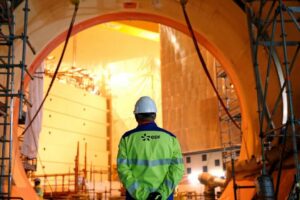
Morgan highlighted a scheme to build a first-of-its kind nuclear power station on Anglesey (Ynys Môn) in north Wales, announced in November, and the creation of two AI growth zones in south Wales.
The first minister said if Plaid led the next Welsh government, its desire for an independent Wales would be a distraction. “What we’ll get is constant talk about the constitution and a constant battle with the UK government.”
Morgan said Reform “threw the kitchen sink” at the Caerphilly byelection and came up short.
“There is a percentage of people who will buy into their negativity, their division-making, their hatred. What I’m interested in doing is competing on a positive pitch. I want to look to the future and I’m not interested in chasing them down an immigration agenda.
“We have a situation in Wales, particularly in the area I represent [mid and west Wales], where 48% of doctors and dentists have been trained overseas. We are dependent on these people.”
She said companies would be less keen to invest in Wales and public services would be at risk under Reform. “Reform have no experience of running anything. That is one hell of a risk for the people of Wales to take.”
In the summer, Morgan expressed impatience with UK Labour, calling on Keir Starmer to rethink policies on welfare and said she was “tacking to the left”.
She said she was pleased changes had been made to the winter fuel allowance and the two-child benefit cap had been abolished.
Morgan also said UK Labour was following the Welsh party’s lead on schemes such as free school breakfasts. “We’ve been doing that for 21 years. And they want to introduce a youth guarantee. Again, 60,000 young people in Wales have already benefited from our youth guarantee. What’s great is, they’re following us. We’ve set the pace, I think, for the UK government. It’s a shame they don’t give us as much credit for the creativity we’ve shown in the past.”
Some Labour party members have privately suggested it may be time for a spell in opposition, giving time and space for reinvention but Morgan said it would be an “awful thing” for Wales if her party lost power.
“I think that the things people rely on every day may not be there. Think about free prescriptions – something they’re not offering in England. That may go. It won’t go if Welsh Labour is in power.”
More than anything, she said Labour provided stability.
“Instability is very, very dangerous for the country at a time when the world is facing instability. You see the challenges people have with the cost of living crisis, climate change and flooding, Russia and the aggression happening there. All of those things create an environment of instability. I think that what we can offer is stability in an age of instability.”