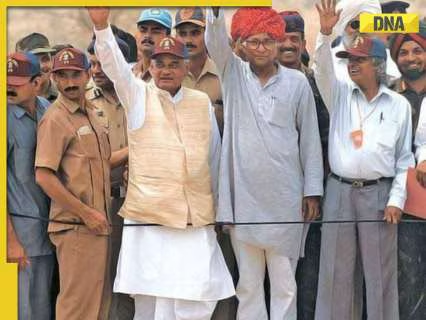
Today, on 25th December, we remember Atal Bihari Vajpayee on his birth anniversary. Born in 1924 in Gwalior, Madhya Pradesh, Vajpayee was not just a politician or a poet.
Today, on 25th December, we remember Atal Bihari Vajpayee on his birth anniversary. Born in 1924 in Gwalior, Madhya Pradesh, Vajpayee was not just a politician or a poet. He was the leader who transformed India from a country that bought weapons from others into a nation that could defend itself with its own strength. His vision and courage changed India’s defence story forever.
The Day India Surprised the World
On 11th May 1998, something extraordinary happened. India conducted nuclear tests at Pokhran in Rajasthan, becoming only the sixth country in the world with nuclear weapons capability. This wasn’t just about having powerful bombs. It was about sending a clear message to the world: India can protect itself.
What makes this achievement truly remarkable is how secretly it was done. The operation was called ‘Shakti’, meaning power. The planning was so careful and the execution so precise that even America’s advanced satellites and intelligence agencies had no clue what was coming. Imagine keeping such a massive operation hidden from the world’s most powerful surveillance systems. That required not just scientific brilliance but incredible political courage.
Between 11th and 13th May, India conducted five nuclear tests. These included both thermonuclear devices and fission bombs. The entire operation was completed in less than two months after Vajpayee became Prime Minister. This shows the kind of decisiveness and clarity he brought to India’s security.
Why Did India Need Nuclear Weapons?
Many people ask: why did India need to become a nuclear power? The answer lies in understanding our neighbourhood. To our north, China already had nuclear weapons and had even attacked India in 1962. To our west, Pakistan was secretly developing nuclear weapons with China’s help. India had faced wars in 1962, 1965, and 1971. In such a dangerous neighbourhood, India needed the ability to defend itself effectively.
When the world criticised India and imposed sanctions, Vajpayee stood firm. He told Parliament on 27th May 1998: “We do not intend to use these weapons for aggression or for mounting threats against any country; these are weapons of self-defence.” This statement captured his philosophy perfectly. India didn’t want to threaten anyone, but it would not allow anyone to threaten it either.
The tests showcased the genius of Indian scientists. Dr APJ Abdul Kalam, who later became our President, and Dr R Chidambaram led teams from the Defence Research and Development Organisation (DRDO) and the Department of Atomic Energy (DAE). These scientists had worked for years to develop India’s nuclear capability. Vajpayee gave them the political support and courage to finally demonstrate what India could achieve.
Building India’s Security System
But Vajpayee’s contribution went far beyond nuclear tests. He understood that a strong country needs strong institutions. Under his leadership, India got the National Security Council (NSC), which helps plan our country’s long-term security. He also created the Strategic Policy Group and the National Security Advisory Board. These bodies ensure that our military, intelligence agencies, and government work together smoothly.
The 1999 Kargil War was a difficult time for India. Pakistan’s soldiers had sneaked into Indian territory in the mountains of Kashmir. The war exposed gaps in our military preparedness and intelligence gathering. Instead of hiding these problems, Vajpayee set up the Kargil Review Committee to study what went wrong. This honest examination led to major improvements in how India buys weapons, gathers intelligence, and modernises its military. These reforms continue to benefit India even today.
Making India Self-Reliant
Vajpayee believed deeply in self-reliance or ‘atmanirbharta’. He knew that if India kept buying all its weapons from other countries, those countries could control us by threatening to stop supplies. True independence meant making our own defence equipment.
Under his government, India’s missile programmes received strong support. The Integrated Guided Missile Development Programme, started in the 1980s, produced missiles like Agni, Prithvi, and Akash. These missiles can carry conventional or nuclear warheads and can hit targets at different ranges. In 2000, his government approved the Ballistic Missile Defence programme. This system is designed to shoot down enemy missiles before they can hit Indian cities.
Vajpayee’s vision extended to all defence technologies. From radar systems that detect enemy aircraft to naval ships that patrol our oceans, his government emphasised indigenous development. The message was clear: reduce dependency on foreign suppliers, develop our own technological capabilities, and ensure that no other country can blackmail India by denying technology.
Responsible Nuclear Power
After the 1998 tests, India could have behaved aggressively. Instead, Vajpayee’s government announced a responsible nuclear doctrine. India adopted ‘Credible Minimum Deterrence’, meaning we would keep only enough nuclear weapons to deter attacks, not to start arms races. India also declared a ‘No First Use’ policy, promising never to use nuclear weapons first in any conflict.
This responsible approach showed the world that India was a mature nuclear power. It helped India eventually gain acceptance in the international community, despite remaining outside the Nuclear Non-Proliferation Treaty. The foundation Vajpayee laid made possible the US-India civil nuclear deal that came later.
A Legacy That Lives On
As we remember Vajpayee today, we see his impact everywhere in India’s defence. Every time India tests a missile, every time our scientists develop a new weapon system, every time India takes an independent decision on security matters, we see Vajpayee’s legacy at work.
He proved that a leader can be both gentle and strong, poetic and powerful. He gave India the confidence to stand on its own feet and the capability to defend itself. On his birth anniversary, we remember not just a Prime Minister, but a visionary who transformed how India thinks about its own strength and security.
(Disclaimer: The views expressed above are the author’s own and do not reflect those of DNA)
(Girish Linganna is an award-winning science communicator and a Defence, Aerospace & Geopolitical Analyst. He is the Managing Director of ADD Engineering Components India Pvt. Ltd., a subsidiary of ADD Engineering GmbH, Germany.)