A heritage going back hundreds, even thousands of years
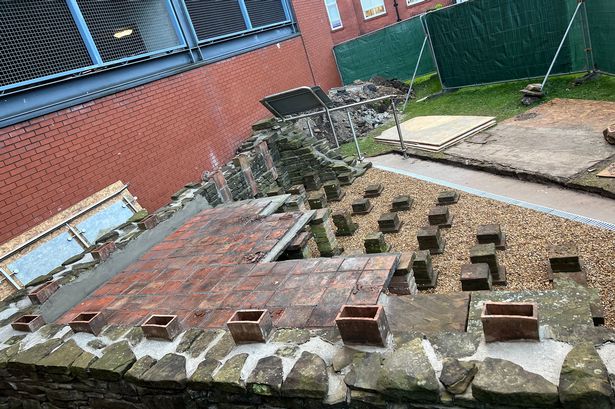
The remains of a Roman bath house in Wigan
There’s so much more to Wigan than its notoriety as the birthplace of screen icon George Formby, George Orwell’s famous book ‘The Road to Wigan Pier’, or the hugely successful rugby league club, Wigan Warrirors.
A sit-down with two members of the Wigan Local History and Heritage Society, as the town’s museum with 35,000 artefacts in its care undergoes a revamp, reveals its proud past.
What stands out about Marie-Clare Kenyon [known as Clare] and Andy Lomax is how passionate they are about the rich heritage Wigan has – dating further back than the big cities of Liverpool and Manchester.
In fact, Wigan’s history spans way before the Roman occupation circa 2,000 years ago, onward as an Anglo-Saxon settlement and its evolution into a medieval borough with a royal charter giving the town permission to hold a market granted in 1246.
The Ringditch at Aspull, a Bronze Age cremation site dating back thousands of years
Later, during the two Industrial Revolutions in the UK in the 18th and 19th centuries, it became a major centre for coal mining and cotton spinning, a fact alluded to by George Orwell in his now-famous work, which he wrote while staying in the town during the 1930s.
But here’s the thing. According to Clare, not everyone in Wigan was happy with the image he painted of the place in his book.
She said: “Orwell was commissioned to come to the town and look for specific things. He had his own agenda, which was about finding poverty and seeing how the ‘poor people’ were living.”
Orwell had been funded by his publisher Victor Gollancz [believed to be to the tune of £500] for his Left Book Club to research and write his book.
Clare went on: “He came to Wigan with a story in mind and was determined to find it, and he did. He stayed somewhere in Darlington Street and in Beech Hill.
Marie-Clare Kenyon and Andy Lomax
“In the first place he stayed, he couldn’t find what he wanted. He then moved and he found somewhere that was worse. A lot of Wiganers do resent ‘The Road to Wigan Pier’ because they feel it didn’t reflect the town as it should have done.”
Over to Andy: “It focused on the negative social deprivation side. The flip-side is – like my grandma used to say – God rest her soul – 1940s Wigan was booming. You never knew there was a war on.
“My grandma described the nightlife – the ballrooms, the dancing, the cinema, the theatre. Orwell didn’t talk about any of that. It was purely all about the down and outs eating tripe and all that.”
But he went on: “I’m over it, because if he was focused on poverty, what he saw was real. Also, we can use his name because he’s written a book about our town.
“So we had the Orwell pub, which has shut down on Wigan Pier and we’ve got an enclosure in the reference library [in the museum], the Orwell room. They’ve still got the signing-in book with his signature in it.”
Back to Clare: “But he made it [the poverty] out to be all that Wigan was. It absolutely lacked balance, which is unfortunate.”
In reality, Wigan has a lot more to brag about, said Andy. “I think one thing that slips through the net quite a lot is that it’s in the top 10 – maybe the top five – oldest boroughs in the country.
“It’s older than Liverpool and apparently there’s some ancient argument with Preston that goes way back along the lines of, ‘we’re older than you’ and vice-versa.
“The old town motto was ‘ancient and loyal’. So they carried that through and it came through the English Civil War [from 1642 and 1651] when it remained loyal to the Crown.”
Back to Clare: “And it was a very important market town, even bigger and more important than Manchester.”
But according to Andy and his research, in the run-up to the first Industrial Revolution in the 18th century, there were lots of people and wealth coming into Wigan, but that prosperity never found its way down to the working classes.
He went on: “Before that, Wigan would’ve been hardly populated – quite sparse. It was full of nailmakers, goldsmiths, silversmiths, clockmakers and people who made clothing. It was rich. There was a lot of money knocking about the place. It’s believed people were paying more in business rates than in Manchester and Liverpool.
“For everything we know about Wigan, I do think it’s punched above its weight for an awful long time – possibly for hundreds and hundreds of years,” said Andy.
“Of course, its location couldn’t be more ideal when it comes to the economy and manufacturing base, with Liverpool 20 miles in one direction and Manchester the other way.
“That’s why we have our railway system the way we do – with two adjacent train stations across the road from each other going in different directions. That’s because the location [geographically] of the town is perfect.”
The Local Democracy Reporting Service (LDRS) was talking to the duo in Wigan’s Life Centre, a stone’s throw from the highest point of the town and the place where the remains of a Roman fort were discovered.
Close by, there are the visible remains of a Roman bath house, which underlines its importance to that once-great empire.
It is believed that back then it was named as Coccium by the Romans and formed a key part of the journey between Manchester and Ribchester in Lancashire.
Andy described the point in Wigan – at Believe Square – as a ‘perfect spot if you were a Roman general. “You would be on top of the hill overlooking what would be nothingness, just rivers, fields and ancient woodland,” he said.
Believe Square, where a statue of rugby league great Bill Boston now stands, was once the site of a Roman fort
And another reason for Wigan’s strategic importance is the River Douglas.
Clare explained: “Before they rerouted the river to build the central railway station, Wigan was surrounded on three sides by the Douglas. So it was like a natural moat, and thus it offered protection. So there was only one side they would have to keep watch over and defend.
“And the river was a good source of food because it had lots of salmon. That was right up until the Industrial Revolution, before it became polluted. They’re trying to clean it up now, but there’s trouble with sewage pollution.”
Going back in time even further, there is the ‘Ringditch’in the Wigan outpost of Aspull – a Bronze Age cremation site, currently being excavated by archeologists.
Andy said: “To put it into context, that predates the Egyptians. Even their burials aren’t that old. The beauty of archeology is that not all of it’s been found.
“So when you come across something like that – which is nationally significant – they’re [the Wigan Archeological Society] are trying to keep hold of it, because it’s on private land.”
One thing that irks Andy, however, is the townsfolk’s reputation as ‘pie-eaters’.
He said: “To the ignorant, untrained mind, that suggests we like to eat a lot of pies. But that’s nonsense. It’s not about that.
“The reason for it was the coal miners’ strike in 1926 during the renowned General Strike. The miners from the next town in Leigh kept saying, ‘don’t go back [to work] too early, we’ll get a good deal’.
“But the Wigan miners went back too early. So they were made to eat humble pie. And, literally, that’s where it comes from.”
Such is the local interest in Wigan’s history, the society has almost sold out of its book, which is a deep dive into the history of King Street, the town centre home to the offices of the local industrialists of yesteryear and where there are 10 Grade II-listed buildings.
It’s called ‘King Street: Wigan’s King of Streets’ and is available from the society, contactable on the website: https://wiganlocalhistoryandheritagesociety.org/