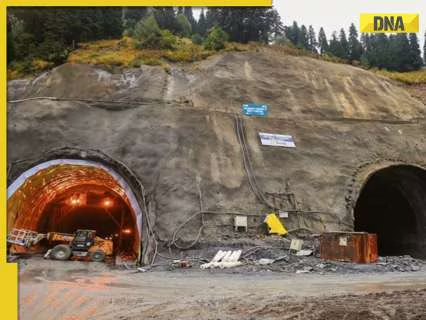
The Zojila Tunnel, Asia’s longest highway tunnel at high altitude, is set for completion by May 2026. Spanning 13.150 km, it will provide all-weather connectivity between Jammu and Kashmir and Ladakh, boosting strategic mobility and reducing travel time by 3.5 hours.
The Zojila Tunnel, Asia’s longest highway tunnel at high altitude, is set to revolutionise travel and connectivity between Jammu and Kashmir and Ladakh. With a length of 13.150 kilometers, this ambitious project is on track to achieve a significant milestone by April–May 2026, providing all-weather access to one of India’s most remote and strategically vital regions.
Overcoming Extreme Challenges
The construction of the Zojila Tunnel, costing an estimated Rs 2,600 crore, has been a formidable task due to the region’s extreme weather conditions and challenging terrain. Located at the Zojila Pass in the Himalayas, the tunnel will connect Ganderbal in Kashmir with Drass in Ladakh’s Kargil district. Once completed, it will ensure year-round access to Ladakh, which is typically isolated for months each year due to heavy snowfall that blocks the Zojila Pass.
Despite the harsh conditions, including freezing temperatures as low as minus 18 degrees and the constant threat of avalanches, workers and engineers are pushing forward with determination. Excavation work has made significant progress, with 12 kilometres of the tunnel already completed, and the final stretch of just one kilometre remains.
Strategic Importance and Military Mobility
The Zojila Tunnel will not only ease civilian travel but will also be a game-changer for India’s strategic interests. The tunnel will enable the swift movement of military personnel, vehicles and heavy hardware to Ladakh, which borders both Pakistan and China. This enhanced mobility is critical for India’s defence capabilities in the sensitive region.
Harpal Singh, Joint CEO of Megha Engineering and Infrastructures Limited (MEIL), the company executing the project, expressed confidence that the tunnel would be fully connected by May 2026. ‘Once the breakthrough happens, we will ramp up efforts on multiple fronts to complete the tunnel, focusing on lining, safety features, and other essential installations,’ he said.
Cutting-Edge Technology and Safety Features
The Zojila Tunnel is being built using state-of-the-art international technologies. Designed by Spanish experts, the tunnel incorporates best practices from advanced tunnelling regions such as Europe and North America. Safety has been a top priority, with extensive measures in place to mitigate risks from water ingress, complex geology, and avalanche threats.
The tunnel will feature two lanes of traffic and a 1.5-meter-wide walkway for maintenance and emergencies. For enhanced safety, every 750 meters will include a widened section to accommodate breakdowns or emergencies. Additionally, advanced fire safety systems, including automatic fire detection and suppression, will be installed.
Boosting Connectivity and Economic Growth
Once completed, the Zojila Tunnel will significantly reduce travel time between Srinagar and Leh by approximately three-and-a-half hours. This will have a transformative impact on tourism, trade, and the supply of essential goods in the region. It will also benefit local communities by improving accessibility to healthcare, education, and other services.
In conclusion, the Zojila Tunnel represents a monumental achievement in India’s infrastructure and strategic planning. With construction progressing at an impressive pace, the tunnel is set to become a key lifeline for the region, ensuring all-weather connectivity and enhancing national security.