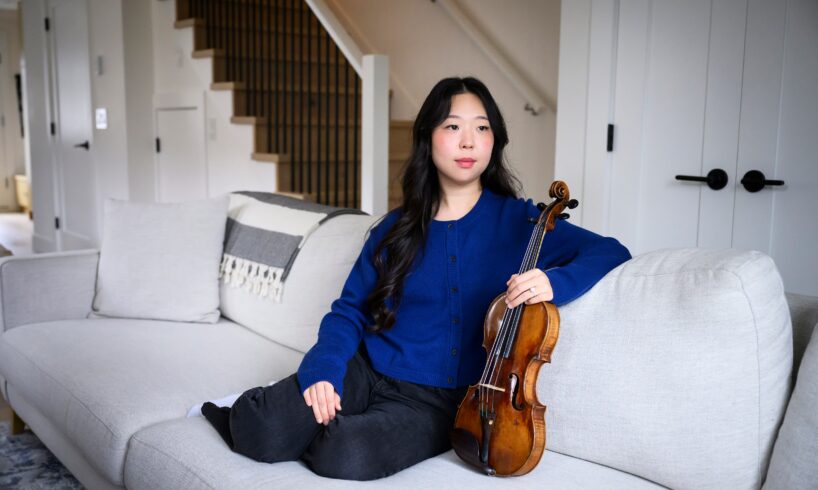
Open this photo in gallery:
Esther Hwang broke a confidentiality agreement last week to speak publicly about a sexual assault complaint against a senior member of the Vancouver Symphony Orchestra.Jennifer Gauthier/The Globe and Mail
The Vancouver Symphony Orchestra has sent a cease and desist letter to a violinist who publicly accused the organization of retaliating against her for filing a sexual-assault complaint against one of its senior members.
The musician, Esther Hwang, received the legal demand last week, a day after the Globe and Mail published a story about her complaint. In speaking publicly, Ms. Hwang, 30, violated a confidentiality agreement that she had signed in 2019 with the orchestra.
The VSO denies that there was any retaliation, and has said it treated Ms. Hwang’s allegations seriously.
News of the orchestra’s legal threat has triggered significant backlash within the classical music community.
A committee representing the full-time members of the VSO issued a public statement in support of Ms. Hwang. The musicians praised her for speaking out against what they called the “unethical and immoral” use of confidentiality agreements in instances of alleged sexual violence.
Baltimore-based oboist Katherine Needleman, an influential voice on instances of alleged sexual harassment and misconduct within classical music, wrote about Ms. Hwang on her Substack page. Ms. Needleman has since created a petition demanding that the VSO confirm it will not take further legal action against Ms. Hwang and commit to ending its use and enforcement of confidentiality agreements, often referred to as non-disclosure agreements or NDAs, in instances of alleged harassment, discrimination, sexual misconduct, or abuse.
From the archives | Opinion: Regaining my voice: How non-disclosure agreements are used to silence
“I do everything I can to support all of these women who do such a difficult thing. Like Esther – she’s doing this to improve our industry, our very backward industry,” Ms. Needleman said in an interview.
A lawyer representing the VSO sent Ms. Hwang the cease and desist on December 18, a day after the story appeared in The Globe. The two-page document refers to the Globe article as well as an e-mail that Ms. Hwang sent to musicians of the VSO after the story was published, with further details about the alleged incident and accusation of professional retaliation.
“The VSO is prepared to seek to recover all damages arising from your breaches, including reputational and consequential losses, in any legal proceedings commenced to enforce its rights,” the letter says.
In a statement to the Globe, VSO president and chief executive officer Angela Elster said that the organization decided to send the demand “because specific individuals currently employed by the VSO are publicly identified in connection with unproven allegations.”
Ms. Elster, who was appointed CEO in 2020, said that the VSO is using the discussion to look for ways to improve.
“Should allegations like these ones be brought forward in the future, the VSO would apply a modern lens to them and follow current best practices and legal requirements as we always have,” she said. “These are serious and painful issues, and we understand why they resonate so deeply.”
Ms. Hwang’s story is coming to light at a time of evolving laws around the use of confidentiality agreements.
Such agreements are often – and uncontroversially – used in business settings to protect trade secrets. But the use of them in instances of alleged criminality or discrimination has raised legal and ethical questions.
Many American states have passed laws restricting their use in certain instances, such as in cases of alleged discrimination, abuse or sexual misconduct. In Canada, Prince Edward Island became the first jurisdiction to pass similar legislation in 2021, and Ontario has also since enacted a law restricting the ways universities can deploy NDAs in instances of alleged sexual impropriety. The Senate is now considering such a law, and the issue is also under review in British Columbia.
Critics of the use of these agreements in cases of alleged abuse say complainants sometimes sign them under duress, and in doing so give organizations leeway to avoid reckoning with internal problems.
But there is also some reluctance to restrict the agreements, because the justice system has historically struggled to deal with sexual assault and harassment cases. For some complainants, the best way forward is securing a settlement with compensation. In these instances, one of the best points of leverage is a promise of silence.
Ms. Hwang, for her part, said she never wanted to sign her confidentiality agreement. But she alleges the VSO made it clear that she would need to agree to the NDA if she wanted to continue working at the orchestra. (The VSO says that because of the confidentiality agreement, it cannot comment on this allegation. The organization noted that Ms. Hwang was represented by experienced legal counsel during the negotiations.)
Opinion: We must expand our understanding of what fear can look like for sexual-assault victims
At the time, Ms. Hwang was working as an extra violinist, essentially a freelancer. After attending the Juilliard School, she was offered the position in early 2017 and for two years was called to work nearly every week. But in March, 2019, Ms. Hwang filed a complaint with the VSO, alleging that she had been sexually assaulted by a senior member of the orchestra. In August, the parties signed a settlement that included the confidentiality agreement.
In exchange for about $7,100 – mostly to reimburse counselling expenses – and an assurance that the accused member would depart the orchestra, Ms. Hwang agreed to give up her right to speak about what had happened.
Within weeks, Ms. Hwang says the VSO began reducing her hours and offering her diminished roles. By early 2020, she said, they stopped calling altogether. Extra violinists have no job security.
Ms. Hwang later filed a second complaint alleging that the VSO had professionally retaliated against her. The orchestra hired Southern Butler Price LLP to investigate and, in May, 2025, the firm concluded that Ms. Hwang’s allegation was not substantiated.
Ms. Hwang told The Globe that, in addition to losing her job, one of the most painful parts of the experience was the day she learned a rumour had been circulating among Vancouver musicians that she had had a consensual affair with the accused member, and that this was why they were both no longer working for the VSO.
Ms. Hwang said that in that moment she decided to violate the NDA in order to set the record straight.
She said she is speaking out now to lend her voice to the movement to restrict the use of these agreements.
Opinion: #MeToo changed our culture, but it couldn’t change our courts
“The VSO has been trying to use the NDA as a tool for intimidation, to silence me, and the cease and desist is just a clear example of that. And I do not feel intimidated. I am not intimidated,” she said.
Ms. Needleman, who is the principal oboist at the Baltimore Symphony Orchestra, said that classical music is due for a reckoning. The community has been slow to change, even after the #MeToo movement, she said.
She said there are many reasons for this, including poor workplace protections for contract workers, a scarcity mindset for limited jobs, and a culture rooted in the past.
“I think maybe the first element is that we study the works of ancient dead white men like they are gods. Bach, Mozart, Schumann, Beethoven,” she said. “We are really stuck in the past and these men, who are actually just men, can kind of do no wrong.”
This reverence for top talent continues to permeate modern orchestras, she said, and those who try to disrupt the system can be punished. Ms. Needleman noted that since she has started speaking out on misogyny and sexual misconduct in classical music – in October, the Washington Post called her classical music’s #MeToo vigilante – she has stopped being invited to perform in some spaces. However, because she is a tenured member of the BSO, she can’t easily be fired.
“I think it’s actually more of a problem in our industry than others,” she said.