India’s Republic Day chief guest tradition highlights the country’s diplomatic priorities and global ties. From President Sukarno in 1950 to European Union leaders in 2026, the invited dignitaries reflect India’s evolving foreign policy, strategic partnerships, and international outreach.
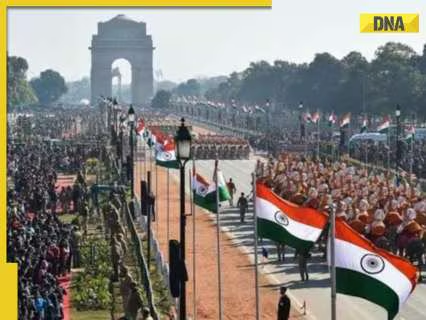
India’s Republic Day, observed every January 26, celebrates the implementation of the Constitution in 1950 and the birth of the country as a sovereign republic. A key feature of the annual celebrations in New Delhi is the attendance of a chief guest, usually a visiting head of state or head of government. This tradition underlines India’s diplomatic outreach and reflects its evolving foreign relations over the decades.
The idea of inviting a distinguished international leader began with India’s first Republic Day parade in 1950, when President Sukarno of Indonesia attended, symbolising links with newly independent nations. Since then, the choice of chief guests has often mirrored India’s geopolitical focus, strategic partnerships, and cultural ties.
How the Chief Guest Is Decided
The process of selecting a chief guest is managed by the Ministry of External Affairs months before Republic Day. Factors influencing the choice include strategic cooperation, defence links, economic ties, and shared diplomatic goals. Feedback from Indian embassies abroad, high-level consultations in the government, and timely diplomatic negotiations all contribute to the final decision. The choice is sometimes announced quietly to maintain diplomatic sensitivity.
Chief Guests from 1950 to 2026
The following list includes all foreign leaders invited as Republic Day chief guests over the years:
1950 President Sukarno, Indonesia
1951 King Tribhuvan Bir Bikram Shah, Nepal
1952 No invitation
1953 No invitation
1954 King Jigme Dorji Wangchuck, Bhutan
1955 Governor-General Malik Ghulam Muhammad, Pakistan
1956 R. A. Butler (UK) and Kotaro Tanaka (Japan)
1957 Marshal Georgy Zhukov, Soviet Union
1958 Marshal Ye Jianying, China
1959 Prince Philip, Duke of Edinburgh, UK
1960 President Kliment Voroshilov, USSR
1961 Queen Elizabeth II, UK
1962 Prime Minister Viggo Kampmann, Denmark
1963 King Norodom Sihanouk, Cambodia
1964 Lord Louis Mountbatten, UK
1965 Rana Abdul Hamid, Pakistan
1966 No invitation
1967 King Mohammed Zahir Shah, Afghanistan
1968 Prime Minister Alexei Kosygin and President Josip Broz Tito
1969 Prime Minister Todor Zhivkov, Bulgaria
1970 King Baudouin, Belgium
1971 President Julius Nyerere, Tanzania
1972 Prime Minister Seewoosagur Ramgoolam, Mauritius
1973 President Mobutu Sese Seko, Zaire
1974 President Josip Broz Tito; Prime Minister Sirimavo Bandaranaike SFR Yugoslavia, Sri Lanka
1975 President Kenneth Kaunda, Zambia
1976 Prime Minister Jacques Chirac, France
1977 First Secretary Edward Gierek, Poland
1978 President Patrick Hillery, Ireland
1979 Prime Minister Malcolm Fraser, Australia
1980 President Valéry Giscard d’Estaing, France
1981 President José López Portillo, Mexico
1982 King Juan Carlos I, Spain
1983 President Shehu Shagari, Nigeria
1984 King Jigme Singye Wangchuck, Bhutan
1985 President Raúl Alfonsín, Argentina
1986 Prime Minister Andreas Papandreou, Greece
1987 President Alan García, Peru
1988 President Junius Jayewardene, Sri Lanka
1989 General Secretary Nguyen Van Linh, Vietnam
1990 Prime Minister Anerood Jugnauth, Mauritius
1991 President Maumoon Abdul Gayoom, Maldives
1992 President Mário Soares, Portugal
1993 Prime Minister John Major, United Kingdom
1994 Prime Minister Goh Chok Tong, Singapore
1995 President Nelson Mandela, South Africa
1996 President Fernando Henrique Cardoso, Brazil
1997 Prime Minister Basdeo Panday, Trinidad and Tobago
1998 President Jacques Chirac, France
1999 King Birendra Bir Bikram Shah Dev, Nepal
2000 President Olusegun Obasanjo, Nigeria
2001 President Abdelaziz Bouteflika, Algeria
2002 President Cassam Uteem, Mauritius
2003 President Mohammed Khatami, Iran
2004 President Luiz Inacio Lula da Silva, Brazil
2005 King Jigme Singye Wangchuck, Bhutan
2006 King Abdullah bin Abdulaziz al-Saud, Saudi Arabia
2007 President Vladimir Putin, Russia
2008 President Nicolas Sarkozy, France
2009 President Nursultan Nazarbayev, Kazakhstan
2010 President Lee Myung-bak, South Korea
2011 President Susilo Bambang Yudhoyono, Indonesia
2012 Prime Minister Yingluck Shinawatra, Thailand
2013 King Jigme Khesar Namgyel Wangchuck, Bhutan
2014 Prime Minister Shinzo Abe, Japan
2015 President Barack Obama, United States
2016 President François Hollande, France
2017 Crown Prince Mohammed bin Zayed Al Nahyan, UAE
2018 Leaders of the 10 ASEAN countries
2019 President Cyril Ramaphosa, South Africa
2020 President Jair Bolsonaro, Brazil
2021 No chief guest
2022 No chief guest
2023 President Abdel Fattah el-Sisi, Egypt
2024 President Emmanuel Macron, France
2025 President Prabowo Subianto, Indonesia
2026 Ursula von der Leyen and António Costa, European Union leaders
What the Tradition Represents
The Republic Day chief guest reflects India’s efforts to strengthen global friendships and showcase cooperation across continents. Over time, the list reveals not only historical alliances but also India’s growing role in international diplomacy and multilateral relations.