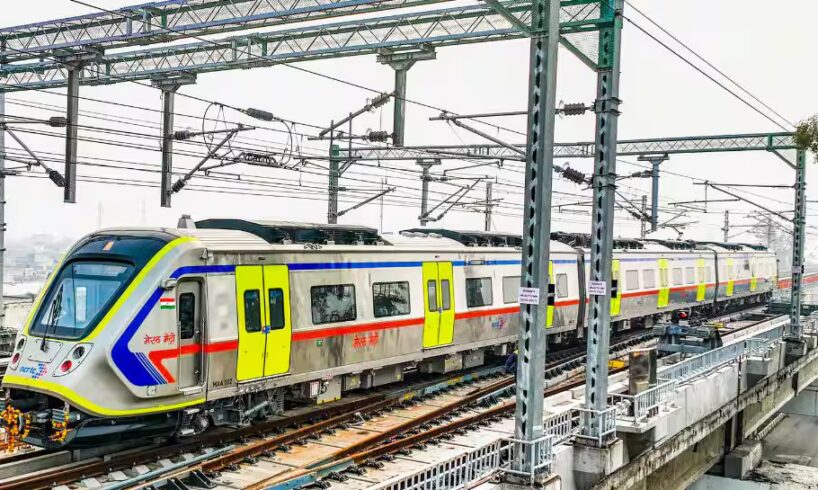
When Prime Minister Narendra Modi travelled to Meerut on February 22, the spotlight was on the completion of the 82-km Delhi-Meerut Namo Bharat corridor. But the bigger story was unfolding quietly beneath the headlines: with a single inauguration, India activated two rail systems running on the same set of tracks.
The Prime Minister flagged off the full stretch of the National Capital Region Transport Corporation-built Namo Bharat Regional Rapid Transit System (RRTS) and also launched the Meerut Metro. In doing so, Meerut became the first Indian city where a regional rapid rail and a metro operate on shared infrastructure.
One corridor, two services
Add Zee News as a Preferred Source
At the heart of this model is integration.
The RRTS, branded as Namo Bharat, connects Sarai Kale Khan in Delhi to Modipuram in northern Meerut across 82 km. Designed for semi-high-speed intercity travel, its trains can reach up to 180 km/h. The full journey between Delhi and Meerut now takes about 55-58 minutes, a sharp improvement over road travel, which can stretch beyond two hours depending on traffic.
Within Meerut city limits, however, the same tracks serve a different purpose.
The Meerut Metro operates along the RRTS alignment between Meerut South and Modipuram, roughly 23 km, but stops at 13 stations compared to the RRTS’s four stops in the city. Metro trains, built for urban commuting, run at a maximum speed of 120 kmph and complete the end-to-end city ride in around 30 minutes.
The infrastructure is shared. The trains are not.
RRTS coaches are engineered for longer distances and higher speeds with fewer halts. Metro coaches are built for frequent stops and intra-city movement. Advanced signalling systems and platform design allow both services to function safely and efficiently on the same corridor.
What was launched on February 22?
The visit operationalised the final sections of the corridor: The 5-km stretch between Sarai Kale Khan and New Ashok Nagar in Delhi, the 21-km segment between Meerut South and Modipuram in Uttar Pradesh. The New Ashok Nagar to Meerut South section had already opened earlier in 2025 in phases. With the latest inauguration, the entire Delhi-Meerut corridor is now fully functional.
Why the RRTS matters
Namo Bharat is India’s first RRTS project, a semi-high-speed regional rail system aimed at connecting cities across the National Capital Region (NCR). Unlike metro networks, which are city-focused, the RRTS is designed to move people quickly between urban centres with limited stops and dedicated tracks.
The Delhi-Meerut line is expected to reduce congestion across the NCR and encourage commuters to shift from private vehicles to public transport.
Eight additional corridors linking Delhi have already been identified and are in various stages of planning and approval.
Union Housing and Urban Affairs Minister Manohar Lal Khattar said on Sunday that proposals for two new rapid rail corridors originating from Sarai Kale Khan are likely to be approved soon, according to PTI.
“One corridor is planned from Sarai Kale Khan to Karnal in Haryana, covering a distance of around 125–130 km, which can be completed in about one-and-a-half hours,” Khattar was quoted as saying. Another proposed route would connect Sarai Kale Khan with Babarpur in Haryana and Neemrana in Rajasthan, he added.
How track-sharing works
The two-in-one arrangement avoids duplicating infrastructure. Instead of building separate lines for regional and metro systems, planners designed a corridor capable of supporting both.
The concept is not entirely new globally. In Germany, the Karlsruhe Stadtbahn runs tram-trains that transition between city tram lines and main railway tracks. In France, parts of the RER network share infrastructure with suburban and national rail services. Tokyo also uses through-running systems where metro services interoperate with suburban railways.
But this is the first time such an arrangement has been implemented in India between an RRTS and a metro system.
To understand the difference in service patterns, think of long-distance rail travel. A premium train like the Rajdhani Express halts only at major junctions, while an express like the Magadh Express stops at many smaller stations along the same broad route. The track may be common, but the stopping pattern defines the service.
The Meerut model applies a similar logic to modern urban mobility.
What this means for commuters
The integration delivers flexibility.
A commuter in Meerut can use the Metro for quick city travel across 13 stations. The same passenger can switch to a Namo Bharat train and reach New Delhi in under an hour. Regional and urban mobility are now stitched together seamlessly.
Beyond faster travel, the shared corridor reduces construction costs, improves land use efficiency, and ensures optimal use of high-value infrastructure.
With this launch, Meerut has not just gained faster trains; it has introduced a new template for how Indian cities might build transport networks in the future.