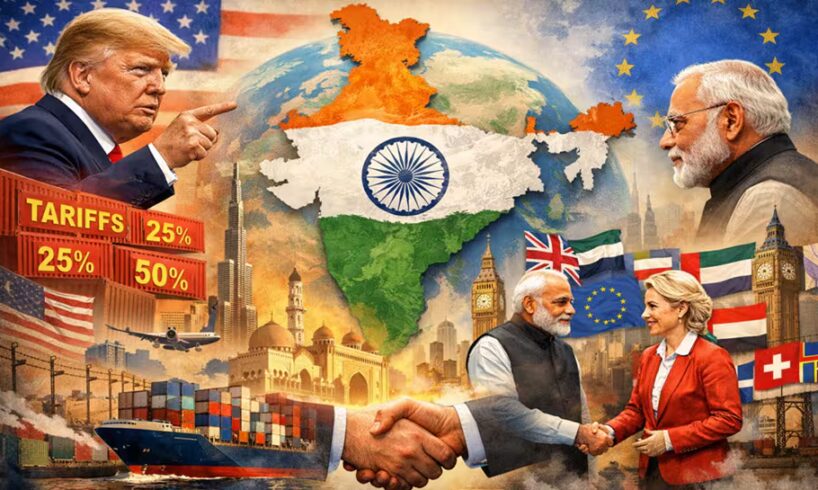
It was January 2025 and the world was hopeful of a stable government in the United States of America with Donald Trump at the helm. However, in April, the first shockwave arrived when Trump unleashed worldwide tariffs. Following the Liberation Day tariffs (now scrapped by the US Supreme Court), a 25% tariffs came into effect against India on 7 August 2025 and an additional 25% for the purchase of Russian oil on August 27 the same year. The trade deal negotiations between the two nations were put on the backburner and verbal rhetoric took the centrestage from the US officials. India remained calm and started diversifying its trade to mitigate the tariff impact.
Behind the curtains, India moved swiftly to secure trade deals. The goal was to secure stable, predictable and assured market conditions, away from Trump’s bullying. India had already begun 2025 with several operational free trade agreements, including with the United Arab Emirates, Mauritius, and Australia, which were already in force from previous years.
Just the next month of Liberation Day tariff, India secured a trade deal with the United Kingdom in May 2025. The FTA took place in the backdrop of growing economic relations between India and the UK as exemplified in the bilateral trade of about USD 60 billion, which is projected to double by 2030.
Add Zee News as a Preferred Source
Then came the India–EFTA Trade and Economic Partnership Agreement — signed on 10 March 2024 with the European Free Trade Association (including Switzerland, Norway, Iceland and Liechtenstein) — officially came into effect on 1 October 2025.
In December 2025, India concluded a comprehensive trade deal with Oman, offering near-zero duties on most Indian exports to the Gulf nation and expanded cooperation in services and investment.
In the same month, negotiations concluded on a free trade agreement with New Zealand, expected to liberalise tariffs on most traded goods and deepen market access.
On January 27, India and the European Union finalised a historic free trade agreement after nearly two decades of negotiations, marking a significant milestone in India’s trade diplomacy.
On February 2, India and the United States announced their agreement for a trade deal and agreed on a framework for an Interim Trade Agreement on February 7. By this time, India had secured stable markets for its goods. New Delhi is already in talks with nations like Chile, Peru, Israel and Brazil for trade deals.
On February 24, a Joint Statement on the India-GCC Free Trade Agreement (FTA) was signed between Piyush Goyal, Union Minister of Commerce and Industry and Jasem Mohamed Albudaiwi, Secretary General of the Gulf Cooperation Council, formally launching negotiations for a comprehensive and mutually beneficial agreement.
The Commerce Ministry and its officials burned the midnight oil to ensure that the Trump-induced volatility does not affect Indian trades badly. They also made Trump realise that India won’t be bowing down to his tantrums.
Commerce Minister Piyush Goyal recently said that at a time when the world is grappling with uncertainty, India is building “bridges of trade, trust and transformation.” He further said that India now enjoys preferential trade access to nearly two-thirds of global trade owing to a series of high-quality free trade agreements (FTAs). Goyal further informed that India and Canada are hopeful of finalising the terms of reference and launching FTA negotiations with Ottawa.
While the US was busy imposing tariffs, India was navigating the global trade paths, inking deals and securing export routes. India turned uncertainty into opportunity, stitching together a web of strategic trade partnerships that now give New Delhi preferential access to nearly two-thirds of global trade. As Washington raised tariff walls, India built trade bridges — signalling that its economic diplomacy will be guided not by pressure, but by long-term national interest and diversification.