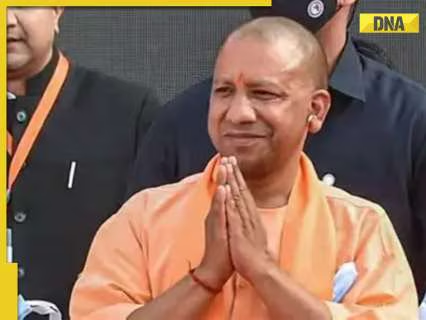
As Chief Minister Yogi Adityanath’s government in Uttar Pradesh completes nine transformative years on March 18, 2026, a series of clear and resounding messages has been delivered to the people of the state and beyond.
Yogi Adityanath’s 9-Year Legacy
As Chief Minister Yogi Adityanath’s government in Uttar Pradesh completes nine transformative years on March 18, 2026, a series of clear and resounding messages has been delivered to the people of the state and beyond. These messages encapsulate the core philosophy, achievements, and future vision of the administration, reinforcing its commitment to stability, progress, and inclusive growth.
The foremost and most emphatic message is the *unwavering unity within the National Democratic Alliance (NDA)*. This solidarity, built on shared vision and coordinated efforts between the central and state governments-often referred to as the “double-engine sarkar”-has been repeatedly highlighted as the bedrock of Uttar Pradesh’s remarkable turnaround. Under the guidance of Prime Minister Narendra Modi, this alliance has enabled seamless policy implementation, resource mobilization, and strategic alignment. The NDA’s cohesion ensures political stability, which in turn fosters investor confidence and long-term planning. In an era where fragmented mandates often stall progress, the unified front presented by the Yogi government and its national partners stands as a powerful symbol of reliable governance, capable of delivering on ambitious promises without internal discord.
The second pivotal message centers on the government’s unrelenting focus on *development* as its primary mandate. Over the past nine years, Uttar Pradesh has undergone a profound shift from being perceived as a state plagued by stagnation to emerging as one of India’s fastest-growing economic engines. Chief Minister Yogi Adityanath has described this period as a “golden chapter of reconstruction” and “unprecedented development and sustained prosperity.” Key indicators reflect this transformation: the state’s Gross State Domestic Product (GSDP) has more than doubled, rising from approximately ₹13.30 lakh crore in 2016-17 to over ₹30 lakh crore in recent years, with projections pushing toward ₹36 lakh crore. Infrastructure has seen explosive growth, including India’s largest network of expressways (accounting for about 55% of the national total), the operationalization of 16 domestic and four international airports, and the impending completion of the massive Noida International Airport (Jewar). Major projects like the Ganga Expressway, the Defence Industrial Corridor (including BrahMos manufacturing units), and extensive rail connectivity have positioned the state as a logistics and manufacturing hub.
Investment inflows have surged dramatically, thanks to investor-friendly policies, single-window clearances, and aggressive global outreach. Recent international visits by the Chief Minister to places like Japan and Singapore have yielded MoUs and proposals worth lakhs of crores, targeting sectors such as data centres, logistics, real estate, and advanced manufacturing. The government aims to elevate Uttar Pradesh to a USD 1 trillion economy by 2029-30, with the upcoming budget nearing ₹9.12 lakh crore underscoring this momentum. Employment generation, particularly for youth, women, and marginalized communities, has been prioritized through skill development, industrial parks, and welfare schemes. Farmer welfare, women empowerment, and upliftment of the underprivileged have received focused attention, ensuring development is inclusive and equitable.
Equally critical is the third message: a steadfast commitment to *law and order* through a strict *zero-tolerance policy* toward crime, mafia influence, and disorder. Before 2017, Uttar Pradesh was often synonymous with fear, riots, extortion, and lawlessness, where ordinary citizens, women, and traders felt unsafe. The Yogi administration reversed this narrative decisively. By curbing organized crime, eliminating “mafia raj,” and enforcing rule of law, the state has achieved a dramatic improvement in public safety. There is “no fear, tension, chaos, or threat of riots” today, as the Chief Minister has asserted. This security paradigm has directly fueled economic revival—investors now see a stable environment conducive to business, while citizens experience freedom to celebrate festivals and conduct daily life without disruption. The shift from curfews and unrest to discipline and celebration marks one of the most visible successes of the past nine years.
These three intertwined messages—NDA unity, development-centric governance, and zero-tolerance law enforcement—form the cornerstone of the Yogi government’s narrative as it marks this milestone. The launch of the commemorative book Nav Nirman Ke 9 Varsh (Nine Years of Reconstruction) in Lucknow symbolizes this reflective yet forward-looking moment, chronicling achievements while outlining an ambitious roadmap.
Looking ahead, the administration pledges continuity and acceleration. Uttar Pradesh is no longer content with incremental progress; it aspires to become a global manufacturing powerhouse, a leader in technology and innovation, and a model of balanced, people-centric development. With a population of over 25 crore representing immense human capital, the state is leveraging its cultural heritage—birthplace of Lord Ram and sacred sites of Lord Buddha—to blend tradition with modernity.
In essence, the nine-year journey under Chief Minister Yogi Adityanath has been one of decisive action, policy-driven reforms, and collective resolve. From addressing deep-rooted challenges like poor governance and insecurity to building systems for sustained prosperity, Uttar Pradesh today stands transformed. The messages conveyed on this occasion are not mere rhetoric—they are a reaffirmation of a government that has delivered tangible change and remains committed to making the state a leading contributor to India’s rise as a global power. As the administration moves into its next phase, the focus remains clear: unity for strength, development for prosperity, and zero tolerance for justice and security.
(The author is an Associate Professor at the University of Delhi. He writes regularly on political and social issues.)