Australia and the European Union look set to finally sign off on a long-awaited free trade pact after almost a decade of negotiations.
European Commission President Ursula von der Leyen and Prime Minister Anthony Albanese are expected to green-light the deal in Canberra later today and sign a new security partnership that could bolster defence industry cooperation between Europe and Australia.
The final details of the much-anticipated trade deal are not yet public, but one European government source told the ABC that both sides were making compromises to get the agreement over the line in the face of the Trump administration’s assault on global trade rules.
The deal is set to slash tariffs on countless goods, with the Prime Minister Anthony Albanese declaring during Question Time on Monday that an EU trade deal would “give Australian farmers and growers and exporters better access to a market of 450 million consumers”.
It would also allow the government to boast that it had filled the largest remaining gap in Australia’s free trade architecture, bolstering the global trading system while it was under enormous international strain.
The red meat industry could be disappointed by the deal reached. (ABC Landline)
Red meat industry likely to be disappointed
But while the deal will substantially improve market access for Australian farmers, industry groups look set to be disappointed by the outcome on red meat, which was key to the collapse of talks back in 2023.
The EU has been adamant it would only allow about 30,000 tonnes of imported Australian beef in every year tariff free, with several member nations deeply uneasy about possible political blowback from farmers in the wake of a separate EU deal with the Mercosur bloc of South American nations.
Although the final result was not yet clear, it was set to be well short of the 50,000 tonnes of beef and 67,000 tonnes of lamb which the National Farmers Federation (NFF) had been pushing for.
NFF president Hamish McIntyre told the ABC he still believed Australia should “walk away” if there were not big improvements to the EU’s offer on meat.
“We need to remember that this is a generational deal,” he said.
“This isn’t a short-term thing, this will be for our children in 30 or 40 years’ time.
“So there’s no hurry, we need to get this right.
“We’re better off to have no deal than a bad deal.”
Luxury cars, minerals and prosecco part of the agreement
Meanwhile, the government appeared to have struck a compromise on Australia’s luxury car tax, which has frustrated European car-makers, with the Financial Times reporting the EU has dropped its bid for it to be scrapped entirely.
EU deal trade-off concerns
Both sides also appeared to be heading towards a compromise that would allow Australian producers to keep using many names claimed by European producers — like prosecco, parmesan and fetta.
Although it was likely some would still have to be phased out on exports overseas.
The agreement was likely to significantly bolster the critical minerals trade between Australia and the EU, which is key for European nations looking to cut their reliance on China for the raw materials they need for defence industries and the green energy transition.
Australians to benefit from work rights in the European Union
Officials have also flagged the agreement will cover new labour mobility arrangements that could make it much easier for Australians to work and live in the European Union, as well as the other way around.
Australia and the EU also hoped the free trade deal would buttress the broader strategic relationship between both sides, which are both grappling with increasingly belligerent authoritarian powers and the ruptures caused by a deeply unpredictable Trump administration.
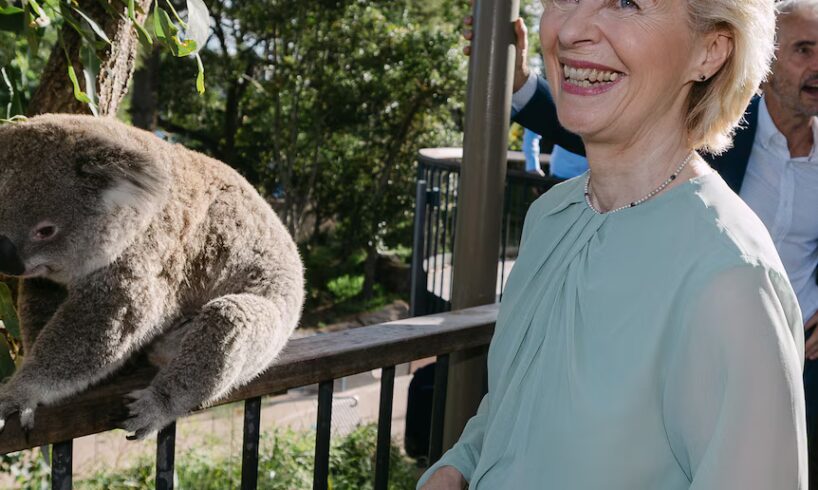
Ursula von der Leyen, pictured in Sydney, will address a special joint sitting of federal parliament. (Supplied: European Commission)
Ms von der Leyen has put a premium on expanding the bloc’s relationships beyond its traditional allies, and Anthony Albanese said her address to federal parliament would be a “milestone moment for the relationship between Australia and the European Union”.
Ms von der Leyen will become the first female foreign leader to address federal parliament during the special joint sitting on Tuesday.
Security partnership reached
The EU has publicly flagged that it would sign a security partnership with Australia this week, following similar arrangements it had already struck with a host of other countries, including Canada, Japan, India and South Korea.
Ms von der Leyen first proposed the partnership when meeting Mr Albanese last year in Rome, and Australia had warmed to the idea despite the prime minister’s initially lukewarm response.
The new agreement was not a binding treaty or security pact, but Matthew Sussex from the Australian National University said it could allow Canberra to access EU programs and funding designed to encourage joint defence industry projects.
“We’re in an era where Australia is looking to diversify some of its purchasing of military equipment and there’s very much an urgency about acquiring things like uncrewed systems,” he told the ABC.
“The European Union is a leader in that respect.”