PM Modi has spoken at length over how West Asia crisis revealing how India is navigating the situation, its preparedness and stockpiles of energy and petroleum.
PM Modi has addressed Parliament over the ongoing West Asia crisis
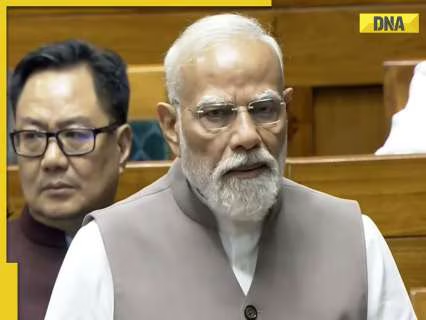
As the US-Israel-Iran war has made oil refineries and other crude and energy hubs across the Gulf, including Iran, vulnerable to attacks India has been facing crude oil, LPG, LNG crises for weeks now. Prime Minister Narendra has addressed the Parliament during its budget session over the ongoing gas crisis talking about India’s preparedness amid the situation, its energy stock and other measures India is taking to navigate the crisis situation.
Below are some of the important points highlighted by PM Modi regarding India’s situation in the current crisis.
PM Modi in his Lok Sabha address pointed out that the ongoing West Asia conflict will have long lasting impact on India’s energy resources and added that India is making all diplomatic efforts to de-escalate the crisis. He maintained that diplomacy is the only solution and India must be prepared for the war challenge.
-“India is continuously making efforts through diplomacy to ensure the safe passage of Indian ships, even in this war-like environment. India has always advocated for the welfare of humanity and peace,” he added.
-He highlighted that the situation in West Asia amid the ongoing US-Israel-Iran conflict was “worrisome” and had a severe impact on the global economy and people’s lives.
National security and relations with Gulf
-“This war has also posed unprecedented challenges for India. These challenges are economic, related to national security, and humanitarian as well. India has extensive trade relations with the warring and war-affected countries. The region where this war is taking place is also an important route for our trade with other countries of the world. In particular, a large part of our needs for crude oil and gas is met by this very region,” he added.
-“Since this war began, every Indian in the affected countries has been provided assistance. I have spoken over the phone with the heads of state of most West Asian countries for two rounds. All have assured the safety of Indians. During the conflict, some people have lost their lives, and some have been injured. We are helping their families,” PM Modi said, adding that the Indian government was involved in helping citizens, including tourists.
-“The Indian government has been issuing advisories amid the ongoing conflict, with outreach rooms and emergency helplines being operational 24 x 7,” the PM said. He further stated that over 3.75 lakh Indian nationals have returned safely to the country, with at least 1,000 of them having been escorted from Iran.
Diplomatic strategy: Navigating Strait of Hormuz and stocking crude oil
-He acknowledged that the challenge to the movement of cargo ships through the Strait of Hormuz was one of the effects of the ongoing conflict, informing about the efforts made by the Indian government.
-“A large quantity of crude oil, gas, fertilisers and many essential items comes to India through the Strait of Hormuz route. Since the war began, the movement of ships through the Strait of Hormuz has become very challenging. Despite this, our government has made efforts to ensure that the supply of petrol, diesel, and gas is not severely impacted,” PM Modi said.
-“As we all know, the country imports 60 per cent of its LPG requirement. Due to uncertainty in supply, the government has prioritised domestic LPG consumers. At the same time, domestic production of LPG is also being increased. Continuous efforts have also been made to ensure that the supply of petrol and diesel across the country remains smooth. LPG production in the country is also being increased,” he added.
-The PM informed about the steps taken by the government in the last 11 years to prioritise the storage of crude oil for times of such crises. He said that India has strategic petroleum reserves of more than 5.3 million metric tons.
-“India has strategic petroleum reserves of more than 5.3 million metric tons, and the country is working on arrangements for reserves of more than 6.5 million metric tons. In the past 11 years, there has also been a notable increase in our refinery capacity. The government is also in constant contact with suppliers from different countries. First, we used to import from 27 countries; now we do from 41 nations,” PM Modi said.
Steps to lessen oil imports
-“Another major challenge of the war is that the summer season is beginning in India. In the coming days, with rising temperatures, the demand for electricity will increase. Currently, adequate coal stocks are available at all power plants across the country,’ PM Modi said.
-Prime Minister Narendra Modi further said, “Because of such efforts, many of our ships that were stranded in the Strait of Hormuz have also arrived in India. Due to ethanol blending, we are saving the import of about 4.5 crore barrels of oil every year. Similarly, railway electrification is also bringing great benefits. If such large-scale railway electrification had not happened, an additional 180 crore litres of diesel would have been required every year. We have also expanded the metro network. In 2014, the metro network was less than 250 km, which has now increased to more than 1100 km…”