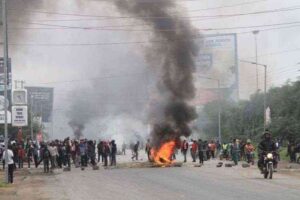
The battle for Nigeria’s future will not be fought only on the streets or in polling units. It will also be fought in the digital space — through narratives, perceptions, and the credibility of information… The question is no longer whether Nigeria needs a coordinated crisis communication system. The question is whether it can afford to delay its implementation.
Nigeria today is not only battling insecurity on the ground; it is also confronting an equally dangerous war in the digital space. This invisible conflict — fought through misinformation, disinformation, and manipulated narratives — is steadily shaping public perception, eroding trust in institutions, and threatening national cohesion.
Recent findings by the (CCC) paint a sobering picture of the country’s information environment. Through advanced social-listening analysis powered by PRrev, an AI-driven monitoring tool developed by Shuaib Agaka, the study reveals a nation gripped by a volatile mix of fear, frustration, and fragile hope.
Across platforms such as X (formerly Twitter), Facebook, WhatsApp, and online forums, Nigerians are navigating an information ecosystem in which truth competes with falsehood in real time — and often loses.
The findings highlight a troubling trend: misinformation is no longer crude or easily detectable. It has evolved, becoming more sophisticated, more strategic, and more dangerous. Forged official documents, coordinated disinformation campaigns, and politically motivated narratives are now commonplace.
As Nigeria inches closer to the 2027 general elections, this trend is particularly getting alarming. False narratives are increasingly weaponised to influence public opinion, deepen political divisions, and manipulate voter behaviour. In many cases, misinformation spreads faster than corrections, leaving lasting damage even after being debunked.
More concerning is the role of private messaging platforms like WhatsApp. Unlike open social media platforms, these encrypted spaces allow false information to circulate unchecked, making detection and response significantly more difficult.
This creates a dangerous gap — one where rumours thrive, speculation escalates, and public trust deteriorates.
One of the most critical insights from the CCC report is the role of communication gaps during crises. When official information is delayed, unclear, or absent, the vacuum is quickly filled by rumours and falsehoods.
In today’s hyperconnected world, silence is no longer neutral; it is risky.
Delayed responses from authorities not only allow misinformation to flourish but also reinforce public suspicion. Citizens begin to rely more on unofficial sources, many of which lack credibility, further compounding the problem.
This cycle — delay, misinformation, distrust — has become a defining feature of Nigeria’s information landscape.
It is against this backdrop that the proposed Crisis Communication Hub (CC-Hub) emerges not just as an innovation, but as a necessity.
The CC-Hub, championed by the CCC in collaboration with key institutions such as NITDA, is envisioned as a multi-stakeholder platform designed to coordinate, monitor, and respond to information during crises.
Its objectives are both strategic and urgent:
Real-time detection and countering of fake news and disinformation;
Coordinated communication across federal, state, and local authorities;
Strengthening public trust through timely and accurate information.
Importantly, the Hub is not intended as a censorship tool. Rather, it is a collaborative framework that brings together government agencies, security institutions, the media, civil society, and technology partners.
In an era where information travels faster than facts can be verified, such coordination is indispensable.
While technology will play a central role in the CC-Hub’s operations, the real challenge lies deeper — in rebuilding public trust.
Misinformation thrives in environments where trust is weak. When citizens doubt official narratives, they become more susceptible to alternative versions of reality, regardless of their accuracy.
Therefore, the success of the CC-Hub will depend not only on its technological capabilities but also on its credibility, transparency, and inclusiveness.
It must be seen not as a government mouthpiece, but as a trusted national platform for verified information.
Addressing Nigeria’s information crisis cannot be the responsibility of government alone. It requires a whole-of-society approach.
Media organisations must strengthen fact-checking processes. Civil society must promote digital literacy. Technology platforms must take greater responsibility for the content they host. And citizens themselves must become more discerning consumers of information.
The CCC’s recommendations — ranging from improved crisis communication to enhanced public awareness — underscore the need for collective action.
Nigeria stands at a critical juncture. With political activities already building momentum toward the 2027 elections, the stakes have never been higher.
The convergence of insecurity, political tension, and digital misinformation presents a complex and evolving threat. If left unaddressed, it could undermine democratic processes, weaken national unity, and erode confidence in public institutions.
But there is also an opportunity.
With proactive measures such as the Crisis Communication Hub, Nigeria can transform its information ecosystem — from one defined by chaos and confusion to one anchored in clarity, coordination, and credibility.
The battle for Nigeria’s future will not be fought only on the streets or in polling units. It will also be fought in the digital space — through narratives, perceptions, and the credibility of information.
The question is no longer whether Nigeria needs a coordinated crisis communication system. The question is whether it can afford to delay its implementation.
The answer, increasingly, is clear.
Chris Olukolade, a retired Major General in the Nigerian Army, is the chairman of Centre for Crisis Communication (CCC) Abuja.