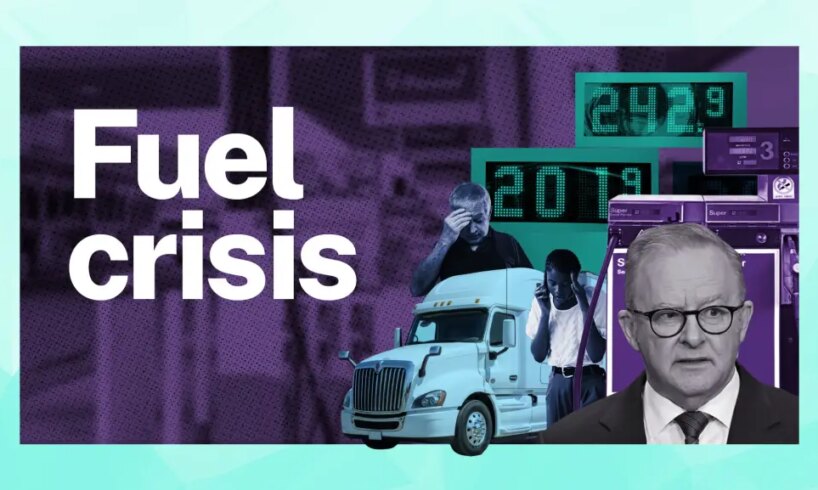
Australia’s fuel crisis isn’t showing signs of slowing down. The Australian federal and state governments are rolling out a mix of emergency powers, tax relief and financial support as supply disruptions ripple through the economy.
Here’s what small businesses need to know right now.
We’ll be updating this piece daily so be sure to check back for the latest news.
Australian federal response to the fuel crisis
Related Article Block Placeholder
Article ID: 333872
The Albanese government has outlined a $2.55 billion fuel relief package aimed at easing pressure on households and businesses while stabilising supply.
Key measures include a temporary 50% cut to the fuel excise for three months and a national fuel security plan designed to escalate if conditions worsen. There is also a pause on the heavy vehicle road user charge, and expanded powers to secure additional fuel imports.
Smarter business news. Straight to your inbox.
For startup founders, small businesses and leaders. Build sharper instincts and better strategy by learning from Australia’s smartest business minds. Sign up for free.
By continuing, you agree to our Terms & Conditions and Privacy Policy.
Australia is currently operating at stage two of the national fuel security plan, focused on keeping supply moving through the economy.
If conditions worsen, governments may move to prioritise fuel for critical sectors, introduce coordinated demand reduction measures, direct supply to essential users, or expand emergency powers at both state and federal levels.
The government has warned the months ahead may remain volatile as global conditions continue to affect the nation’s fuel supply. However, Prime Minister Anthony Albanese will visit Singapore this week to secure more supply.
“Singapore is Australia’s largest two-way trade partner and investor in Southeast Asia, and one of our closest strategic and economic partners. The visit follows Australia and Singapore’s joint commitment to keep fuel flowing between both countries and to work together to strengthen energy supply chain resilience,” Albanese said during a press conference on Tuesday.
Related Article Block Placeholder
Article ID: 334203
The government has also announced $1 billion in interest-free loans for freight, fuel and fertiliser businesses through the National Reconstruction Fund, aimed at providing short-term liquidity rather than offsetting rising costs entirely.
ATO fuel support
The Australian Taxation Office (ATO) has introduced temporary support for businesses struggling with rising fuel costs.
Eligible businesses can access three-year payment plans with monthly instalments and a no upfront payment requirement, with the possibility of interest charges being remitted if repayments are maintained.
Related Article Block Placeholder
Article ID: 334163
The ATO has also confirmed it will limit some compliance actions and pause debt recovery in the hardest-hit industries, reflecting the scale of disruption facing businesses exposed to fuel and logistics costs.
Leniency for small business borrowers
The federal government expects the banks and other financial institutions to work with small businesses struggling to repay their debts due to surging fuel costs.
Members of the Big Four are now calling on hard-hit SME borrowers to step forward before their debts spiral out of control.
At the same time, specialist lenders like Prospa and Judo are promising tailored support.
How the state and territory governments are responding to the fuel crisis
Each Australian state and territory is responding to the fuel crisis in its own way. This is the current state of play.
NSW fuel response: emergency powers and supply monitoring
The NSW government has activated emergency powers to better understand and manage fuel distribution across the state.
Energy Minister Penny Sharpe has issued formal notices requiring fuel companies to provide detailed information about supply chains, particularly for regional areas.
“This information puts us in a strong position to work with industry and keep supply flowing where it is needed most,” Sharpe said.
The data will be used to assess supply risks and plan potential next steps, including more direct intervention if shortages worsen.
Under existing laws, the government has the power to direct fuel distribution or impose rationing in a severe scenario.
Victoria: free public transport to curb fuel demand
The Victorian government has made all public transport free during April to reduce fuel demand and ease cost-of-living pressure.
Extra train, tram and bus services have been added to handle higher patronage, with the aim of taking pressure off both regional and urban fuel supplies.
Tasmania: transport subsidies to reduce fuel use
Similarly, Tasmania has introduced a temporary public transport subsidy, effectively making many services free or heavily discounted for three months in response to fuel security concerns.
Western Australia: fuel security and contingency planning
The Western Australian government has said its current fuel stocks are secure, with more than 30 days of reserves and shipments still arriving, while continuing to monitor supply chains closely.
Similar to NSW, it has also activated powers under its fuel security framework to require fuel companies to share detailed information about inventories, imports and distribution, allowing fuel to be directed where it is needed most if conditions worsen.
Northern Territory: anti fuel-gouging powers revived
The Northern Territory government has revived a law from the 1940s, the Price Exploitation Prevention Act, to force fuel retailers to reveal their full cost structures amid concerns about price gouging.
This is reportedly the first time the law has been used since 1949 and has been described as an “unprecedented” response to the fuel crisis.
The move is aimed at ensuring pump prices better reflect underlying wholesale and transport costs, rather than providing direct subsidies to businesses.
For small operators in remote and regional areas, the intervention is intended to prevent extreme price spikes that could otherwise make trading uneconomic.
What about Queensland, South Australia and ACT?
At the time of publication, Queensland, South Australia and the ACT have not announced major fuel-specific relief measures relevant to small businesses beyond participation in the federal excise cut and national fuel security arrangements.
Related Article Block Placeholder
Article ID: 333652
Australia Post lifts contract rates
In response to surging fuel costs, Australia Post will this month increase the fuel surcharge leveled on its contract customers.
Local businesses locked into large-scale parcel delivery contracts will see the fuel surcharge applied to domestic parcel deliveries and StarTrack Courier services more than double from 4.8% to 12%.
The surcharge applied to StarTrack Express and StarTrack Premium deliveries will increase from 15.5% to 22.7%.
Those hikes apply from April 23. MyPost Business customers and everyday retail customers are not affected.
What the Australian fuel crisis means for small businesses
Related Article Block Placeholder
Article ID: 334261
For small businesses, the impact is already being felt across costs, cashflow and day-to-day operations. Rising fuel prices are pushing up transport and logistics expenses, while also flowing through to supplier pricing across the broader supply chain.
Businesses that rely heavily on diesel (including freight operators, tradies and agricultural producers) are particularly vulnerable, with both cost pressures and the risk of supply disruptions becoming more pronounced.
While government support measures are starting to roll out, they are largely designed to keep businesses operating rather than offset the full impact of higher fuel costs. This could mean many SME may still need to absorb or pass on these increases in the months ahead.