“Boro: Timeworn Textiles of Japan”
(Tūhura Otago Museum)
Over the past few decades, it has become fashionable to wear ripped, faded, or heavily patched clothing, especially jeans.
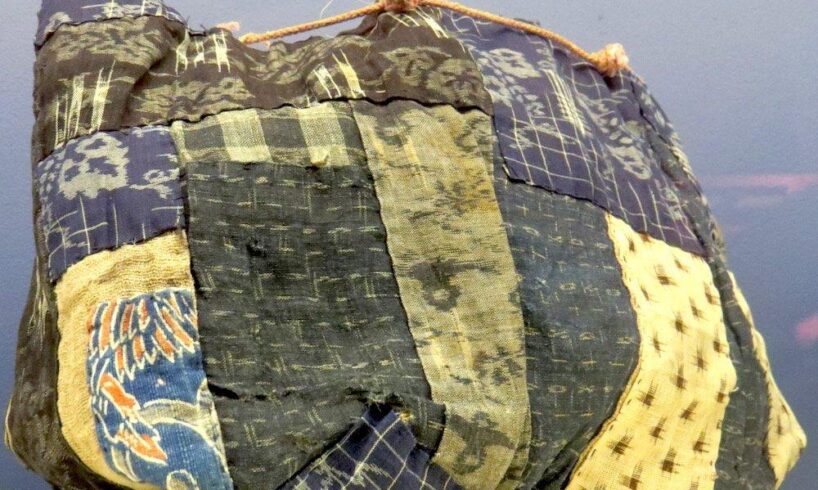
Historically, the reusing and recycling of cloth was not a fashion statement, but was rather a reflection on poverty. Such was the case with the heavily reworked “boro” clothes of farming and fishing communities in 19th and early 20th-century Japan. These textiles are the subject of an exhibition at Tūhura Otago Museum.
The pieces give evidence of the poor level of parts of society and the innovative and skilful reuse of material, and are also now regarded as precious historical items.
The exhibition, which — as always with the museum — is excellently annotated, presents many features of boro, from the saving of the long strips of cloth, its reworking, stencilling and dyeing, through to the finished clothing and bags.
The reuse and recycling is shown in such examples as an astonishingly multiple-patched noragi work jacket in which the threadbare cloth only just holds together. Alongside is a pair of momohiki trousers which show that a heavily reworked piece of utilitarian ware can still be attractive and impressive.
A fascinating feature of the exhibition is a series of komebukuro — rice bags created from scraps of pre-used cloth, the remnants hand-spun and hand-woven into impressive new forms.
Two works on journeys
(Blue Oyster Art Project Space)
In the main gallery, the time of renewal at Matariki is acknowledged with a display positing a possible post-apocalyptic moment which sees a full rebirth of te ao Māori. The exhibition title, “Hawaiki Apōpz”, with its promise of a return to ancestral lands, is reflected in music and spoken recordings composed and collated by Mara TK. Bathed in this sound are works by Te Ikahoungata, Keita Newbery and Ngaumutane Jones.
Newbery’s photographs of rural life under the shadow of Te Urewera occupy one end of the gallery, presenting a study of the people of the mist that has taken some features from Pākeha society but which retains its traditional tikanga. This shrouded land presents a world apart.
At the other end of the space is a sacred structure created from brightly coloured fabric. This enclosure becomes a sanctuary from the tainted world beyond its walls.
In the Pearl gallery, Ilish Thomas presents a personal and spiritual journey with “Ghost Hiikoi 2”, a recollection and retelling of travels with a long lost friend. A bed’s canopy becomes the screen for projections of this journey, its soft distortions leaving the bed as a true dream space in which the sounds of the dead and the living intertwine in their own tales of lost and remembered happiness.
“What Did People Do All Day?”, Nick Austin
(Dunedin Public Art Gallery)
“What Did People Do All Day?” is an exploration of the quotidian moments which pass by unnoticed. We are presented with the journey from birth to death, punctuated with the meaningless moments which build up to human existence.
Austin has created a number of exhibits for some distant-future exhibition of 21st-century society. The various tableaux are uneasily recognisable, taking features and juxtaposing them in unfamiliar ways. A wall of radios creates a wall of Babel, the concept of expended breath and the function of the radio wryly juxtaposed with packets of “Airwaves” breath-freshening gum. Nearby, a wall planner is covered in “contractions”, a series of hieroglyph-like times — the title giving the hint that these are the moments leading up to a birth.
Opposite is a series of antique mirrors, each marked with a female New Zealand artist’s name. The pieces reflect, literally and figuratively, on the use of the names of women of culture by nursing and retirement homes.
Between these musings is a group of works concerning a more universal truth, the slow destruction of the earth and our overuse of plastic. The pieces have an ambivalence, as if to say this too is all part of the cycle, their found polystyrene glaciers raised as museum exhibits of how the world once was.
By James Dignan