Shafaq News-
Washington
Iraqi Prime
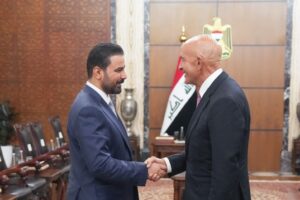
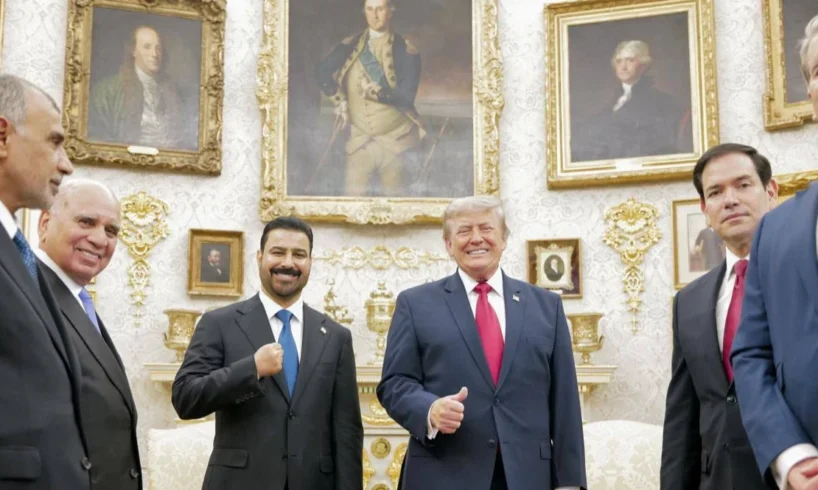
Minister Ali al-Zaidi met US President Donald Trump at the White House on
Tuesday to advance the outline of an economic partnership, oil and gas agreements,
and US involvement in pipelines that would route Iraqi crude around the Strait
of Hormuz, set against Washington’s central demand: measurable progress on
disarming Iran-aligned factions by September 30. That deadline coincides with
the scheduled withdrawal of the remaining US forces from Iraq, binding the two
governments’ timelines together.
Read more: Iraq’s September 30 weapons deadline leaves terms of disarmament unresolved
Al-Zaidi’s
visit runs through July 18, during which more than 18 agreements are expected
to be signed, according to Shafaq News sources.
The pairing
defines al-Zaidi’s position. A businessman with no prior political career, he
was installed in May as a consensus candidate after a year of post-election
deadlock and an American veto against Nouri al-Maliki, and he arrived in
Washington with a delegation of Iraqi executives, casting the trip as the start
of an economic opening.
Trump backed
al-Zaidi’s candidacy earlier this year and, in the Oval Office, promised a
series of deals and praised Iraq’s oil potential. Both leaders said the
remaining 2,500 US troops would leave by the end of September.
Since taking
office, al-Zaidi has also mounted a public anti-corruption drive, with raids
and the arrest of dozens of current and former officials, with some leaked
reports revealing that the campaign was launched with indirect US coordination
and support. Even a senior lawmaker from the Iran-aligned Badr Organization,
Mukhtar al-Mousawi, told Shafaq News that the US “contributed to the success of
Iraq’s Dawn Crackdown anti-corruption campaign.”
Read more: Iraq detains top officials in anti-corruption sweep: What we know so far
Washington
attached a condition to the partnership. A senior US administration official,
speaking on background before the meeting, told Shafaq News that the United
States would make decisions based on Iraq’s efforts “to disarm Iran-backed
militias,” linking the economic relationship explicitly to a security outcome
rather than treating the two as separate tracks.
US Secretary of
Defense Pete Hegseth told al-Zaidi that those groups were responsible for more
than 600 attacks on US personnel this spring, during the US-Israel-Iran war,
adding that Iraq must assert its sovereignty and “disarm the militias,” and
progress on that demand would open the way to commercial and defense ties.
The factions at
issue operate in and around the Popular Mobilization Forces (PMF), a
state-sanctioned umbrella of mainly Shiite paramilitary groups formed in 2014
to fight ISIS and since absorbed into Iraq’s security payroll and its politics.
Several are aligned with Tehran and revere Qassem Soleimani, the Iranian
Revolutionary Guard commander killed alongside Iraqi PMF leader Abu Mahdi
al-Muhandis in a 2020 US strike in Baghdad. Trump described Soleimani as
“brilliant, but evil,” and asked al-Zaidi whether killing him and
“another very bad man from Iraq [al-Muhandis]” had benefited Iraq.
The Iraqi PM declined to engage, saying he had not been in politics at the time
and preferring to focus on the future.
The
Secretary-General of Harakat Hezbollah Al-Nujaba, Akram Al-Kaabi, criticized
Trump’s remarks, saying that Soleimani and other figures of the resistance were
more honorable than the US president’s “rotten head,” describing
Trump as a “fool who kills children” and his administration as
“criminal and evil.”
The economic
component turns on Iraq’s exposure to the Strait of Hormuz, the Gulf waterway
that has been effectively closed since the war between Iran and the United
States and Israel began on February 28. Iraq ships roughly 90 percent of its
oil through the strait, and oil sales fund about 90 percent of the state
budget; production and exports fell sharply after the closure. To route around
that chokepoint, Iraq’s cabinet approved in 2024 the Basra–Haditha pipeline, a
roughly 700-kilometer line with a target capacity of 2.25 to 2.5 million
barrels per day, designed to carry southern crude northward for export via
Ceyhan in Turkiye, Baniyas in Syria, and Aqaba in Jordan. In recent months, the
cabinet approved heads-of-agreement and non-disclosure accords with a
consortium that includes the US firms Chevron and TI Capital and Qatar’s UCC to
conduct technical and financial feasibility studies; the project remains at the
study stage, not a signed construction deal. A parallel effort to revive the
older Kirkuk–Baniyas line, brokered by Tom Barrack, Trump’s envoy to Turkiye,
Syria and Iraq, was expected to feature in the visit.
Energy analysts
tracking the regional response to the Hormuz closure describe Baghdad’s
pipeline push as part of a wider scramble by Gulf producers to reduce
dependence on a strait Iran can disrupt, a rationale that, in Iraq’s case, runs
alongside rather than against the US partnership, since the same infrastructure
deepens commercial ties to Washington.
Read more: Iraq’s al-Zaidi rebalances Iran ties before Washington visit
On the security
demand, al-Zaidi did not push back. He told reporters that armed factions would
have no justification to remain after September 30 and that confining weapons
to the state was a decision rather than an option, adding that the government
had already received arms from some groups.
Whether he can
act on that pledge is where analysts locate the difficulty. Renad Mansour,
director of the Iraq Initiative at Chatham House, the London-based think tank,
said he expects Washington to press al-Zaidi on disarmament and that al-Zaidi
will respond that he needs intelligence, technical and armed support to attempt
it. Mansour pointed to the risk the attempt itself could carry: “There is
a scenario in which, if the Iraqi government starts going after these groups,
they will also go after the government,” he told ABC News.
Victoria
Taylor, director of the Iraq Initiative at the Atlantic Council in Washington,
noted that al-Zaidi’s standing as a political outsider coexists with his
dependence on the establishment that selected him, a system that disarmament
and anti-corruption measures would, in part, require him to confront.
Inside Iraq,
resistance surfaced even before he began the visit. The Islamic Resistance in
Iraq (IRI) outlined a series of conditions, warning against any agreements that
would “compromise Iraq’s sovereignty or political independence.” Issued under
the title “Statement No. 1,” the document called on Al-Zaidi’s
government to adhere to “national principles” while reaffirming its opposition
to the continued US military presence and normalization with Israel.
Sadiqoon bloc,
the political wing of Asaib Ahl al-Haq, a faction within the IRI umbrella that
has agreed to disarm, said past visits by Iraqi prime ministers to Washington
produced no concrete results for Iraq, urging
Ali al-Zaidi to break that pattern.
Abdul Rahman al-Jazairi, a figure in the
Coordination Framework, told Shafaq News that some factions object both to
surrendering weapons and to the wider opening toward Washington, and cautioned
that US pressure could strain the ties binding Baghdad to Tehran.
Ihsan
al-Shammari, who heads the Political Thinking Center, said the prime minister
is pressed at once by the US’s demand and the factions’ patrons. “Washington
wants quick action, while the political factions want the prime minister to
protect their interests. His challenge is to carry out his program without
breaking the coalition that brought him to power.”
Abbas al-Aqabi,
a specialist in legal affairs and international agreements, argued that the
trip came at Trump’s invitation, spanned energy, investment, agriculture and
industry, and that confining weapons to the state was written into the
government’s program before any US pressure, “making disarmament a domestic
policy that aligns with Washington’s demand rather than a concession to it.”
Al-Zaidi has
ordered an Iraqi committee to negotiate the post-withdrawal security
relationship with Washington, his military spokesman Sabah al-Numan said.
Whether that committee inherits a disarmament already underway or one that
remains a promise is unresolved. September 30 is the point: the day US forces
are due to leave, and the day al-Zaidi set for the factions to stand down.
Read more: Iraq PM al-Zaidi to Washington with energy deals front, “militia file” unresolved
Written and Edited by Shafaq News Staff.