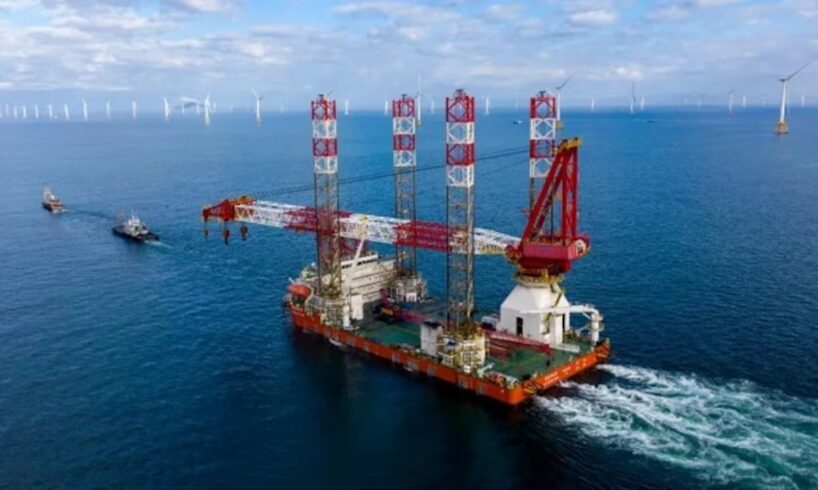
Over the past five years, Top has invested $15 million into establishing the feasibility of developing a 1GW (gigawatt) wind farm in the South Taranaki Bight.
Taranaki Offshore Partnership business development director Giacomo Caleffi.
New Zealand power generators are spending billions of dollars on onshore wind, solar and battery projects, yet there is still a reliance on coal and gas to provide back-up for the system.
Giacomo Caleffi, Top’s business development director, said the recent passing of the Offshore Renewable Energy Bill, which establishes a permitting regime for offshore renewable energy projects, could see the country’s first offshore wind farm commissioned by the mid-2030s at a cost of about $5 billion.
“Obviously, we had been working with the MBIE [the Ministry of Business, Innovation and Employment] and with Government for over three years really on that legislation, so it’s great to see it finally passed,” Caleffi said.
“These days, we’re actually waiting to see the full, final text of the act just to make sure that we understand it entirely, but we’re very happy with the way it was developed.”
The New Zealand legislation was along similar lines to that employed in Australia and in some European jurisdictions.
Energy Minister Simeon Brown said at the time that the absence of a regulatory framework for offshore renewable energy – wind, solar, wave or tidal – had created uncertainty for potential developers.
Passing the bill would allow the selection of developments that best meet New Zealand’s national interests, while managing risks to the Crown, he said.
The partnership’s plans for the South Taranaki Bight were first unveiled in March 2022.
“In the world of development, things could always go quicker but having said that, CIP has been behind quite a few offshore wind markets – we know that this is a complex exercise,” Caleffi said.
He added that the legislation was an important first step.
“It’s not sufficient by itself to ‘press go’ on all the rest of the big feasibility spend, so we still have quite some work there to understand if the parameters are just right.”
Caleffi, noting that some of CIP’s competitors had exited, said: “We are setting up something from scratch so it’s not uncommon to see exits, but we’re happy to say that we still think the opportunity in South Taranaki is absolutely exceptional.
“There’s still a lot of work to do, but certainly the investors – CIP and NZ Super – are very excited about the opportunity.”
All going well, the partnership is expected to make its final investment decision (FID) on the project by 2030-31.
Between now and then, Top would be doing feasibility work, environmental and geotechnical studies.
Work was then needed on understanding the national grid’s preparedness for accepting a potential 1GW from the project.
Offshore wind’s backers say the proposed 1GW wind farm would provide as much as seven typical onshore wind farms, or almost 7500ha of solar panels.
The 4.5 terawatt hours per year connecting into the North Island network would reduce reliance on the Cook Strait cable connecting the islands’ power supply.
It would also reduce the demand on the southern hydro lakes to provide baseload power, allowing them to act as a giant battery to be called on during peak demand.
Genesis chief executive Malcolm Johns, in a recent interview with Ryan Bridge TODAY, said the impact of offshore wind generation would be big.
“Even the smallest offshore wind farm would have a dramatic impact on the supply of electricity in New Zealand,” Johns said.
Caleffi said that in the future, there would be conversations with Transpower to make sure that the national grid was ready to take that amount of power.
Then there would be wider discussions with the Government around what its role would be in supporting or “de-risking” such a big and complex project.
Once the FID is reached, construction is expected to take three or four years.
Caleffi said 2035 is the time when offshore wind would make more sense, assuming greater electrification of transport and industry between now and then.
“It wouldn’t really work in today’s environment, but 2035 is the horizon where we start seeing limitations in achieving the amount of power that we need via the common renewables like onshore wind and solar farms, and that’s where the value of something that brings in a lot of efficient power like offshore wind lies,” he said.
“We’re saying the whole point of this project is that the impact that will have on the market and on the system in New Zealand needs to be positive and that’s what we’re working towards.”
Offshore wind has its detractors – particularly in the US – but Caleffi says some Asia-Pacific countries are enthusiastic adopters.
He said offshore wind is about attracting large energy users who require clean, green energy.
Big offshore wind projects tend to avoid the complexity of having multiple on-land projects, with each one going through separate consenting processes.
Caleffi said the sector globally took a big hit when the United States suddenly got cold feet on offshore wind, as much of the world’s supply chain was starting to gravitate towards the US.
The offshore wind industry suffered a setback when the US pivoted away from renewable energy in favour of gas.
CIP completed its first US offshore project – the 810-megawatt, 62-turbine Vineyard Wind Farm off the Massachusetts coast early this year, but has paused future builds because of the political climate in the US.
Now, much of that supply chain is tilted towards the Asia Pacific – particularly South Korea and Taiwan, which would be beneficial for New Zealand.
Some offshore wind developers had voiced their concerns about Trans Tasman’s plan to mine for vanadium, titanium and iron off the Taranaki coast, but those plans look to be on the backburner for now.
Trans Tasman lodged a fast-track application last year to mine but withdrew its application after an expert panel declined marine and discharge consents.
The company – part of the ASX and NZX-listed Manuka – still regards the mining project as being “environmentally benign” and is looking at “alternative pathways” for approvals.
Caleffi said seabed mining in the area would have added extra complexity.
He said offshore wind farms all over the world co-exist with other marine activities – such as shipping and fishing, but some activities – deep-sea trawling and seabed mining – were incompatible.
“And so the idea that there would be a potential overlap between the only really premium spot for offshore wind in New Zealand and the seabed mining area was always of concern.”
The costs of just getting the project to the FID stage were estimated at between $200m and $300m, but Caleffi said the wind speeds available justified the expense.
“The efficiency that we could get out of this offshore wind farm is world-class, so that’s what keeps our investors interested.”
If it goes ahead, the project would be 20-25km out at sea – barely visible from the coast.
Offshore wind’s critics say the projects only exist because of government subsidies – something Caleffi firmly rejects.
“With offshore wind, they’re really big projects.
“They don’t come to market by themselves.”
He said the scale of projects meant there would always need to be some form of partnership between developers and governments.
“I think there’s a misconception about offshore wind being heavily subsidised – that makes it sound like it’s some project that is commercially not viable and just requires subsidies to keep it going.
“That’s not really the way it works.”
Designing offshore wind farms, getting them to the FID and then building them takes a long time.
“It involves lots of capital that is mostly lent by banks and so what is always required is some form of de-risking early on to help reassure banks that the revenue and returns on the wind farm will be sufficient to service the debt effectively.”
Over the decades, various governments have adopted a number of mechanisms to get around the problem.
In the UK, contracts for difference (CFD) are employed to make projects bankable.
CFDs guarantee a strike price for every megawatt-hour (MWh) of electricity generated.
If the market electricity price is below the strike price, the generator receives a top-up payment.
Conversely, if the market price is above the strike price, the generator pays the difference back.
“That allows a project in the early phases to get finance as cheap as possible and get the project built as efficiently and cheaply as possible,” Caleffi said.
He also expected power purchase agreements, when users sign up for a certain amount of power from a new project for a certain period, would also play a part.
At the end of last year, Top signed a memorandum of understanding with Genesis Energy aimed at discovering how the market might value the generation profile of offshore wind.
Caleffi said the market would appreciate extra power coming into the mix over the peak demand times of winter and spring.
While the FID is still a long way off, Caleffi says he has high hopes that the project will go ahead.
“I would say we’re optimistic.
“Obviously, there’s still a lot of work to do, but the market is moving in the right direction,” he said.
“Let’s put it this way, offshore wind has always happened in countries that really realised that it was going to have a strategic value and was going to be an essential part of the energy mix.”
Jamie Gray is an Auckland-based journalist, covering the financial markets, the primary sector and energy. He joined the Herald in 2011.
Stay ahead with the latest market moves, corporate updates, and economic insights by subscribing to our Business newsletter – your essential weekly round-up of all the business news you need.
Source