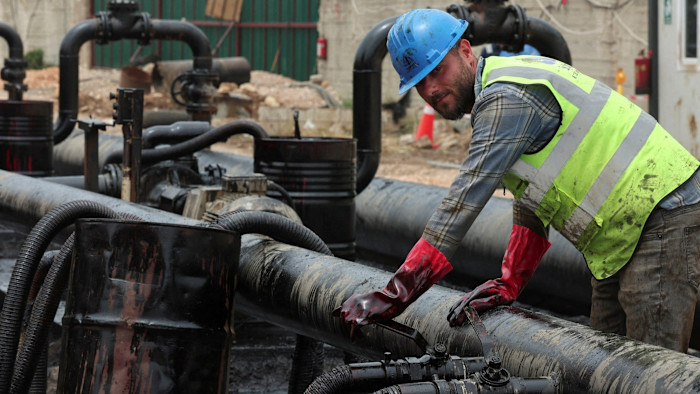
Chevron and Iraq are in advanced discussions to form a consortium to build and revive a pipeline network running into Syria as countries look for ways to bypass the Strait of Hormuz.
The US oil major is partnering with Los Angeles-based TI Capital and a group owned by the Syrian-Qatari billionaire Al-Khayyat brothers to form a consortium to establish the pipeline network, according to four people familiar with the matter.
Chevron, which is expected to sign a memorandum of understanding with Iraq regarding the development of two major oilfields in the south of the country on Thursday, is in negotiations to work on building a pipeline running from southern Iraq to the north of the country near the oil town of Kirkuk.
The consortium is discussing building a second line, partially utilising an older pipeline network, that would run from Kirkuk in northern Iraq directly west through Syria to the port of Baniyas, bringing southern Iraqi oil to the Mediterranean.
The discussions come as Iraq’s ability to export oil has been hit hard by the shutdown of the Strait of Hormuz during the Iran war, which has led countries in the Middle East to explore alternative export routes.
One of the people said another option being explored would be the planned pipeline from Basra splitting at Haditha just south of Kirkuk, which would then branch out to Syria, Turkey or Jordan.
A senior Chevron executive said the company needs to conduct further studies on the feasibility of the pipeline which would “provide alternate access to markets going out from up north and then to the west through Syria”.
The executive added: “We’ll have to see how that plays out, but it’s certainly an exciting project that will help provide some more optionality.”
The Iraqi government this month authorised the state-owned Basra Oil Company to engage Houston-based engineering firm KBR to explore export pipeline options.
The MoU for Chevron to develop two southern Iraqi oilfields is expected to be announced during Iraqi Prime Minister Ali al-Zaidi’s visit to the US this week.
Tom Barrack, a longtime friend and adviser to US President Donald Trump — who is also the US ambassador in Turkey and the US special envoy for Syria and Iraq — has been helping orchestrate agreements with Baghdad, the people said.
Barrack, worked with TI Capital to launch a Spac focused on technology investments in 2021, before it was cancelled after he was charged with acting as an agent of the United Arab Emirates. Barrack, who denied any impropriety, was acquitted in 2022.
Barrack has also helped co-ordinate other large deals in Syria with the Al-Khayyat brothers in energy, aviation and agriculture.
The US embassy in Ankara did not immediately respond to enquiries.
Syria is seeking to capitalise on the Iran war by positioning itself as an alternative export route to the Strait of Hormuz as the US seeks to weaken Iran’s influence over oil exports from the Middle East.
At the start of the year Iraq was Opec’s second-biggest producer, pumping more than 4mn barrels a day, and is heavily dependent on the strait for its oil sales, which make up the bulk of the country’s income. The strait’s closure forced Iraq to cut production by more than half, triggering a domestic financial crisis.
The US war with Iran has caused one of the largest energy supply disruptions in history, with the strait normally the conduit for a fifth of the world’s oil and seaborne gas supplies.
Over the weekend, Iran said it would fully close the strait again as tit-for-tat clashes with the US threaten the collapse of the ceasefire. In response, the US resumed a blockade on Iranian ports.
Other Gulf countries including Saudi Arabia and the UAE are looking to expand their own pipelines that can bypass the strait.
Trump met Zaidi at the White House this week where he praised the leader, a wealthy businessman and political novice who took office in May, for being “amazing” and “handsome”.
Trump said oil companies were strengthening the US relationship with Iraq ahead of Washington’s withdrawal of all troops from the country by the end of September.
“Iraq has tremendous potential because of their oil,” said Trump on Tuesday. “We’re going to be doing a lot of deals . . . a lot of oil is coming out, and the American companies are doing it.”
US energy majors have signed several nonbinding agreements in Iraq and Syria but few have moved on to more concrete contracts. Much of the pipeline infrastructure in northern Iraq and Syria was damaged during the conflict with Isis over the past decade.
Both governments have limited ability to guarantee the security of pipeline infrastructure in areas long plagued by insurgents.
Recommended
Chevron is in negotiations with Iraq to take over ownership of West Qurna 2, one of the country’s largest oilfields, after Russia’s Lukoil was left unable to operate it following the imposition of US sanctions in 2025.
In February, Chevron signed a MoU with the Al-Khayyat brothers’ Power International Holding to explore Syria’s first offshore oilfield.
ConocoPhillips became the first US oil and gas major to sign a contract with Syria’s new government in June after striking a deal with the state-owned Syrian Petroleum Company and Novaterra Energy to develop existing gasfields.
Earlier this year, US oil and gas company HKN Energy, which was founded by Texas billionaire Ross Perot Jr, began operating at the Rmeilan oilfields in north-east Syria following its finalisation of a 25-year upstream contract with Damascus to take over the field. In July, Zaidi’s cabinet struck an agreement with HKN Energy to develop the Hamrin oilfield in Iraq.