Proposed LNG import terminal unlikely to cause disruption
Checkpoint
Port Taranaki has reassured nearby residents that initial assessments of a proposed LNG import terminal indicate it is unlikely “risk management zones” will impact on the community or popular recreational areas like Ngāmotu Beach and Breakwater Bay.
In a letter sent to hundreds of local properties, port chief executive Simon Craddock confirmed both shortlisted proposals involved a ship being moored alongside the Main Breakwater.
Opponents of the project argue Port Taranaki is the wrong place for a liquid natural gas (LNG) import facility.
Watch: Taranaki’s Liquefied Natural Gas import facility expected to save New Zealanders millions
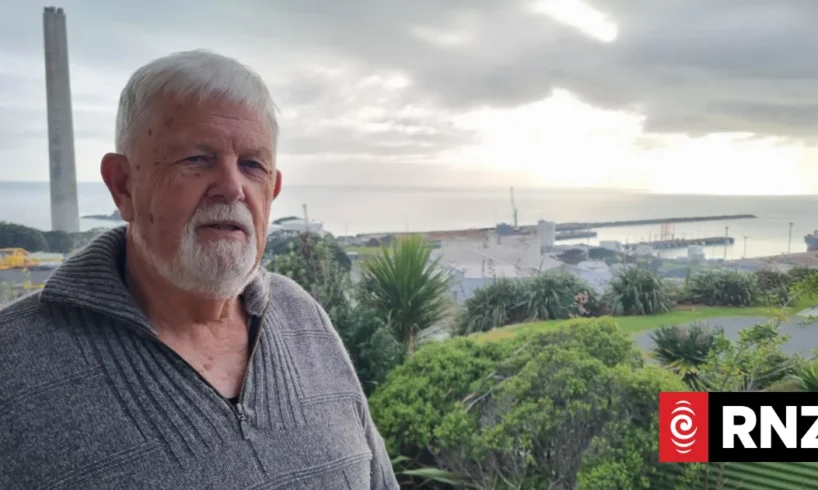
Former oil and gas industry project manager Rob Green’s home on Port View Crescent overlooks Port Taranaki.
“I can look straight down on the port, all the ships at anchor here, and I can see all the logs and so on. So, I’m looking straight down on the port at the Main Breakwater and all those berthing possibilities for ships,” he said.
“It’s very close, all the noises from the port operations I can hear. I’m looking straight at it.”
Green was not convinced the port, about 1km from his apartment, was the right place for an LNG import facility.
“I keep hearing that safety is the top priority, but quite frankly I won’t believe it until I can see the risk assessment analysis for myself.
“Here we are bulldozing on to a contract the government seems totally committed to regardless to the concerns of the neighbourhood.”
Port Taranaki’s letter and an article on the Ministry of Business Innovation and Employment’s LNG webpage explain that the vessel to be moored at the Main Breakwater would store LNG and be capable of regasifying it and distributing it into existing transmission pipelines.
Other vessels from suppliers overseas would deliver LNG – which was frozen – to the moored vessel.
The Main Breakwater was about 200m away from popular recreational areas at Ngāmotu Beach, Breakwater Bay and the Lee Breakwater, where recreational fishers both surfcasted and launched boats.
Port Taranaki referred questions about the safety assessment to MBIE, which was managing the procurement process.
In a statement, MBIE said safety was the bottom-line and the plant would not get built if it could not meet safety standards.
“An initial safety evaluation has been undertaken as part of both of the providers’ feasibility work, and detailed health and safety assessments will be carried out through the Safety Case process under the Health and Safety at Work Act 2015 once the preferred provider is contracted,” it said in a statement.
“This includes a quantitative risk assessment which is location-specific and will cover the facility and all phases of its operation, as well as generating risk contour lines (or ‘buffer zones’) to keep the community safe.”
MBIE said it was inappropriate to make the initial safety assessment public as it was commercially sensitive.
In statement, WorkSafe said it had no role in the choice of location, but it would work with the preferred provider on the more detailed Safety Case.
“Before the facility can be built and operated, the preferred provider must submit both a design notice and a Safety Case to WorkSafe.
WorkSafe would assess these to determine whether the facility could comply with major hazard facility requirements and that risks had been identified and appropriately managed.
“WorkSafe will either accept or decline the Safety Case. If it is declined, the facility will not go ahead.”
The regulator said it didn’t publish safety cases in full.
However, if the LNG project was designated a major hazard facility, prescribed information must be published on the WorkSafe website.
This would include an explanation of activities undertaken at the facility, hazard classifications of substances that could cause or contribute to a major incident, and the characteristics of those substances that made them dangerous.
General information about how the public would be warned in the event of a major incident would also be published, and information on how the public should act and what precautionary steps they should take if a major incident occurred.
Taranaki Energy Watch’s Sarah Roberts
RNZ / Robin Martin
Taranaki Energy Watch spokesperson Sarah Roberts said that would be a case of too little too late.
“What we’re saying is this location is not the right place for an LNG import terminal. We know that there’s a known potential worst case fatality distance to approximately 2km from these types of facilities. There are thousands of people and a number of schools in this area.”
Roberts said right from the outset former Minister of Energy Simon Watts talked about working alongside the Port Kembla Energy Terminal in New South Wales.
“Over there, they have built a new terminal and they have the 2km separation distance between the terminal itself and the nearest residence.”
Roberts worried people in the area surrounding Port Taranaki would be hurt if something went wrong.
“We feel like they’re purposely avoiding the RMA and Fast Track legislation to get something through that should have been looked at primarily at the beginning. Looking at the location, seeing if there’s any alternatives, and making it publicly available, making the safety assessments publicly available.”
MBIE said the exact size and details of the safety buffer zones around the LNG import facility at Port Taranaki would be determined independently to the procurement process, once it had been completed.
“It is inappropriate to estimate the exact size of the buffer zones ahead of this detailed Safety Case process. Until the Safety Case is accepted, the import facility will not be built.”
People walking along Ngāmotu Beach and at Breakwater Bay had mixed views on the LNG proposal.
Kevin said he accepted it was necessary: “I suppose we have to have the gas to run the country. There’s no great place to put it. Everyone wants it somewhere else, but Taranaki has had all the gas and gas production over the years.”
His mate, Denis, wasn’t so keen: “I’m not really in favour of the whole thing. It’s all imported fossil fuels and a bit close to a residential area.”
Don had an alternative idea and reckoned the infrastructure was mostly already in place: “Pipe it in, which would eliminate any need for changes around the harbour area.”
Robyn was willing to put her trust in the process: “They’ve got very stringent safety things, that’s the big thing with oil and gas.”
Grant worried about access to recreational areas: “Not very happy at all.
“There’s a lot of people who use this area here. So, is there going to be an exclusion zone for people walking around here? And what about the cafes here, are they going to remove those?”
Graham said he could see both sides of the dilemma: “It’s probably no more dangerous than anything else, but it is an unnecessary addition to danger, and the actual plant itself is unnecessary.”
Bernard’s home was within 2km of the proposed site: “I think it is a bit risky. It is a highly volatile thing and that. I would prefer them going back to Marsden Point and doing it there.”
Bridget’s husband had a career in oil and gas and she was comfortable with the proposal: “I’d like to think they had safety under control. We’ve been involved in oil and gas for years, yeah, so no problem there.”