“We are here to protest against the Education Minister and the government, not to raise abusive slogans or use vulgar language.”
Nandini, 21, spoke loudly with responsibility in her voice as she urged fellow Gen Z protesters not to lose moral ground. Having joined the protest on July 18, she moved through the crowd, making the joiners think that anger should not come at the cost of civility.
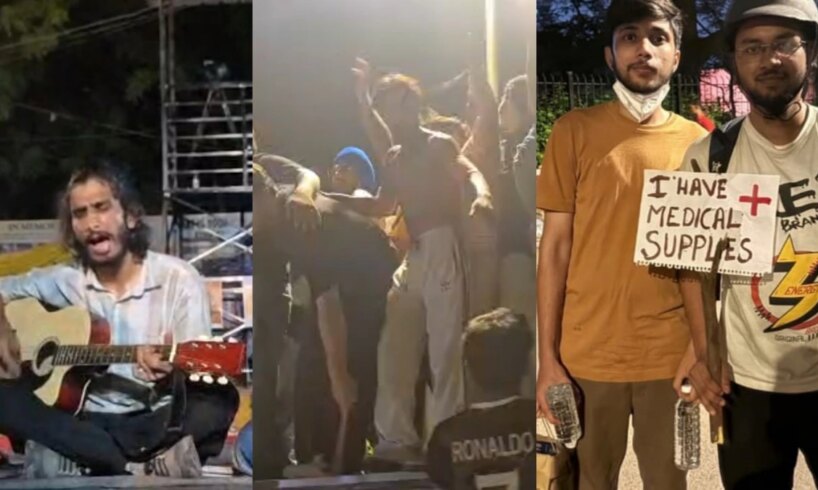
That contrast defined much of the month-long agitation at Jantar Mantar. While one section of protesters was visibly angry, impatient and often resorted to abusive slogans, another group, largely young Gen Z participants, drew on sustaining the movement through volunteer work, cleanliness drives and peaceful demonstrations.
The scenes at Jantar Mantar captured the character of an unusual protest that occupied the heart of the national capital for over 30 days.
Many participants described it as the “Gen Z Revolution”.
The larger question, however, remains unresolved: which strand of the movement ultimately influenced the government’s decision to accept the minister’s resignation?
The answer may only become clear with time, offering deeper insights into the politics that shaped one of the most closely watched student-led protests in recent years.
“CJP and its members were at the core of the movement, but many felt they failed to shoulder that responsibility effectively,” says Aditya, 23, who travelled from Gurugram to join the protest.
HOW THE GEN Z MOVEMENT UNFOLDED FAST
When the protest first began in June and was later joined by Sonam Wangchuk, Gen Z was not at its centre. But as the movement gathered momentum and national attention, the very basic characters started evolving.
During the early phase, the agitation remained largely organised. The focus was on the demands associated with the resignation of the Education Minister and changes in the structure of NTA.
Creative posters, handwritten placards, and catchy slogans drew students from Delhi University, Jawaharlal Nehru University, and many left organisations like AISA, AISF, DISHA held the ground for almost a month.
“Education Minister, gaddi chhodo!”, “Students maange insaaf”, and “Shiksha hamara adhikar” echoed across Jantar Mantar, reinforcing a singular demand: the resignation of the Education Minister.
As the days passed, more Gen Z protesters joined the movement, some from Jamnapar, some from South Delhi, and others from almost every part of Delhi, as well as from outside the city.
The demographic was highly heterogeneous. Social media played a major role in mobilising people, reels began going viral, and Bollywood stars also started speaking out in support of the movement.
Not until July 20 did the protesters cross the roads of Connaught Place.
The eventual call for the Sansad March by CJP founder Abhijeet Dipke turned into something much bigger than a march. The crowd, which included many politically affiliated individuals, became increasingly energetic. Soon, clashes broke out with the police and Army personnel. Stone-pelting, pellet guns, tear gas, and lathi charges all marked the day.
Property was vandalised, and protesters confronted the security forces following the alleged mishandling by them.
The repercussions were evident, with over 100 police personnel injured, while thousands of students also sustained injuries.
Just two days later, on the evening of July 22, a group of youngsters almost lynched a media person. It was like seeing a mob turn violent right in front of you. The close proximity created a genuine sense of fear. Why did Gen Z have to do that?
How many unwanted social elements diluted the protest is still unknown, but the larger picture spoke of one version of Gen Z that had become almost impossible to control.
Abusive and foul language was heard, while instances of hooliganism by sections of the crowd brought shame to the government. The scenes were difficult for anyone present to ignore and could perhaps have been avoided.
What began as an expression of dissent became anything but an expression.
On the other hand Nandini spent hours distributing medicines, supplying ORS, providing sanitary pads, rubbing swelled leg, applying spray on it, collecting waste, and requesting fellow protesters to maintain basic discipline. For her, responsibility formed part of democratic expression.
Like her, many volunteers spent their time cleaning and sweeping the roads, sharing laughs and discussions, helping those in need, and supporting fellow protesters.
Human chains were formed to keep the crowd formalised.
Food distribution points became crowded, volunteers struggled to maintain queues, and organisers frequently appeared overwhelmed by the size of the gathering.
Ekanch, Moksh, and Vedant were helping maintain the dignity of the protest to the utmost level. Their words were filled with frustration, but maintaining silence and controlled outrage remained their first choice.
“My aim is not merely to create an uproar; The entire effort is to bring about a change in the situation,” says Ekkanch, 26, who is a writer came from Mumbai to join the protest.
The absence of effective crowd management became increasingly evident as attendance grew.
Astha, 22, a Delhi University student, summarised the challenge: “Young people bring enormous energy, but without clear coordination, it becomes difficult to keep everyone focused on the purpose of the protest.”
History offers several examples. During the JP movement, organisers repeatedly emphasised discipline because they understood that isolated acts of violence could weaken public support. The same lesson remains relevant today.
WHEN CROWDS BECOME DIFFICULT TO MANAGE
Crowds possess a psychology different from that of individuals. Political scientist Gustave Le Bon, in The Crowd, argued that individual responsibility often weakens inside large gatherings.
Democratic protests across the world have repeatedly demonstrated this tension: peaceful objectives can coexist with disruptive behaviour by a small section of participants.
“There will always be a spectrum of responses within any generation. Some volunteered, cleaned, and helped at medical camps, while others simply showed up in support. That doesn’t make anyone’s contribution less meaningful. Showing up itself took courage when authorities were trying to prevent people from gathering,” says Shubharti, 25.
The observation was visible. From the “I got medical supplies” posters to raising slogans against the democratically elected government asking it to leave office, the contrast was evident.
An individual asking for a quick date reflects the seriousness that one is having for the protest.
“The differentiation is simple,” said Aditi, born in 2000. “Not every young protester was part of the disruption. Those who crossed into violence or disorder were no longer representing the purpose of the protest.”
For Shishir, a UPSC aspirant from Chhattisgarh, the month-long protest revealed both the promise and the pitfalls of his generation.
“I saw young people taking responsibility without being asked—organising cleanliness drives, volunteering, and standing peacefully for what they believed in. At the same time, a small section created unnecessary disruption, and eventually everyone paid the price for those actions.”
His words capture the defining paradox of the movement at Jantar Mantar.
Tolstoy Marg turned into a party zone for youngsters, while Sansad Marg became the borderline
THE LONG HISTORY OF STUDENTS MOVEMENTS
India’s political history has repeatedly shown that student movements become significant only when discipline matches dissent. The Nav Nirman movement in Gujarat (1974) and the Jayaprakash Narayan (JP) movement demonstrated how youth participation could reshape national politics.
JP consistently argued that change required moral legitimacy alongside public mobilisation.
His call for “Sampoorna Kranti” (Total Revolution) was not merely political; it demanded ethical conduct from participants.
JP Andalon at its peak, Jayprakash Narayan with the crowd.
The same principle shaped Mahatma Gandhi’s mass movements. Civil disobedience was effective because restraint became a political strategy rather than a weakness. Bhagat Singh’s hunger strike inside Lahore Jail similarly demonstrated resistance without abandoning political purpose.
Every successful mass movement has therefore balanced anger with organisation.
“We are fighting to bridge our differences and come together. Both sides are part of our country, India. Those of us who have had the privilege of receiving quality education also carry the responsibility to lead with empathy and work towards peace,” says Adreeta Roshni, a social worker and Dance Movement Therapy practitioner who travelled from Kolkata to join the protest in late July.
For many like Roshni, the movement was about more than demanding political accountability.
The defining story was not that Gen Z protested. Student movements have shaped Indian democracy for decades. The defining story was that the same generation displayed two sharply different political cultures at the same site, during the same movement.
In every protest, there is a very thin line that defines its true nature. From the fight for freedom nearly 100 years ago to the fight against the Emergency imposed in 1975 and the JP Andolan, that line has always existed.
In the Jantar Mantar protest, that line was erased the moment anyone started joining it. Gen Z was able to shame the government in its language, but many reflected the anarchist form of the revolution that is hard to ignore.
The protest came to an end on July 25 following the resignation of former Education Minister Dharmendra Pradhan.
– Ends
Published By:
Rishab Chauhan
Published On:
Jul 27, 2026 07:00 IST