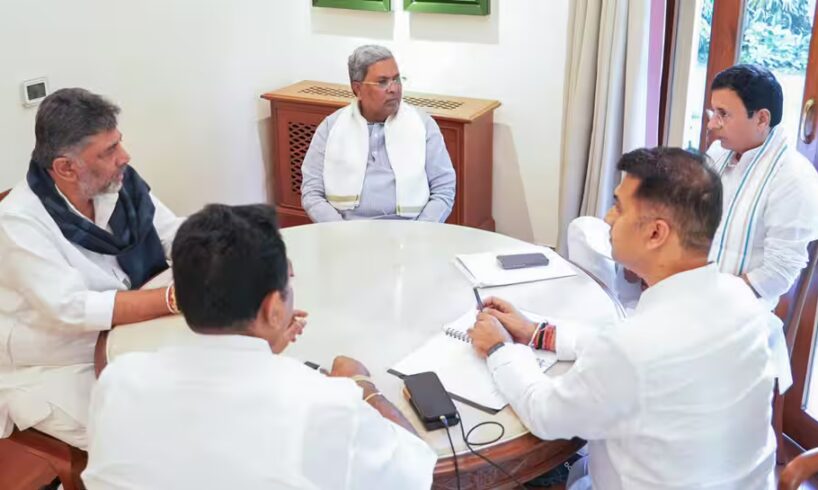
In a move that could fundamentally alter Karnataka’s political landscape, Chief Minister Siddaramaiah appears on the verge of stepping down, clearing the path for his ambitious deputy, DK Shivakumar, to take the helm. This imminent transition follows a high-stakes, closed-door conclave between Siddaramaiah and the Congress central leadership in New Delhi. For months, the Shivakumar camp has aggressively championed a pre-negotiated, 2.5-year rotational power-sharing pact struck during the intense post-victory deliberations of 2023. Siddaramaiah’s initial reluctance to honor the timeline upon reaching the mid-term milestone triggered a fierce, protracted war of attrition between the two regional titans—a factional feud that the party high command is now forced to decisively arbitrate.
Also Read: Siddaramaiah to resign as Karnataka CM tomorrow: Says Congress MLA; DK Shivakumar to take over
Learnings from Kerala
Add Zee News as a Preferred Source
DK Shivakumar, as Congress president of the Karnataka unit, has successfully led the party to a victory against the mighty Bharatiya Janata Party (BJP) but did not get the CM post despite staking claim for it in front of the Congress high-command. Contrary to this, in Kerala, VD Satheesan got rewarded for carrying out a successful campaign against the Left government as the Leader of Opposition in the Kerala assembly. By picking Satheesan as the Chief Minister in Kerala, Congress has managed to nip any chances of rebellion in the bud itself, leaving no room for future tussle. Removing Siddaramaiah and the likely elevation of DK Shivakumar may boost the morale of the workers, who may see a new ray of hope under new leadership. It will depict something just like what transpired in Kerala.
The Strategic Pivot: Institutionalising the ‘Rotational Formula’
Historically, the Congress high command’s biggest vulnerability has been its tendency to kick the operational can down the road. In states like Rajasthan (Gehlot vs. Pilot) and Madhya Pradesh (Kamal Nath vs. Scindia), vague verbal assurances of power-sharing were used to buy temporary peace post-election, only to result in catastrophic organizational collapses later.
By actively enforcing the 2.5-year rotational agreement in Karnataka—nudging a mass leader like Siddaramaiah toward a national role or a Rajya Sabha seat to elevate DK Shivakumar—the Gandhis are attempting to signal a paradigm shift. They want to prove that the ‘High Command’ still possesses the structural teeth to enforce intra-party contracts. Karnataka is no longer just a state government to protect; it is a testing ground for a disciplined, time-bound succession model that Congress desperately needs to institutionalise nationwide.
The New Playbook: Meritocracy Over Legacy
This transition reflects an emerging internal reform strategy within Congress that mirrors its recent, successful structural overhauls elsewhere:
The Kerala Blueprint: The party’s recent decision in Kerala to elevate VD Satheesan to the Chief Minister’s chair—rewarding his relentless, on-the-ground campaign as Leader of the Opposition—demonstrates a growing institutional preference for active organisational drivers over passive legacy heavyweights.
Enforcing Accountability: For years, state satraps believed that holding a vice-like grip over local MLAs made them immune to central directives. By executing a systematic transition in Bengaluru, the leadership is drawing a line: no individual leader, regardless of their caste arithmetic or regional clout, is bigger than the party’s long-term organisational health.
Countering the BJP’s Machine: The BJP has mastered the art of treating chief ministerial posts as organisational chess pieces—frequently replacing established giants with unexpected, next-generation faces to neutralise anti-incumbency and quell rebellion. Congress is finally realizing that to compete with a corporate-style political machine, it must adopt corporate-style institutional agility.
Also Read: Karnataka leadership row: Siddaramaiah going to Rajya Sabha? Set to resign from CM post- Report
Structural Risks of the Karnataka Experiment
However, executing this reform in a complex state like Karnataka is akin to performing open-heart surgery on a moving patient. The structural risks are profound and will test the party’s crisis-management capabilities to their absolute limit.
1. The AHINDA Backlash
Siddaramaiah is not just a veteran politician; he is the architect and face of the AHINDA coalition (Minorities, Backward Classes, and Dalits). If his exit is perceived by these communities as a forced ouster by the Delhi elite to accommodate Shivakumar’s dominant Vokkaliga base, the Congress risks fracturing the very social coalition that granted them a majority in 2023.
2. Managing the Fractured Cabinet
Shivakumar’s biggest challenge will not be taking the oath, but governing a cabinet packed with Siddaramaiah loyalists. Senior ministers who openly opposed the power-sharing formula will now have to report to a man they actively tried to keep out of the top job. If the high command does not meticulously manage the redistribution of key portfolios, the rebellion will simply migrate from the top floor to the second-rung leadership.
If Congress successfully pulls off this leadership transition without triggering an open split or a collapse of the state government, it will mark the birth of a “New Congress Playbook.” It will prove that the central leadership can manage ambitious regional titans through structured compromise rather than total capitulation.
However, if the transition triggers a localized revolt or alienates the AHINDA base, Karnataka will instead serve as a grim warning: that Congress’s internal machinery remains too fragile to handle the weight of its own internal democracy. The transition in Bengaluru is far more than a local power struggle; it is a live-fire simulation of whether the grand old party can successfully reform itself into a modern, disciplined political enterprise.