Updated April 8, 2026 — 10:15am,first published April 8, 2026 — 4:00am
Save
You have reached your maximum number of saved items.
Remove items from your saved list to add more.
Save this article for later
Add articles to your saved list and come back to them anytime.
Got it
AAA
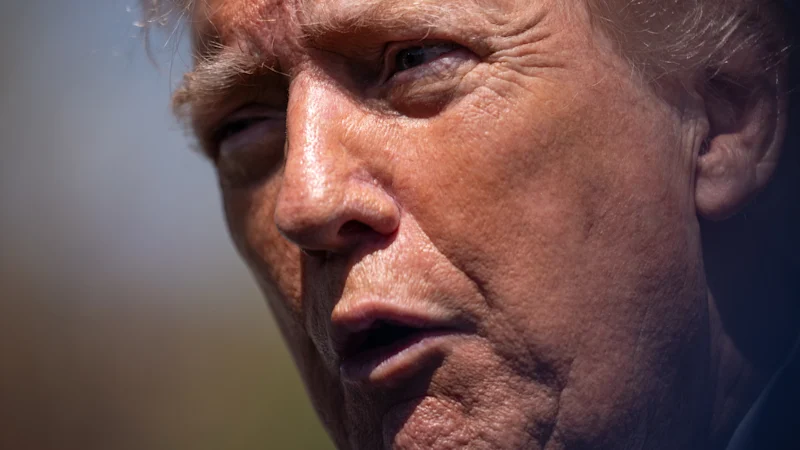
Washington: Donald Trump has backed down from his threats to unleash carnage on Iran, saying he agreed to a two-week ceasefire contingent on Tehran reopening the Strait of Hormuz and claiming a full peace agreement was close to fruition.
The US president’s about-face came hours after he threatened that “a whole civilisation will die tonight” unless Iran struck a deal, prompting widespread concern about the level of destruction he was prepared to unleash on Iran’s infrastructure and population.
US President Donald Trump said on social media: “A whole civilisation will die tonight, never to be brought back again.”AP
Iran said it had agreed to the two-week ceasefire, provided the attacks against Iran were halted, and its armed forces would co-ordinate safe passage through the strait “with due consideration of technical limitations”.
It was not immediately clear what terms Trump had agreed to, but he said it involved a 10-point plan by Iran. Such a proposal was made by Tehran earlier in the week and was dismissed by Trump at the time as “not good enough”, but a significant step.
A White House official, speaking on condition of anonymity, told this masthead Israel had also agreed to the ceasefire. Israeli Prime Minister Benjamin Netanyahu was yet to comment. CNN reported Israel was part of the ceasefire, but officials had concerns.
With about 90 minutes until his self-imposed deadline, Trump said on social media that because of requests made by Pakistani Prime Minister Shehbaz Sharif, and subject to Iran reopening the strait, he had agreed to suspend his planned bombing of Iran’s power plants and bridges for two weeks.
“This will be a double sided CEASEFIRE!” he posted. “The reason for doing so is that we have already met and exceeded all Military objectives, and are very far along with a definitive Agreement concerning Longterm PEACE with Iran, and PEACE in the Middle East.
“We received a 10 point proposal from Iran, and believe it is a workable basis on which to negotiate. Almost all of the various points of past contention have been agreed to between the United States and Iran, but a two week period will allow the Agreement to be finalized and consummated.”
Shortly afterwards, Iranian Foreign Minister Abbas Araghchi published a statement from the country’s Supreme National Security Council saying that “if attacks against Iran are halted, our Powerful Armed Forces will cease their defensive operations”.
“For a period of two weeks, safe passage through the Strait of Hormuz will be possible via co-ordination with Iran’s Armed Forces and with due consideration of technical limitations,” Araghchi said.
Vice President JD Vance, rallying support for hard-right Hungarian Prime Minister Viktor Orban, confirmed the US had struck Kharg Island.AP
Sharif said the ceasefire would start immediately and apply to all theatres of the war, including Lebanon, where Israel had been bombarding Hezbollah targets in the country’s south. He invited delegations from the US and Iran to meet for talks in Islamabad on Friday.
Earlier in the day, developments indicated that a deal of sorts might be underway. Several Westerners detained by Iran and its regional proxies were released in an apparent goodwill gesture amid the ongoing negotiations.
French President Emmanuel Macron announced two French citizens, Cécile Kohler and Jacques Paris, had been freed and were returning to France after 3½ years of detention in Iran. Macron thanked Omani authorities for their mediation efforts.
Related Article
Kataib Hezbollah, an Iran-backed terrorist group in Iraq, also said it would release American journalist Shelly Kittleson, whom it kidnapped on a Baghdad street last week, on the condition she left Iraq immediately.
With a few hours to go until Trump’s deadline, Sharif made a public statement saying diplomatic efforts were progressing “steadily, strongly and powerfully”, and calling for both sides to give it more time.
To that end, Sharif publicly proposed a two-week ceasefire, with Trump to extend his deadline for that period and the Iranians to open up the Strait of Hormuz as a goodwill gesture.
Earlier, US Vice President JD Vance told an audience in Hungary that talks were ongoing, and he hoped Iran would “make the right response”.
Related Article
Vance and a White House official confirmed the US had struck additional military targets on Iran’s Kharg Island, through which about 90 per cent of Iran’s oil exports ordinarily pass. They did not say how many targets had been hit, but reports from US media outlets suggested it was dozens.
Israel also launched fresh attacks on Iranian railway tracks and bridges. In a video, Prime Minister Benjamin Netanyahu claimed the targets were used by the Islamic Revolutionary Guard Corps to transport weapons and raw materials.
Trump’s backdown came after he issued an incendiary social media post that was widely seen as a negotiating tactic but which also alarmed international law experts, Democrats and some Republicans.
“A whole civilisation will die tonight, never to be brought back again. I don’t want that to happen, but it probably will,” Trump wrote on his Truth Social page on Tuesday morning (Washington time).
Related Article
“However, now that we have Complete and Total Regime Change, where different, smarter, and less radicalised minds prevail, maybe something revolutionarily [sic] wonderful can happen, WHO KNOWS?”
Most experts regarded the post as a last-ditch attempt to scare the regime into submission, and many were sceptical of whether the tactic would succeed.
Karim Sadjadpour, a senior fellow and Iran expert at the Carnegie Endowment for International Peace, said Trump’s threats to destroy Iranian civilisation were a gift to the regime.
“They will alienate even its fiercest opponents, who believe the Islamic Republic has spent decades erasing 2500 years of Iranian civilisation,” he said. “It’s malpractice for the US president to threaten the same.”
Richard Haass, president emeritus of the Council on Foreign Relations, said it appeared Trump had learnt little about Iran as these attacks would not lead to capitulation but to retaliation and misery for the region.
Trump’s political opponents – and some allies – slammed his latest online missive. “This is an extremely sick person,” said Chuck Schumer, the leader of the Democrats in the Senate.
“Each Republican who refuses to join us in voting against this wanton war of choice owns every consequence of whatever the hell this is.”
Democratic senator Chris Coons, who is on the foreign relations committee, said it was “barbaric” and a threat to commit a war crime. “This is not how an American president should speak, let alone act,” he said on X.
Stanford Law School Professor Tom Dannenbaum said the threat alone could constitute a violation of the US Department of Defence’s manual, which prohibits threats of violence designed to spread terror in the civilian population.
Get a note directly from our foreign correspondents on what’s making headlines around the world. Sign up for our weekly What in the World newsletter.
Save
You have reached your maximum number of saved items.
Remove items from your saved list to add more.
Michael Koziol is the North America correspondent for The Age and Sydney Morning Herald. He is a former Sydney editor, Sun-Herald deputy editor and a federal political reporter in Canberra.Connect via X or email.