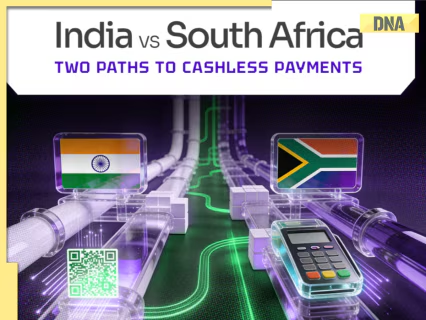
South Africa’s cashless model highlights the role of reliable rails, merchant trust, and compliance as India faces scaling challenges in digital payments.
As India debates what the next phase of digital payments looks like beyond UPI, South Africa is already racing ahead with a different model. Card-based transactions are projected to surpass ZAR 2.9 trillion by 2025, driven by expanding merchant acceptance and the rise of contactless payments.
For India, where UPI has transformed domestic payments, the comparison is less about technology and more about how reliability, redundancy, and trust are built at scale.
The pace of this transition offers a useful case study for India, as policymakers and businesses look beyond UPI to address SME participation, consumer trust, and fraud prevention at scale.
The limits of India’s UPI scale
Design
Flow:
Volume growth
Single rail dependency
Outages
Disputes & trust erosion
With a contrasting path:
Redundant rails
Embedded compliance
Contained failures
South Africa’s move toward cashless payments has been shaped by steady investments in card infrastructure, merchant reliability, and fraud controls – a contrast to India’s rapid, QR-led expansion through UPI.
The difference is becoming harder to ignore as India’s digital payments system strains under its own scale.
Scale, not resilience: India processed 21.6 billion UPI transactions worth ₹27.9 lakh crore in December 2025, but system strain is rising with volume.
Wide acceptance, shallow depth: 56.86 crore QR codes across ~6.5 crore merchants mask uneven uptime and single-rail dependence.
Reliability under pressure: Repeated outages have forced policy focus on 99.5% uptime targets.
Trust frays in failure: The RBI logged 13.34 lakh complaints in FY 2024–25, pointing to gaps in dispute resolution.
Outages go public: UPI failures surface as visible system-wide disruptions, not contained backend incidents.
What India can learn from South Africa’s cashless playbook
As UPI strains under its own scale, South Africa’s steadier, card-led cashless model highlights what India may have missed in the rush to grow fast. South Africa’s experience offers less a blueprint and more a set of design principles that India’s next phase can adapt.
Design for uptime, not just adoption
South Africa scaled cashless payments by investing early in card and POS infrastructure that worked reliably for small merchants. Today, over 60% of in-person payments are contactless, according to Reuters.
India’s QR-first growth delivered reach, but outages show that scale without redundancy erodes trust.
Normalise contactless for daily use
Post-2020, tap-to-pay became routine in South Africa for low-value, high-frequency spends. The shift reduced friction without changing consumer behaviour. India’s next phase may require similar invisible layers beyond QR scans, especially in transit and retail.
Win SMEs through economics, not mandates
Banks and fintechs in South Africa drove adoption with faster settlements, cleaner records, and lower cash risk for merchants. India achieved scale through policy incentives, but deeper usage will depend on improving uptime, dispute resolution, and merchant-side reliability.
Closing the gaps at the infrastructure layer
As payment systems scale, the challenge shifts from enabling transactions to governing them. MAI Labs, a blockchain infrastructure company, has developed Kwala, a platform that embeds compliance, AML checks, and programmable enforcement directly into payment rails.
In markets like India, where UPI’s scale has exposed stress around reliability and trust, such protocol-level infrastructure helps make high-volume systems more auditable and resilient without adding new consumer-facing layers.
The limits of adoption alone
India’s UPI experience shows that growth alone can’t solve structural fragility. High volumes reveal cracks in compliance, dispute handling, and system reliability, all lessons relevant to Web3, fintech, and regulators alike.
Tapan Sangal, Chief Visionary, Kwala, puts it this way:
“You can push volumes endlessly, but without rails that enforce rules and track trust, growth exposes weaknesses faster than anyone expects.”
Essentially, architecture sets the limits for what adoption can achieve. Without resilient rails, even the most popular systems can falter.
Lessons from scale
As digital payments reach mass scale, the challenge shifts from growth to governance. South Africa’s experience underscores the importance of reliable rails and merchant confidence. India’s next phase will depend less on adoption and more on whether compliance, oversight, and resilience are embedded directly into the system. Without that, even the most successful payment platforms can struggle under their own scale.
(Disclaimer: The views expressed above are the author’s own and do not reflect those of DNA)