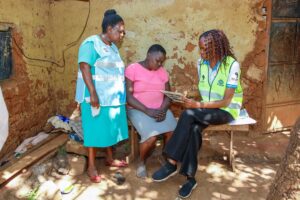
While informal markets keep Kenya’s economy going, childcare solutions for the mostly female traders are scarce. But now small daycare centres are opening at the markets, allowing these women to work without worrying about their children.
Just after sunrise, Miriam Otieno lifts her two-year-old son on to her back and locks the door of her one-room house in Nairobi’s Eastlands. By 7am she will be at a stall in the market, carefully arranging pyramids of tomatoes.
For years, Miriam’s son would go to work with her, tied to her back while she sold on the stall. Some days, she paid a neighbour to watch him. Some days neither was an option and she would stay at home with him, losing a day’s income.
Across Kenya’s cities, informal markets keep the economy moving – and women make up the majority of traders.
Keep up with the latest headlines on WhatsApp | LinkedIn
Yet the system around them rarely addresses childcare. Markets are built for business, not children. Workdays are long, profits are small and childcare, when it exists, is often unsafe or too expensive.
Stigma and sisterhood: how one Kenyan woman knitted a healthcare revolution
Dr. Mercy Wanjiku, an early childhood development specialist, explains: “Childcare has been seen as a private family matter. But in urban, low-income areas that assumption falls apart. When care fails, children face risks and mothers bear the economic and emotional burden.”
But in recent years, childcare spaces have begun to appear at Nairobi’s markets, formed through partnerships between traders, caregivers and organisations such as Wow Mom Kenya.
The small rooms with their low tables, plastic chairs and mats on the floor may not look like anything special but for mothers like Miriam, they are life-changing.
She now leaves her son in a childcare room a few minutes from her stall. “I still check on him,” she says. “But my mind is not divided anymore.”
Kenya: The accidental librarian keeping Kibera’s kids in books
Impact on development
“We separate work and care as if they exist in different worlds,” says Professor David Ochieng, an urban planning scholar. “But for informal workers, especially women, those worlds overlap constantly. Planning that ignores this reality creates inequality.”
Kenya’s cities have grown rapidly, outpacing social support structures. Public childcare is limited and private options are beyond the reach of most informal workers. In the resulting gap, care arrangements become dependent on informal networks that can fail unexpectedly.
The consequences of this lack of childcare go beyond the effect on family incomes. Research in early childhood development shows that inconsistent care affects nutrition, safety and cognitive growth during a key stage of development.
“The first five years are crucial,” says Wanjiku. “When children spend long days in unsafe or unstimulating places, the effects can last a lifetime.”
The rocket builder sending Kenyan kids’ imaginations into orbit
‘Care work is undervalued’
At the childcare centre at Gikomba Market, the staff start the day by making porridge. Most are women from the local community, trained but still earning modest wages.
They know how much trust is placed in them. “These children are someone’s everything,” one worker says.
The work is challenging, with space limited and resources scarce, and demand often outstrips capacity.
For Asha Abdalla, a clothes seller and single mother, this childcare space allows her to work without leaving her daughter alone. “People think we are strong because we survive,” she says. “But surviving is not the same as being supported.”
Sign up for free AllAfrica Newsletters
Get the latest in African news delivered straight to your inbox
Success!
Almost finished…
We need to confirm your email address.
To complete the process, please follow the instructions in the email we just sent you.
Error!
There was a problem processing your submission. Please try again later.
Wow Mom Kenya argues that childcare should be viewed as vital urban infrastructure, as essential as water or transport. Their research and pilot projects are beginning to influence policy discussions, although the pace of change is slow.
“What’s lacking is not evidence – it’s political priority,” Ochieng says. “Care work remains undervalued because it is seen as feminine and invisible.”
As evening comes, Miriam picks up her son and weaves through the crowd towards home. Tomorrow, she’ll be back at her stall and he’ll be back at the childcare space.
While the city around her hasn’t changed, this small oasis of support allows her to get on with her working day.