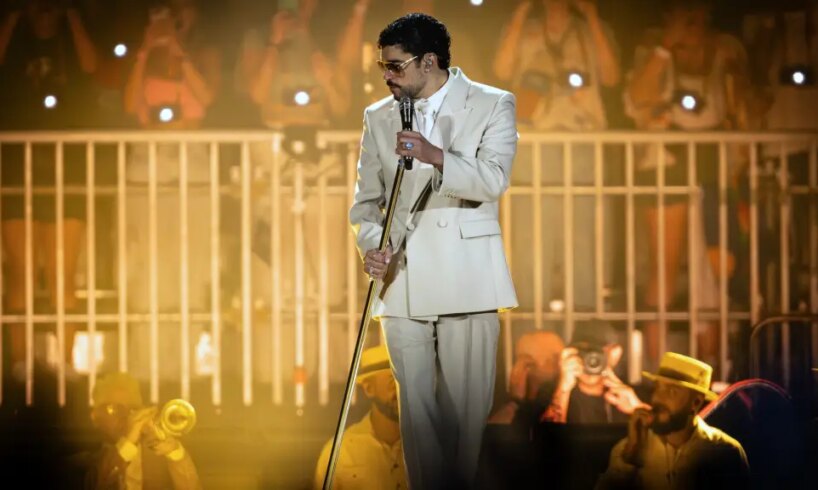
When Bad Bunny sold out two stadiums in Sydney, becoming the first Latin artist in history to headline and sell out stadium shows in Australia, it wasn’t just a concert.
It was a business case study.
Related Article Block Placeholder
Article ID: 328315
Because this wasn’t driven by heavy English-language radio rotation, nor by a massive local Latin population. Latinos make up roughly 1% of Australia’s population. The Puerto Rican community here is tiny.
And yet he filled stadiums.
That doesn’t happen because of hype.
It happens because of brand power.
From Vega Baja to a $435 million empire
Born Benito Antonio Martínez Ocasio in Vega Baja, Puerto Rico, Bad Bunny began uploading songs to SoundCloud while working in a supermarket. His breakout track Soy Peor launched him into global visibility, and within a decade, he became one of the most-streamed artists in the world, a Grammy winner, a fashion force, a cultural commentator and a commercial powerhouse.
His brand is now valued in the hundreds of millions.
But here’s what makes that extraordinary.
He did not build it by becoming more global.
He built it by becoming more himself.
1. Authenticity: He built trust, not just attention
For years, the dominant strategy in business and media was simple: be everywhere. More content. More visibility. More noise.
That was the attention economy.
Bad Bunny operates differently.
He doesn’t dilute himself for mass consumption. He sings in Spanish. He centres Puerto Rico on global stages. He speaks openly about politics, identity and culture. His fashion, his interviews, his lyrics and his activism are aligned.
Nothing feels like a costume.
That alignment builds trust.
And trust travels further than trends.
When audiences feel they understand someone, when they see consistency between words and actions, loyalty compounds. That is why people who don’t speak Spanish still buy tickets. They aren’t just consuming music; they are buying into identity.
Related Article Block Placeholder
Article ID: 331595
In business terms, he has optimised for resonance over reach.
2. The X-factor: Different on purpose
Within Latin music, he is different.
He plays with fashion in ways that challenge masculinity norms. He experiments with genre. He embraces vulnerability in his lyrics. He shifts aesthetics album to album without losing coherence.
He is not designed to be easy to categorise.
That is his advantage.
Most brands flatten themselves to become more acceptable. They remove the edges. They smooth out the opinions. They avoid standing too far outside the lines.
Bad Bunny does the opposite.
His difference is not an accident; it is the asset.
And here is the commercial truth: differentiation drives demand. When you look and sound like everyone else, you compete on volume. When you are distinct, you compete on value.
Australia saw that play out in real time. Stadiums filled not because he blended in, but because he stood apart.
3. Unapologetic identity: He refused to water it down
The most powerful part of his brand is not style.
It is conviction.
He did not switch to English to expand. He did not neutralise his accent. He did not detach from Puerto Rico to become more globally palatable.
He scaled his identity instead of shrinking it.
That choice is risky. It requires certainty. It requires being willing to polarise. It requires accepting that not everyone will understand you.
But it also builds a brand that cannot be replicated.
Related Article Block Placeholder
Article ID: 276165
In a world saturated with content and AI-generated sameness, sameness is cheap. Identity is scarce.
And scarcity drives value.
Why Australia should pay attention
Australia has a cultural tendency toward humility, sometimes to the point of self-editing. Tall poppy syndrome teaches people not to be too loud, too bold, too different.
In everyday life, that can create grounded leadership.
In branding, it can create invisibility.
Bad Bunny’s success in Australia proves something important. You do not need demographic dominance to win a market. You need clarity of identity.
When roughly 99% of a country is not from your cultural background, and you still sell out stadiums, that is not niche marketing. That is brand gravity.
For founders, executives and creators, the lesson is clear.
Stop asking how to be more visible.
Start asking how to be more unmistakable.
Your accent, your cultural lens, your unconventional path, your opinions, your contradictions, your edges, these are not liabilities to sand down. They are assets to sharpen.
Bad Bunny did not build a $435 million brand by becoming easier to consume.
He built it by becoming impossible to ignore.
The real question for Australian leaders is not how to replicate his music career.
It is this: what part of your identity have you been softening to stay palatable? And what might your business be worth if you scaled that instead?