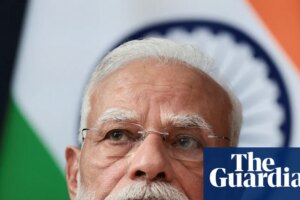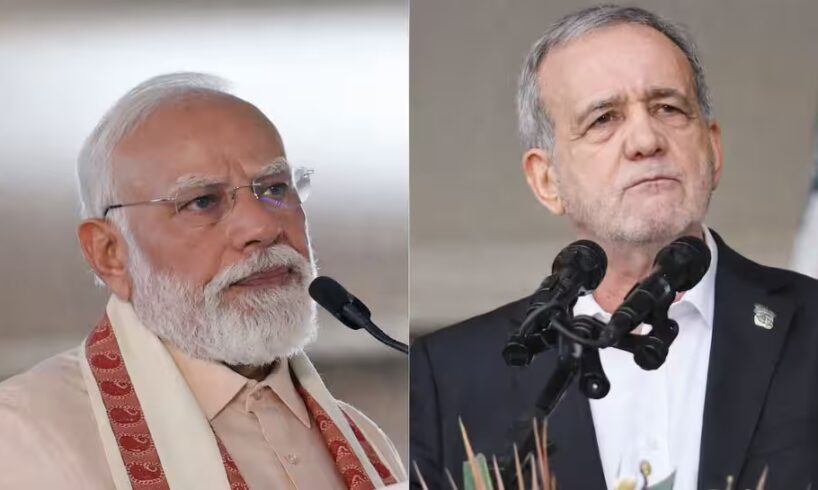
Prime Minister Narendra Modi held a telephonic conversation with Iranian President, Masoud Pezeshkian on Thursday.
With the tensions across West Asia continuing to escalate, worries are mounting over civilian casualties, regional stability, and the safety of Indian nationals.
Sharing details of the conversation on X, PM Modi said the two leaders discussed the deteriorating situation in the region. “Expressed deep concern over the escalation of tensions and the loss of civilian lives as well as damage to civilian infrastructure. The safety and security of Indian nationals, along with the need for unhindered transit of goods and energy, remain India’s top priorities. Reiterated India’s commitment to peace and stability and urged for dialogue and diplomacy,” said PM Modi.
Add Zee News as a Preferred Source
Had a conversation with Iranian President, Dr. Masoud Pezeshkian, to discuss the serious situation in the region.
Expressed deep concern over the escalation of tensions and the loss of civilian lives as well as damage to civilian infrastructure.
The safety and security of…
— Narendra Modi (@narendramodi) March 12, 2026
The Prime Minister said that India’s primary focus remains the security of its citizens and the smooth, uninterrupted flow of goods and energy supplies.
The conversation comes as the ongoing conflict in West Asia enters its 13th day, with global energy markets facing uncertainty after the closure of the Strait of Hormuz.
Earlier today, while addressing the NXT summit, the Prime Minister noted that the far‑reaching consequences of the current global conflict have affected every nation, underscoring the need for a proactive and multi‑tiered response from the Indian government.
PM Modi said he has been in constant touch with leading global leaders to navigate these complexities and work toward sustainable solutions for the ongoing crisis. He also emphasised that the government is working intensively to manage and overcome the disruptions that have arisen in international supply chains. “Continuous efforts are also underway to determine how we can overcome the disruptions that have occurred in the supply chain,” he stated.
The Prime Minister cited India’s response to the Russia–Ukraine conflict as an example of how the government managed economic pressures stemming from global turmoil. “The Indian government has always made every effort to ensure that the burden of the war’s consequences does not fall on Indian citizens. When the Russia–Ukraine crisis intensified, fertiliser prices surged. Yet, we provided a bag of urea to our farmers for ₹300, which was trading at around ₹3,000 in the international market,” he said.
Appealing for cooperation from state authorities, PM Modi also called for strict vigilance against market manipulation and misinformation during the current crisis. “This time too, we will do everything possible to ensure that the war has the least possible impact on the lives of our farmers and citizens. At this crucial moment, from this platform, I also urge state governments: it is essential to prevent black marketing and the spread of rumours. Therefore, close monitoring of the situation is vital, and strong action must be taken against those indulging in black marketing…” he added.
The developments come after India’s Foregin Minister S Jaishankar held a telephonic conversation with his Iranian counterpart Abbas Aragchi, earlier this week. Following the conversation, the Ministry of External Affairs spokesperson, Randhir Jaiswal, during a weekly press briefing on Thursday, Jaiswal said, “External Affairs Minister Dr S Jaishankar and the Foreign Minister of Iran have had three conversations in recent days. The last one discussed issues pertaining to the safety of shipping and India’s energy security.”
“Beyond that, it would be premature for me to say anything”, added MEA spokesperson Randhir Jaiswal, emphasisin gon India’s energy needs amid the West Asia tensions.