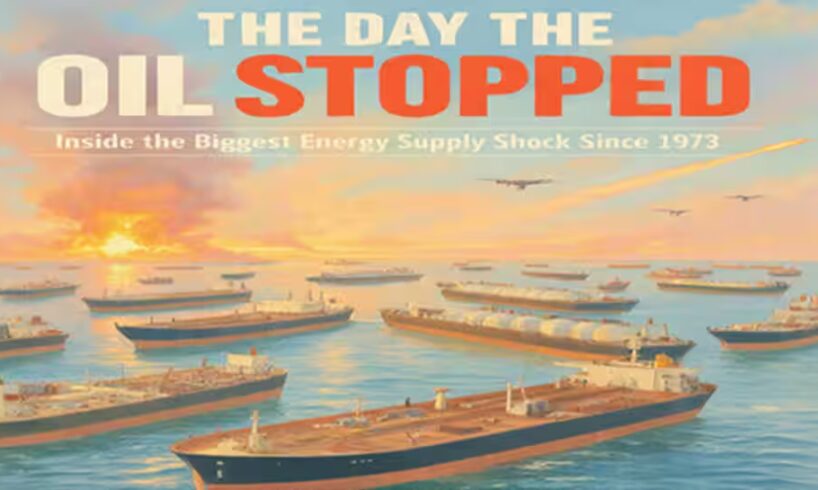
Before 28 February 2026, more than 100 oil tankers crossed the Strait of Hormuz every single day. By 2 March, that number had fallen to zero. Not a slowdown. Not a disruption. A full stop. According to S&P Global Market Intelligence, just 21 tankers have managed to transit the strait in the entire three weeks since the war began. Around 400 vessels now sit anchored in the Gulf of Oman, waiting. According to Bloomberg, roughly 40,000 sailors are stranded aboard those ships, some watching explosions from their decks, others navigating by radar because their GPS signals are being jammed.
This is what it looks like when the world’s most important energy corridor shuts down.
The Strait of Hormuz, a passage barely 33 miles wide between Iran and Oman, normally carries about 20 million barrels of oil per day. That is one fifth of all the oil the world consumes, and one quarter of all oil traded by sea. On the day the oil stopped flowing, it set off the largest supply disruption in the history of the global oil market.
Add Zee News as a Preferred Source
How it began
On 28 February 2026, the United States and Israel launched coordinated airstrikes on Iran under what the Pentagon called Operation Epic Fury. The operation targeted military sites, nuclear facilities, and Iran’s senior leadership, killing Supreme Leader Ali Khamenei. Iran’s response was calculated and devastating in its economic precision. Rather than engage in a conventional war it could not win, Tehran weaponised geography. It deployed drones, missiles, and naval mines to seal the Strait of Hormuz, and then it began hitting energy infrastructure across the Gulf.
Within the first week, drones struck Qatar’s Ras Laffan, the largest LNG facility on Earth, responsible for nearly 20 percent of the world’s liquefied natural gas exports. QatarEnergy declared force majeure and shut production. Saudi Arabia’s Ras Tanura refinery, the kingdom’s largest, was closed after a fire caused by intercepted drone debris. The UAE’s ADNOC shut refineries. Kuwait Petroleum Corporation and Bahrain’s Bapco followed. According to the International Energy Agency’s March 2026 Oil Market Report, Gulf countries have been forced to cut at least 10 million barrels per day of production because, with nowhere to ship the oil, their storage tanks are overflowing.
Then came 18 March. Israel, in coordination with the United States, struck Iran’s South Pars gas field, the single largest natural gas deposit on the planet, shared between Iran and Qatar. Iran retaliated within hours, launching missiles at Qatar’s Ras Laffan again, causing what QatarEnergy described as extensive damage. The UAE confirmed that its Habshan gas complex, one of the world’s largest with a processing capacity of 4,750 million standard cubic feet per day, and the Bab oilfield, capable of producing 485,000 barrels per day, were both shut down after intercepted missile debris fell on the sites. The UAE’s air defence intercepted 13 ballistic missiles and 27 drones from Iran in a single day. Saudi Arabia intercepted four ballistic missiles aimed at Riyadh. A drone struck Kuwait’s Mina Al Ahmadi refinery, one of the largest in the Middle East with a capacity of roughly 466,000 barrels per day. Iran also targeted an LNG facility in Bahrain.
In total, six countries in the Gulf have now had their energy infrastructure directly attacked or shut down: Iran, Qatar, Saudi Arabia, the UAE, Kuwait, and Bahrain.
The numbers that matter
The IEA projects that global oil supply fell by 8 million barrels per day in March. For context, the world consumes about 105 million barrels per day. An 8-million-barrel shortfall is roughly 7.5 percent of all the oil the world uses, vanishing almost overnight. The agency has called it an unprecedented event.
Brent crude, which was trading at around 72 dollars a barrel before the war, surged past 110 dollars on 19 March. It briefly touched 120 dollars earlier in the month. Dubai crude, the benchmark that determines what India actually pays for its oil, hit an all-time high above 150 dollars a barrel. Asian LNG spot prices more than doubled to over 25 dollars per million BTU. European natural gas futures rose over 50 percent. Jet fuel prices globally are up 83 percent, according to the International Air Transport Association. Urea fertiliser prices have risen 35 percent. Helium, essential for semiconductor manufacturing, has doubled in price since Qatar, the source of a third of the world’s helium supply, shut production.
The IEA responded with the largest emergency reserve release in its 52-year history: 400 million barrels. But as the agency itself noted, global consumption runs at 105 million barrels per day. The entire release covers less than four days of demand and roughly 20 days of normal Hormuz flows.
Why India is on the front line
For India, this is not an abstract geopolitical crisis. It is a household emergency unfolding in slow motion.
India imports nearly 90 percent of its crude oil. About half of that crude, and more than three quarters of its liquefied petroleum gas, normally passes through the Strait of Hormuz. According to Business Today, 22 Indian flagged vessels carrying 2.2 million metric tonnes of critical energy cargo, including LPG, LNG, and crude oil, were stranded in the strait as of 18 March. Two LPG carriers, Shivalik and Nanda Devi, each carrying 46,000 metric tonnes, were among the few ships that managed to reach India after Iran permitted their passage.
Bloomberg reported on 17 March that surging oil prices and acute gas shortages are now rippling directly through the Indian economy, with analysts cutting growth forecasts. MUFG Research estimates that every 10 dollar per barrel increase in oil prices widens India’s current account deficit by 0.4 to 0.5 percent of GDP. At 100 dollars per barrel, the deficit approaches 3 percent of GDP, and the rupee could weaken past 95 to the dollar. At 120 dollars, MUFG projects the rupee could fall to 97.50 or beyond.
The Indian government has invoked emergency powers to redirect LPG from industrial users to households. It has accepted a 30-day US sanctions waiver to resume purchasing Russian crude, now selling at roughly 90 dollars a barrel, up from about 50 dollars before the war. Agricultural exports to Gulf countries, including rice and bananas, have been severely disrupted, forcing farmers to sell at depressed prices in local markets. Around 93 lakh Indians work in the Middle East, and 30 percent of India’s total remittances, over 50 billion dollars annually, flows from the region.
Meanwhile, FPIs have been selling Indian equities at a pace of 6,434 crore rupees per day in March, adding pressure on the markets and the currency simultaneously.
Winners and losers
Three weeks into this crisis, the scoreboard is becoming clear.
Russia is the most obvious beneficiary. According to CBS News, citing Ukraine’s President Zelensky, Moscow earned roughly 10 billion dollars in the first two weeks of the war from higher oil prices and looser sanctions enforcement. The discount on Russian crude has vanished entirely, with J.P. Morgan noting Russian barrels now trade at a 4-to-5-dollar premium over Brent. China’s imports of Russian oil rose 22 percent in a single month. American oil companies are thriving. ExxonMobil shares are up 30 percent year to date. Devon Energy is up 30 percent. Refining margins in Singapore climbed to 30 dollars a barrel, a four-year high.
On the other side, the devastation is widespread. More than 30 countries are affected. South Korea imposed fuel caps for the first time in nearly three decades. Japan began releasing oil from its national reserves. Bangladesh stationed troops at oil depots and closed universities to conserve fuel. The Philippines moved government offices to a four-day work week. Nepal started rationing cooking gas. Vietnam has less than 20 days of oil reserves remaining. Thailand’s tourist arrivals fell 9 percent in the first week of March alone, with hotels reporting occupancy as low as 10 percent.
The Asian Development Bank warned that smaller energy importing economies, including the Philippines, Pakistan, and Sri Lanka, would face the sharpest macroeconomic damage, as inflation, currency depreciation, and widening deficits hit all at once.
What comes next?
The deepest concern among energy analysts is not just the current price spike, but what happens after the war ends. Even optimistic scenarios involve months of recovery. Restarting shut in oil fields is not like flipping a switch. It takes weeks to months, depending on the field’s age and the nature of the shutdown. LNG facilities involve sub-zero cryogenic equipment that must be restarted gradually to avoid thermal shock and damage. Qatar alone could need over a month to resume normal production levels, according to Reuters.
Underneath this crisis lies a structural problem that predates the war. Over the past decade, global investment in oil exploration fell by 30 percent, driven by fears of stranded assets and peak oil demand forecasts. The National Center for Energy Analytics estimates the world faces a 1.5 trillion-dollar shortfall in exploration investment over the coming decade. US shale production, the only major non-OPEC growth engine, is expected to flatten in 2026 and decline in 2027 according to the EIA.
The combination of a wartime supply shock landing on top of years of structural underinvestment is what makes this moment potentially different from past crises. In 1973, the oil embargo was a political tool that could be lifted with a political decision. In 2026, even after a ceasefire, the physical, financial, and logistical wreckage will take far longer to clear. As Saudi Arabia’s foreign minister said on 19 March: the trust that held the Gulf’s energy system together has been completely shattered.
Market participants who expect oil prices to simply snap back once the fighting stops may be underestimating how much has broken beneath the surface. The day the oil stopped flowing was not just a day. It may be the beginning of a new era.