
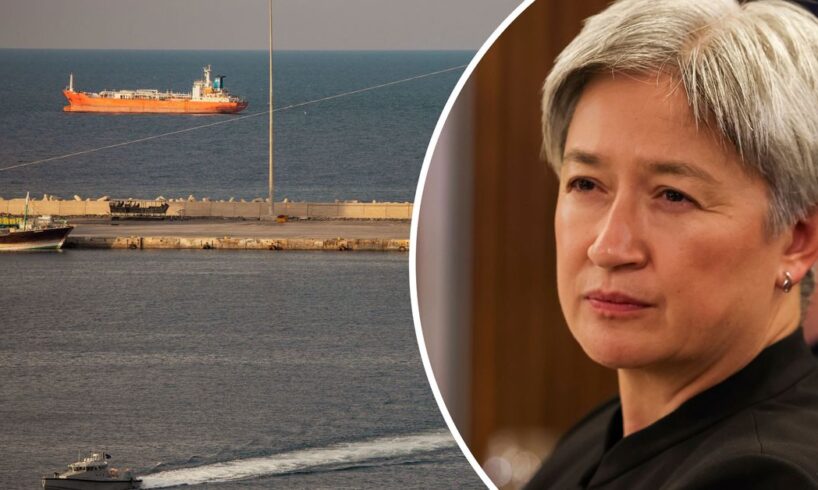
Australia has joined a coalition of other nations to condemn the “weaponisation” of the Strait of Hormuz in a rare display of diplomacy and unity against Iran’s maritime war strategy.Britain hosted an extraordinary call with 40 countries to debate an international effort to reopen the critical waterway after Iran’s de facto closure sent global oil prices soaring.Foreign Affair’s Minister Penny Wong accused Iran of “deliberately inflicting economic pain” following the meeting, but said no offensive action would be taken to lift Iran’s blockade, despite US President Donald Trump telling allies to “just take” the strait.Australia has joined a coalition of other nations to condemn the “weaponisation” of the Strait of Hormuz. (Getty)
“The focus of last night’s meeting was diplomatic and civilian initiatives countries could pursue to make the Strait of Hormuz accessible and safe,” Wong said.
“Ministers agreed on the importance of continued coordination and collective action.”
The federal government lent its support to the universal condemnation of Iran’s act of “deliberately inflicting economic pain”.
Wong said the ministers in the meeting urged Iran to act in line with UN resolutions affirming the freedom of the seas for non-military vessels.
She repeated that Australia would not become militarily involved in the conflict nor would it take offensive measures to bring ships back to the strait.
“Australia is not taking offensive action against Iran and we are not deploying troops on the ground in Iran,” Wong added.
“The Australian government continues to support de-escalation and the resolution of this conflict.
“The longer this war goes on, the more significant the impact on the global economy will be.”
The foreign minister did not mention the US or Israel in her statement, despite their current warmaking being what triggered Iran’s effective closure of the strait.
Penny Wong repeated that Australia would not become militarily involved in the conflict. (Alex Ellinghausen)
The 41 countries represented came from all continents except Antarctica.
The US didn’t attend the virtual meeting, which came after Trump made clear that he thinks securing the waterway is not America’s job.
Trump has also disparaged America’s European allies for failing to support the war and renewed his threats to pull the US out of NATO.
The meeting also discussed working with the UN’s International Maritime Organisation to free 2000 ships and 20,000 seafarers trapped by the conflict, she said.
No concrete measures were announced, however.
Wong’s message comes amid conflicting reports which claim that Australia has Special Air Services (SAS) troops to the Middle East to remain on standby if the situation deteriorates further.
News Corp reports that around 90 SAS members were sent to the region two weeks ago.
The Department of Defence would not confirm where Australian military personnel or assets are located.
Australia deployed a spy plane known as a E-7A Wedgetail to the Gulf region to help “protect and defend Australians and other civilians” last month.
The Wedgetail provides long-range reconnaissance capability, which Australia’s Gulf allies had requested to assist in airspace defence.
Iran’s attack on Gulf continues
Iran fired more missiles at Israel and Gulf Arab states on Thursday, demonstrating Tehran’s continued ability to strike its neighbours even as Trump claimed the threat from the country was nearly eliminated.Iran’s attacks on Gulf states along with its chokehold on the Strait of Hormuz have disrupted the world’s energy supplies with effects far beyond the Middle East. That has proved to be Iran’s greatest strategic advantage in the war.Mourners gather during a funeral procession for Alireza Tangsiri, head of Iran’s Islamic Revolutionary Guard Corps Navy, and others killed in Israeli strikes in late March, in Tehran, Iran, Wednesday, April 1, 2026. (AP Photo/Vahid Salemi)
Trump has insisted the strait can be taken by force – but said it is not up to the US to do that.
In an address to the American people on Wednesday night, he encouraged countries that depend on oil from Hormuz to “build some delayed courage” and go “take it.”
Before the US and Israel started the war on February 28 with strikes on Iran, the waterway was open to traffic and 20 per cent of all traded oil used passed through it.
Iran continues to strike Israel and Gulf countries
Iran responded defiantly to Trump’s speech, in which the American president claimed US military action had been so decisive that “one of the most powerful countries” is “really no longer a threat”.
A spokesman for Iran’s military, Lt. Col. Ebrahim Zolfaghari, insisted on Thursday that Tehran maintains hidden stockpiles of arms, munitions and production facilities. He said facilities targeted so far by US strikes are “insignificant”.
President Donald Trump speaks about the Iran war from the Cross Hall of the White House on Wednesday, April 1, 2026, in Washington. (AP Photo/Alex Brandon, Pool) (AP)
Just before Trump began his address — in which he said US “core strategic objectives are nearing completion” — explosions were heard in Dubai as air defences worked to intercept an Iranian missile barrage.
Less than a half-hour after the president was done, Israel said its military was also working to intercept incoming missiles. Sirens sounded in Bahrain, home to the US Navy’s 5th Fleet, immediately after the speech.
Attacks continued across Iran on Thursday, with strikes reported in multiple cities.
In Lebanon — home to Iran-backed Hezbollah militants who are fighting Israel, which has launched a ground invasion — an Israeli strike killed four people in the south, the Health Ministry said.
A firefighter extinguishes a car at the site of Israeli airstrikes, in Beirut, Lebanon, Wednesday, April 1, 2026. (AP Photo/Hussein Malla)
More than 1900 people have been killed in Iran during the war, while 19 have been reported dead in Israel. More than two dozen people have died in Gulf states and the occupied West Bank, while 13 US service members have been killed.
More than 1200 people have been killed and more than 1 million displaced in Lebanon. Ten Israeli soldiers have also died there.
Britain’s Foreign Secretary Yvette Cooper, right, attends a virtual summit at the Foreign & Commonwealth Office in London, on Thursday April 2, 2026, with around 35 countries to discuss ways of reopening the Strait of Hormuz (Leon Neal/Pool Photo via AP)
Shipping in the strait has slowed to a trickle
Iranian attacks on about two dozen commercial ships, and the threat of more, have halted nearly all traffic in the waterway that connects the Persian Gulf to the open ocean.
Since March 1, traffic through the strait has dropped 94 per cent over the same period last year, according to the Lloyds List Intelligence shipping data firm. Two ships are confirmed to have paid a fee, the firm said, while others were allowed through based on agreements with their home governments.
Saudi Arabia piped about 1 billion barrels of oil away from the Strait of Hormuz in March, according to maritime data firm Kpler, while Iraq said on Thursday that it had started to truck oil across Syria to avoid the strait.
The Indian flagged LPG carrier Jag Vasant transporting liquefied petroleum gas, is seen at the Mumbai Port in Mumbai, India, after it arrived clearing the Strait of Hormuz, Wednesday, April 1, 2026 (AP Photo/Rafiq Maqbool)
French President Emmanuel Macron said opening the strait by force is “unrealistic.”
The reopening of the strait “can only be done in coordination with Iran,” through negotiations that would follow a potential ceasefire, Macron told reporters on Thursday during a visit to South Korea.
France is pushing for an international mission involving European and non-European nations to escort oil and gas tankers through the waterway after the most intense phase of the conflict is over.
The British government said military planners from an unspecified number of countries will meet next week to plot ways to ensure security once the fighting ends, including potential mine-clearing work and “reassurance” for commercial shipping.
French President Emmanuel Macron and his wife Brigitte Macron visit the War Memorial of Korea on April 02, 2026 in Seoul, South Korea. Macron is on a strategic visit to East Asia. (Chung Sung-Jun/Getty Images)
But there is a concern that Iran might limit traffic through the waterway even after US and Israeli attacks on it cease.
The idea of an international effort has echoes of the “coalition of the willing,” led by the UK and France, that was assembled to underpin Ukraine’s security in the event of a ceasefire in that war. The coalition is, in part, an attempt to demonstrate to Washington that Europe is doing more for its own security in the face of frequent criticism from Trump.
Oil prices rise again even as Trump suggests the war could end soon
The conflict is driving up prices for oil and natural gas, roiling stock markets, pushing up the cost of gasoline and threatening to make a range of goods, including food, more expensive.
On Thursday, Brent crude, the international standard, rose again and was at $US108 ($156) in spot trading, up about 50 per cent from February 28 when Israel and the US started the war.
US President Donald Trump arrives from the Blue Room to speak about the Iran war from the Cross Hall of the White House on Wednesday, April 1, 2026, in Washington (AP Photo/Alex Brandon)
Though the oil and gas that typically transits the strait is primarily sold to Asian nations, Japan and South Korea were the only two countries from the region joining Thursday’s call about the strait.
The supply of jet fuel has also been interrupted by the conflict, with consequences for travel worldwide.
NEVER MISS A STORY: Get your breaking news and exclusive stories first by following us across all platforms.