New traffic regulation orders have been introduced
Claire Elliott and Plymouth Live readers
16:00, 12 Apr 2026
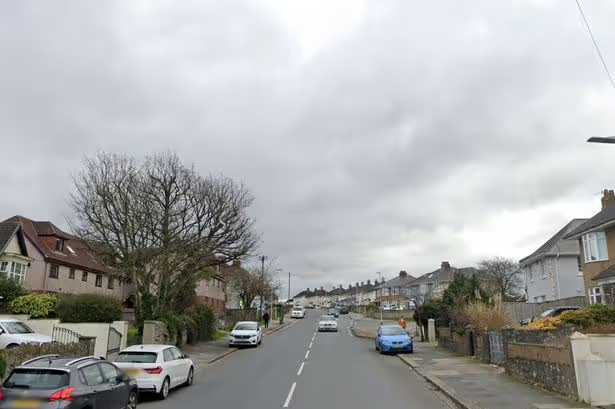
Efford Road, Plymouth, where no waiting at any time restrictions from the north side from its junction with Long Key for a distance of 22 metres in a westerly direction have been confirmed(Image: Google Maps)
Plymouth Live readers have heard that the City Council has brought in a series of new traffic regulation orders – changing parking rules and adjusting speed limits on several roads across the city.
The orders were officially made on 8 April 2026 under the Road Traffic Regulation Act 1984, following consultation with the Chief Officer of Police, and were published in The Herald.
Parking restrictions will be introduced or amended on a number of roads, while speed limits on sections of Jennycliffe Lane, Stamford Lane and Staddon Lane will be reduced from the national speed limit to 30mph.
The council says the changes include updated parking controls with details on exact locations, times and exemptions set out in the sealed orders and supporting plans. The measures form part of the wider Living Streets 8 scheme, aimed at improving traffic flow, road safety and encouraging walking and cycling.
The orders are already in place from 8 April 2026, with on street changes such as signs and road markings being rolled out afterwards.
Full details, including maps and legal documents, can be viewed on Plymouth City Council’s website or requested by phone. Residents also have six weeks from the date of the order to challenge its validity in the High Court if they believe proper procedures were not followed.
Commenter Mottsy asks: “I notice King’s Road is not included in the list, but the signs say permit parking only. Is this a permanent change or temporary, as it is not a residential area?”
Andy Batts adds: “It is fine to introduce parking restrictions in Flamsteed Crescent, but who will actually enforce them? What about King’s Tamerton Road as well? Residents are unable to park near their own garages, and pavements are often lined with cars during school drop off and pick up times. On some days, parents are even there before 2pm.”
Jannerspanner is convinced: “This all seems to be aimed at cyclists and doesn’t really look like it has much to do with safety. It feels more like it’s about promoting cycling than fixing any real safety issues for everyone using the road.”
Busa13 retorts: “In what way has anything mentioned in this report to do specifically for cyclists? If cars park dangerously on junctions and outside schools, then these ‘no parking restrictions’ are surely the only way to make the highway safe for everyone?”
Dis1954 thinks: “It feels like PCC is not really listening to local concerns and is instead pushing its own agenda. There is a sense that driving in the city is being made more difficult, without fully considering the wider impact such as increased congestion, longer journey times, or potential environmental effects from slower traffic.”
Madcaplaughsagain agrees: “It’s an interesting plan. Keep reducing speed limits so that it becomes quicker to cycle. Then reduce parking for cars by painting more double yellow lines. Maybe the millions spent on those empty cycle lanes might prove to be a good investment.”
AJGreen retorts: “I think the initiative is to make those who don’t behave, think. If people observed the rules of the road, there wouldn’t be a need for increasing enforcement.”
Di.Rad points out: “There is no need for extra traffic calming schemes when the roads are already in such poor condition. The potholes themselves are effectively forcing drivers to slow down anyway, so in some ways they are already acting as built in traffic control, just in a far from ideal or safe way.”
Plymouth Live readers, what do you think about these latest parking and speed limit changes? Are they a step in the right direction for safety and traffic flow, or will they cause more frustration for drivers and residents? Share your views in the comments.