I was wearing a T-shirt which displayed the six-word phrase which I can’t say, and I gave a speech using the six-word phrase which I can’t say.
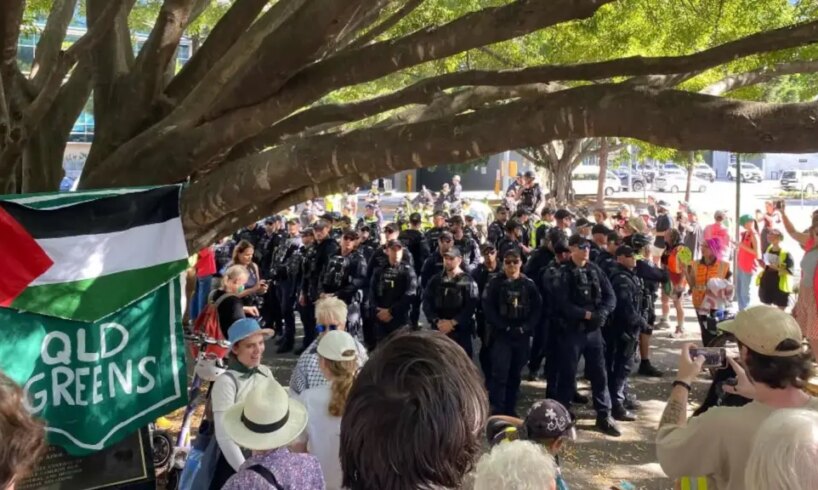
That was 73-year-old psychiatrist Stephen Heydt after his arrest along with 21 others during a rally in Brisbane on Saturday.
Heydt was, he explained, charged with two offences: once in relation to a T-shirt reading “Jews for a free Palestine from the river to the sea”, and again for uttering the same words.
Under the law now prevailing in Queensland, Heydt could, in theory, face two years in jail. The same penalty applies to the phrase “globalise the intifada” if used in a fashion deemed to cause “menace, harassment or offence”.
Australia is not alone in criminalising certain words referring to Israel’s genocide in Gaza. In the UK, the High Court recently overturned the prescription of Palestine Action as a terrorist organisation. But with the government appealing the decision, it remains illegal to voice support for the group — and so, on the weekend, the metropolitan police arrested more than 500 people for holding signs reading “I oppose genocide. I support Palestine Action.”
Meanwhile, in Germany, police have since October 2023 been regularly detaining pro-Palestinian activists for using certain phrases. “Stop saying the river sentence […]!” an officer warns a woman in a widely shared clip. “This sentence is forbidden!”
Related Article Block Placeholder
Article ID: 1242262
In the German context, a prohibition on certain sentences (in relation to genocide, no less) sounds particularly sinister. But we might also note that Australia has some form when it comes to the criminalisation of symbolic dissent, with the bans on Palestine solidarity echoing the equally absurd and authoritarian crusade against the red flag at the end of World War I.
Today, the Anzac celebrations generally ignore the wartime repression unleashed on the home front when Billy Hughes’ War Precautions Act gave the government sweeping powers to censor newspapers and arrest dissenters.
The labour movement’s celebration of the red flag (“raise the scarlet standard high”, etc etc) dates back to the French Revolution and the Paris Commune. But when the Melbourne Trades Hall hoisted the emblem from its turret in the aftermath of the uprising in Russia, the flag became the centre of what we would today call a culture war.
The Argus (basically, an earlier incarnation of The Australian, quite possibly involving the same columnists) led the way. “[T]he flying of the red flag,” it thundered, “proclaims that the Trades Hall has cut itself adrift from the British Empire”.
The Hughes government duly gazetted anti-flag regulations in August 1918, a measure widely understood as an attack on the whole union movement — so much so that Trades Hall briefly threatened a general strike.
Over the next years, a prolonged campaign of civil disobedience ensued, much of it led by activists from the Victorian Socialist Party. On October 7, 1918, for instance, The Argus reported how, on the Yarra Bank:
the red flag fluttered in the breeze, until [plainclothes constable] Kiernan took possession of it. There were a few hoots, and the crowd joined in singing “The Red Flag” … [T]he despoiled party obtained another red flag from somewhere and nailed it to a piece of moulding. This in turn was seized by [a] Senior constable … Still defiant, the red-flaggers obtained a wisp of red material and displayed that … in the slight skirmish which ensued, the substitute for a flag was trampled underfoot, much to the indignation of those who had displayed it.
From the perspective granted more than a century later, these farcical scenes — very reminiscent of the Queensland Palestine protests — look quaint, almost comical.
Related Article Block Placeholder
Article ID: 1214879
And yet, despite the risibility of the flag ban, standing against it required considerable courage.
Repeated defiance of the prohibition led to the poet RH Long’s detention in Pentridge for eight months in 1918 and 1919. The suffragette and socialist Jenny Baines served six months in jail for similar offences, during which she embarked on a hunger strike.
You can’t ban ideas. The prohibition of flags (which lasted until the repeal of the War Precautions Act in 1920) did not induce socialists to embrace capitalism, just as the illegality of certain phrases won’t make young people more enthusiastic about what B’Tselem calls a regime of apartheid “from the Jordan River to the Mediterranean Sea”.
Yet we might remember that when, in March 1919, members of Brisbane’s sizeable Russian émigré population marched with local radicals carrying socialist banners, anti-flag hysteria contributed to a counter-rally involving thousands of right-wing soldiers: a mobilisation that culminated in veterans attacking buildings associated with the Russians while chanting “Burn them out! … Hang them!” One Russian later described the so-called “Red Flag riots” as a “formal pogrom, exactly like the pogroms of Jews organised during the reign of the Czar”.
Government efforts to repress symbols might be futile, or even ludicrous. But that doesn’t mean that they’re not dangerous. Stephen Heydt’s reference to “the six-word phrase which I can’t say” epitomises the extraordinary damage that is being inflicted on the public sphere by a political class as it seeks to buttress support for Israel.