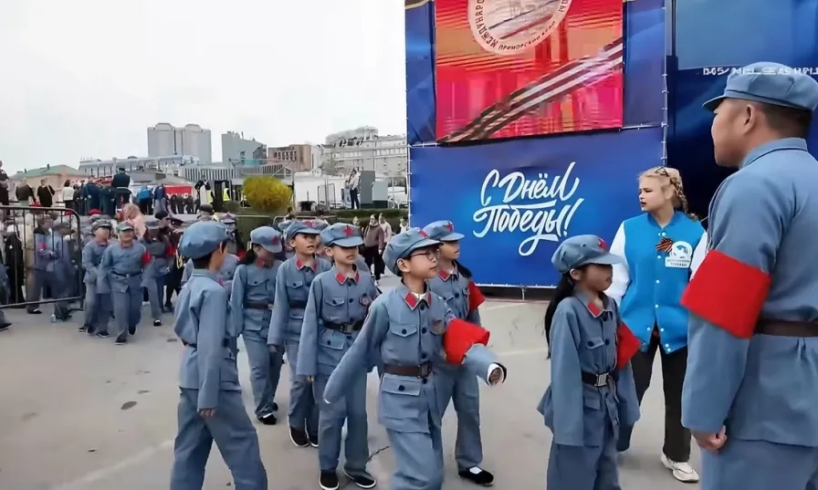
In early May, well before the respective visits to Beijing of American President Donald Trump and Russian President Vladimir Putin, online controversy erupted over Sputnik news agency footage of Chinese schoolchildren, clad in retro Red Army uniforms, marching in a Vladivostok parade in the run-up to Russia’s May 9 “Victory Day,” which commemorates the defeat of Nazi Germany in WWII. CDT editors observed unusually stringent censorship of the topic: of the 15 related articles we archived between May 4-12, at least a dozen were deleted, including one that quickly vanished from the People’s Daily website.
Chinese children, dressed in retro Red Army uniforms, at a celebration in Vladivostok prior to May 9 “Victory Day.”
Vladivostok, still referred to parenthetically on Chinese maps by the older name 海参崴 (Hǎishēncǎi), was once part of vast swaths of Outer Manchuria ceded by the Qing Dynasty to Tsarist Russia in the 1858 Treaty of Tianjin and the 1860 Convention of Peking. Following that transfer of territory, ethnic Chinese residents of the area suffered persecution that persisted even into the Soviet period. In the “Great Purge” of 1937-1938, for example, as many as 10,000 ethnic Chinese fled, disappeared, were sent to the gulag, died of overwork, or were executed. In 2009 and 2010, a highway construction project in Vladivostok unearthed a mass grave containing the historical remains of numerous Chinese who had been executed.
Many Chinese bloggers and commenters argued that in this context, it was deeply offensive to allow Chinese schoolchildren to be used as “props” in a Russian military parade in Vladivostok. Some critics described the spectacle as “dancing on their ancestors’ graves” and “forgetting where they came from.” As one widely circulated analogy phrased it: “It’s like if someone broke into your ancestral home, confiscated the house, and banished your ancestors, but generations later you decide to foot the bill to send your kids to the marauders’ commemoration.”
After a report by Xinhua’s Russian-language service confirmed that “young people from Yiwu, Zhejiang province” were among the participants, Chinese online sleuths pieced together clues to identify Maple Leaf School in Yiwu, Zhejiang province, as the likely organizer. In a now-deleted article, WeChat blogger Nande Jun wrote, “If this decision was made by a principal or leader, I would like to ask: Is that motto inscribed on your school wall—‘Never Forget Our National Humiliation’—just there for decoration?” In another deleted piece, former journalist Huang Zhijie, via his Wechat account Youyou Luming, expanded on the theme of wounded national dignity: “The previous generation was already humiliated, and now we’re sending the next generation over there to be humiliated too?” At the WeChat account 大江报馆 (Dàjiāng bàoguǎn, “The Great River [Yangtze] Gazette”), Gui Hong wrote a scathing takedown of using little kids to propagate a narrative of uninterrupted Sino-Russian friendship: “This bunch of six- and seven-year-olds, forced by grownups into military uniforms and sweating as they marched in formation, probably couldn’t even tell you when the ‘Great Patriotic War’ happened. But still, the little tykes were conscripted to serve as a ‘diplomatic image filters’ and ‘hostages for peace.’”
Even state-media outlet People’s Daily spoke out against the children’s participation in the parade. The People’s Daily “Safe Campus” section published an article that posed the question: “Who Are Chinese Children Cheering for on the Streets of Vladivostok?” Almost as soon as the piece was published, however, it was deleted by the outlet, with no explanation given. CDT has archived several WeChat posts, all of which were later censored, about the People’s Daily piece and its deletion. Blogger Mu Bai mentioned the People’s Daily piece in connection with two of his posts, critical of having Chinese students join in the parade, that were deleted after he became the target of a “complaint campaign” by a group of administrators and parents from the Maple Leaf School. Blogger Xu Peng, on his History Rhymes WeChat account, discussed the People’s Daily deletion and the heavy online censorship of the Vladivostok parade scandal. He also cautioned parents to think carefully before sending their kids on these sorts of propaganda trips, lest it tank their children’s future plans to study abroad in democratic countries.
In a slightly different take that was also scrubbed by platform censors, WeChat account He Liuwei argued against the practice of using schoolchildren to greet and offer flowers to visiting political leaders, including Donald Trump. “The spectacle of minors being trotted out to ‘adorn the lapels’ of political figures turns my stomach, and that reaction didn’t start with Trump,” wrote the author. “When I was a child I thought it odd, but by middle school (this was during the Cultural Revolution), I found it nauseating. Even back then, I told myself that if I ever had a child, I would never allow her to be selected for that ‘honor.’”
Many of the Vladivostok-themed deleted pieces we archived in May discussed double standards regarding former Chinese territories now occupied by Russia, and those occupied by Japan or other nations with whom the PRC has a frostier diplomatic relationship. Among the themes emphasized by online commentators were historical memory, historical nihilism, patriotism, the “national humiliations” of the past, and the elision of certain historical enmities to better align with the Party line on Sino-Russian “friendship with no limits.”
“When First-Graders Set Foot in the ‘Ruler of the East,’” a deleted long-form article from WeChat account 新观察笔记 (Xīnguānchá bǐjì, “Journal of New Observations”), references the history of Vladivostok and the colonial connotations of the name, which the author explains means “Lord of the East” or “Ruler of the East.” The author quotes this analogy: “It’s like someone telling you to your face, ‘Back then, I stole your house and changed the street address to MY HOUSE,’ and you nod and say, ‘That’s a nice name. It’s got a real sense of historical significance.” A portion of the article is translated below:
Now imagine the opposite scenario. What if there were a city in China named after one of the colonial-era Great Powers? Or what if one of the great powers of today were home to a city named “Vanquish Japan,” and they invited Japanese elementary school students to attend a military parade dressed in old Japanese Imperial Army uniforms? Just imagine the public reaction—you can be certain it would be very different from the kid-glove treatment we give Russia.
[…] Today, 160 years after the fact, [unequal] treaties can go unmentioned, historical enmities can be set aside, and it’s fine to say that we should focus on the future. But standing in the middle of a city whose name means “Ruler of the East,” listening to declarations like “Our heroes fought for your children!” feels a bit like this: several generations after your family was dispossessed of their ancestral home, the descendants of the occupiers invite your kids into their yard and dress them up in old military uniforms to help celebrate their historical “victory.” Call it what you will—friendship, exchange, or internationalism—but in this case, language obscures more than it reveals.
[…] It’s a truism that diplomacy requires pragmatism. International politics isn’t an ethics class, and realpolitik will always trump sentimental considerations. In the current geopolitical landscape, the strategic value of close Sino-Russian relations and coordination is self-evident, no one would deny that.
But being pragmatic doesn’t mean being craven.
[…] The term “double standard” couldn’t be more apt here. Ponder this simple question: If a Western nation were still holding military parades in a city ceded from China, and inviting Chinese children to attend and help commemorate a “just war” totally unrelated to that city’s cession, how do you think the Chinese public would react?
I don’t think I need to spell it out; you know as well as I do what the reaction would be. On some historical questions, our reaction is knee-jerk, a conditioned response. But when it comes to Russia, there are suddenly all sorts of justifications: “it was understandable,” or “grounded in practical interests,” or “it’s time to turn the page on that history.” That’s not diplomatic caution, it’s a double standard. These two very different reaction systems operate in parallel and no one thinks it strange, but it is our “dual-SIM” mentality that gives rise to such absurdities. [Chinese]
Another censored article referencing double standards in historical memory (and strongly condemning past Russian depredations) comes from WeChat blogger Mu Bai: “To the Organizers Who Sent Elementary School Students to Vladivostok’s Victory Day Celebration—Have You No Shame?” A brief excerpt:
We often call for others to “remember history” and “not let our national humiliation be forgotten,” but the reality is that not many young people, it seems, remember the evil country that did the most harm to China.
As such, I would like to ask: Which country occupied and partitioned the most Chinese territory, slaughtered the most Chinese people, and caused Outer Mongolia to split off from China? Which country was constantly stirring up trouble and harassing the People’s Republic of China during its most challenging early years? Which country used nuclear coercion against our nascent, struggling nation?
How many of this generation know that Lake Baikal, the world’s largest freshwater lake by volume, is the place where Su Wu once herded sheep, a story you studied in school? It is Russian territory now.
If these things are not remembered, history becomes meaningless. [Chinese]
Nor is this the first time that the topic of historical memory about Vladivostok has encountered censorship on the Chinese internet. In a deleted post from May of 2024, WeChat account Sichuan River Tales featured a screenshot of a poster from a Chinese travel agency advertising a package tour to that city, and asked: “Should We Really Be Flagrantly Promoting Tours to View the Military Parade in Vladivostok?” A portion of that post is translated below:
In light of this history, some have questioned whether it is appropriate to travel to Vladivostok to attend the [May 9 Victory Day] military parade. They point out that when two young Chinese women danced in the street wearing Japanese kimonos, they were met with public outrage, whereas there are now tourism posters exhorting Chinese people to travel abroad to experience a foreign military spectacle on what was originally Chinese territory. This contrast is difficult to reconcile.
A photo circulating online shows several Chinese students displaying a Chinese flag atop Mount Fuji, an act that resonated with many in China. Therefore, some feel that Chinese tourists visiting Vladivostok should also display Chinese flags to express their love for the motherland, and that such courage would be commendable. [Chinese]
A travel company poster from two years ago, promoting a four-day tour to view Vladivostok’s May 9 Victory Day Parade, features ranks of smiling, blue-uniformed, rifle-toting soldiers.
Lastly, a now-deleted article from WeChat account Atypical Buddhist, “Someone Please Save Those Chinese Elementary School Students in Vladivostok,” discusses the history of Vladivostok, how it became Russian territory, the persecution of ethnic Chinese that followed, and the dangers of historical nihilism and “selective editing” of history. The author saves their strongest criticism for those who would leverage Chinese schoolchildren as political pawns and allow their minds to be warped by militaristic displays celebrating a one-sided view of history. The piece ends with a paraphrase of the famous last line (“Save the children …”) of Lu Xun’s 1918 short story “Diary of a Madman”:
We’re always saying we ought to remember history, and that we shouldn’t fall into historical nihilism, and that forgetting history is tantamount to treason. So when we send our schoolchildren to be used as backdrop scenery at a site of our national humiliation, what does that do to their impressionable young minds? Does it imbue them with a sense of “co-prosperity,” of shared glory?
Children are taught to remember some of the humiliations inflicted on their ancestors, but to forget others. Such selective editing of historical memory is a kind of sin. One moment we’re told to bury the hatchet, the next we’re told to never forget the humiliations our nation suffered. This back and forth “sit-up approach” to history leaves people deeply confused.
[…] But children lack this capacity [to judge for themselves how to reconcile history with the present moment]. Ritual works by leveraging atmosphere, symbols, and collective spaces to subtly shape our emotions and memories. Uniforms and orderly ranks of marchers serve to further immerse us in the “monumental” occasion, the environment exerting a subconscious influence and obviating our need to think. Children understand none of this, yet it pulls them into a visceral state of reverence and solemnity that allows certain objects and images to be imprinted onto their minds. In these children’s memories, Vladivostok will forever be associated with victory and friendship, erecting a psychological barrier against the humiliations of the past.
[…] It is the responsibility of educators to spare children from having to perform “historical sit-ups,” to ensure they have sufficient access to information, and that they are able to think independently. But instead, they’ve sent our kids to Vladivostok to take part in a military revue, to serve as props, and to have others’ ideas implanted in their subconscious. Do we really want them to inherit the “Soviet fetish” of their grandparents’ generation? Someone, please … save the children. [Chinese]