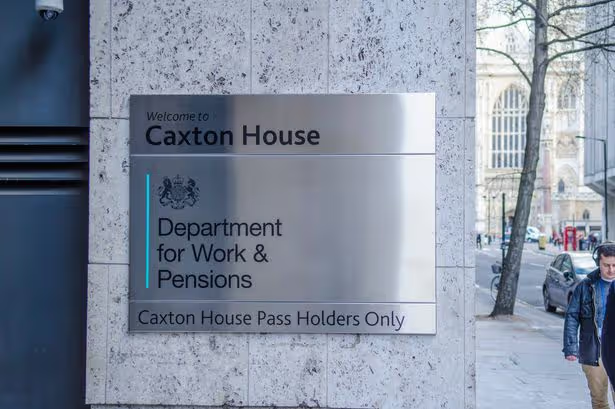
New guidance from the Department for Work and Pensions (DWP) sets out stricter penalties for benefit fraud, with claimants potentially losing payments for up to three years – and facing court or a prison sentence in the most serious cases
Linda Howard Money and Consumer Writer and Ashlea Hickin Content editor
20:36, 27 May 2026
People found to have committed benefit fraud could see payments reduced or stopped entirely, even for a first offence, under revised DWP rules(Image: William Barton via Getty Images)
Individuals receiving benefits could see their payments suspended for months or even years if found guilty of fraud, under new guidance issued by the Department for Work and Pensions (DWP).
The updated regulations reveal that even a first-time offence can result in benefit payments being halted for 13 weeks, with more severe sanctions for subsequent violations or particularly grave cases. A ‘loss of benefit’ penalty may be imposed when someone is convicted of benefit fraud, accepts a caution, or agrees to settle an administrative penalty rather than facing court proceedings.
For an initial offence, claimants may have their benefits suspended for 13 weeks – an increase from four weeks. A second violation committed within a five-year period can trigger a 26-week suspension.
Should a third benefit fraud offence occur within five years of the second (and within 10 years of the first), and the third offence leads to a conviction, the loss of benefit penalty will extend to three years.
In particularly severe instances, such as organised fraud or using someone else’s identity, the maximum three-year penalty can be imposed straightaway, reports the Daily Record.
Nevertheless, the regulations also clarify that not all benefits will necessarily cease entirely. Where a person receives multiple benefits, the DWP may alternatively reduce other payments to enforce the penalty.
Independently of the loss of benefit penalty, anyone found to have committed fraud will typically be required to repay any overpaid sums in full. Offenders may also be hit with further financial penalties. In certain instances, the DWP can propose an administrative penalty instead of prosecution, typically amounting to up to 50 per cent of the overpayment, with a maximum limit of £5,000.
Even agreeing to this form of penalty can still result in a separate loss of benefit sanction for a four-week period.
For more severe violations, proceedings can be brought before the courts, where individuals could face heftier fines or, in the most extreme circumstances, imprisonment.
The DWP states that benefit fraud encompasses deliberately supplying false information, neglecting to report a change in circumstances, or claiming support to which someone is not entitled.
Which benefits can be reduced or stopped?
The following benefits can be reduced or stopped as a penalty for benefit fraud:
Carer’s AllowanceEmployment and Support AllowanceIncapacity BenefitIncome SupportIndustrial Death BenefitIndustrial Injuries Disablement BenefitIndustrial Injuries Reduced Earnings AllowanceIndustrial Injuries Retirement AllowanceIndustrial Injuries Unemployability SupplementJobseeker’s AllowanceSevere Disablement AllowanceHousing BenefitPension CreditUniversal CreditWar Disablement PensionWar Widow’s PensionWar Pension Unemployability SupplementWar Pension Allowance for Lower Standard of OccupationWidowed Mother’s or Widowed Parent’s AllowanceWidow’s Pension or Bereavement AllowanceWorking Tax Credit
The DWP clarified that the following benefits cannot be reduced or stopped as a penalty in their own right, but if they are implicated in benefit fraud, any benefit listed above may be reduced or stopped as a penalty instead.
Attendance AllowanceBereavement PaymentChild BenefitChild Tax CreditChristmas BonusConstant Attendance AllowanceCouncil Tax BenefitDisability Living AllowanceGraduated Retirement BenefitGuardian’s AllowanceIndustrial Injuries Constant Attendance Allowance (if a Disablement Pension is payable)Industrial Injuries Exceptionally Severe Disablement Allowance (if a Disablement Pension is payable)Personal Independence PaymentState PensionSocial Fund paymentsWar Pension Constant Attendance AllowanceWar Pension Exceptionally Severe Disablement AllowanceWar Pension Mobility Supplement
Claimants are advised to maintain accurate records and report any change of circumstances without delay.
Anyone uncertain about their situation or concerned they may have made an error is encouraged to contact the appropriate department or seek independent advice.