Dennis Hull was feared throughout the hockey world for his rapid-fire barrage.
And that was just for his jokes. He also had a wicked slapshot.
Open this photo in gallery:
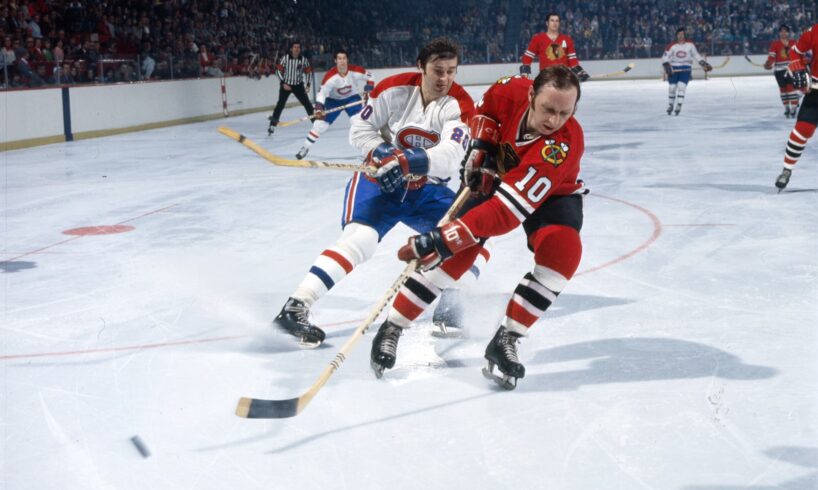
Chicago Black Hawks forward Dennis Hull, right, pursues the puck against the Montreal Canadiens in the 1973 Stanley Cup final.James Drake/Getty Images
Mr. Hull was the brother of one superstar (Bobby) and uncle to another (Brett). In self-deprecating fashion, he titled his memoir, The Third Best Hull, with a kicker of a subtitle: I Should Have Been Fourth But They Wouldn’t Let My Sister Maxine Play.
The rollicking left winger, who has died at 81, put aside his hockey stick for a comedy schtick as a much-in-demand banquet speaker. At the lectern, the bullet-headed jokester resembled Don Rickles, firing zingers and one-liners that as often as not targeted his own shortcomings.
Mr. Hull once served as guest speaker at a dinner honouring broadcaster Don Cherry. Introduced by Ron MacLean, Mr. Cherry’s television partner, Mr. Hull reached into a jacket pocket for his speaking notes while saying with great sincerity, “Thank you very much, whoever you are.”
After acknowledging the audience’s likely disappointment that it was him appearing and not one of his more famous relatives, Mr. Hull continued: “I haven’t been around the National Hockey League since 1979. In those intervening years I’ve been to 600 banquets and five of Bobby’s weddings. Since there’s no one here in a white dress, I guess this is a banquet.”
Noting his nephew Brett had signed a contract worth US$2-million a year, Mr. Hull said: “They’re making a big deal about that. I didn’t think it was any big deal. In 1972 with the Blackhawks, I signed a contract for $2-million a year.” He paused. “I just couldn’t get those … Blackhawks to sign it.”
He said Mr. Cherry was once asked how Toronto got the puck out of its own end.
“Usually by facing off at centre [ice],” Mr. Cherry is said to have responded, meaning they had surrendered a goal.
“Nice outfit, Don,” Mr. Hull complimented his target, known for his flamboyant wardrobe. “It pays to be at the circus when a clown dies.”
“I told Don that if he was ever in my neighbourhood and passed my house,” he said, “I’d appreciate it.”
Claude Lemieux won four Stanley Cups by any means necessary
For all his self-deprecation about his own skills, Mr. Hull enjoyed a solid NHL career, all of it in the shadow of his more famous brother.
When given a rare chance to skate away from that shadow, during the famous 1972 Summit Series against the Soviet Union, the younger Hull made the most of the opportunity.
Dennis William Hull was born in the company town of Point Anne, Ont., on Nov. 19, 1944, to Lena Marguerite (née Cook) Sills, a widow, and Robert Edward Hull, a widower. The senior Hull, a labourer who became a foreman at a Canada Cement Company plant, was a notable amateur hockey defenceman in the Belleville area where he was known as the Blond Flash.
The couple raised 11 children – Laura, Barbara, Jacqueline, Maxine, Robert, Carolyn, Ron, Garry, Dennis, Judy and Peggy – in a company-owned house near an inlet on the Bay of Quinte off Lake Ontario. From freeze-up to spring thaw, all the children skated and played hockey on the inlet. Within the family, the eldest brother was called Robert, never Bob or Bobby, while the youngest was called Den; he wore his sister’s hand-me-down white tube skates. In summer, he practised firing a puck placed on a piece of linoleum on the road. His target: a cement garage about 18 metres away.
At 14, Bobby Hull played with his father on the Point Anne Cementmen in the Trent Valley Hockey League. Bobby made his NHL debut with the Chicago Blackhawks (then rendered as Black Hawks) shortly before Dennis’s 13th birthday. In his third season, Bobby led the league in goals and points with a reputation as the most exciting left winger in league history. He was dubbed the Golden Jet.
Dennis played junior hockey in St. Catharines, where he was taunted even by home fans for not being as good as his brother. In 1964, Dennis made the Chicago roster, wearing sweater No. 10 to his brother’s No. 9. The Golden Jet was joined by the Silver Jet.
In a game against Detroit, the 19-year-old rookie recalled being ordered by coach Billy Reay to “get out there and watch [Gordie] Howe.”
“It wasn’t really necessary,” he would tell a banquet audience years later. “I was pretty sure I could see him well enough from the bench.”
Open this photo in gallery:
Dennis Hull takes to the ice for a ceremony in his honour at a Blackhawks game in 2019.Matt Marton/The Associated Press
While less dynamic a playmaker than his brother, Dennis also had a booming shot and a knack for scoring, though not as frequently. “Bobby could shoot a puck through a car wash without it getting wet,” he said in his memoir, written with Robert Thompson. “I couldn’t hit the car wash.”
Another joke Mr. Hull told about himself was asking goaltender Glenn Hall if it was true he got sick to his stomach before every game.
“Only since you joined the team,” the veteran replied.
He noted fans in Chicago were disappointed Dennis was not as good as Bobby. “Of course,” he wrote, “I was disappointed by that too.”
In his third season, he scored 25 goals, an accomplishment in the NHL before the league doubled with expansion before the 1967-68 season. He scored 30 or more goals in four seasons, including a career-high 40 goals in 1970-71.
By then, he was a regular on a line with centre Pit Martin and right winger Jim Pappin. The trio were dubbed the MPH Line from the initial letter of their surnames.
After 13 seasons in Chicago, Mr. Hull was traded to the Detroit Red Wings, where he played one final, undistinguished season except for scoring his 300th career goal.
In 959 regular-season games, he scored 303 goals with 351 assists. He added another 33 goals and 34 assists in 104 playoff games.
Paul Boutilier was a fan favourite in Nova Scotia
While brother Bobby won a Stanley Cup in 1961, Dennis never got his name on the storied trophy. He skated in the finals in 1965, 1971 and 1973, losing each time to the Montreal Canadiens.
He played in five All-Star games and was named to the NHL’s Second All-Star team in 1973 behind left winger Frank Mahovlich of the Canadiens.
In the Summit Series against the Soviet Union, Bobby Hull was barred from playing for Team Canada by NHL owners for the apostasy of having jumped to the rival World Hockey Association. A “To Russia with Hull” campaign failed to get him included on the roster.
Dennis Hull considered dropping out until his brother convinced him to take part.
“I just came along to represent the family,” he told sports columnist Jim Coleman, adding he was surprised to have been included.
The younger Hull played on a line with Jean Ratelle and Rod Gilbert, both of the New York Rangers, scoring two goals with two assists in four games, including an assist on Brad Park’s tying goal in the first period of the historic Game 8 in Moscow. Paul Henderson’s goal with 34 seconds remaining gave Canada the win in the game, by a 6-5 score, and the series, 4-3-1.
On reunions in Canada, Mr. Hull liked to tease Soviet goalie Vladislav Tretiak that he would never have been invited back to North America and celebrated had the Soviets won the series. By surrendering that last-minute goal, the goalie achieved fame in the hockey world.
“I said to him that if he had stopped it, he’d probably be a cab driver in Moscow today,” Mr. Hull said.
Open this photo in gallery:
Dennis Hull, centre, and Summit Series teammate Phil Esposito, right, greet acclaimed Russian goaltender Vladislav Tretiak at a 2012 exhibition game in Moscow.Grigory Dukor/Reuters/Reuters
After retiring from hockey, Mr. Hull earned a degree in European history and physical education from Brock University in St. Catharines. He taught history and coached the hockey team at Ridley College, a private preparatory school in the same city. Later, he became athletic director at the Illinois Institute of Technology in Chicago.
He spent one season as a colour analyst for San Jose Sharks broadcasts.
When not raising purebred Herefords on a farm in Ontario, Mr. Hull built a career as an after-dinner speaker, attending as many as 100 banquets each year.
Sometimes, he combined his two professions. One of his standard jokes: “A couple of months ago, my wife Janet said, ‘I think you love those cows more than you love me.’ I said, ‘Yeah, but I love you more than the chickens.’”
Mr. Hull joined his brother among the inaugural inductees to the Belleville Sports Hall of Fame in 1987.
Mr. Hull died at Belleville General Hospital on May 30. He was predeceased by his wife, Janet. He was also predeceased by four sisters and two brothers, including Bobby Hull, who died in 2023, aged 84. He leaves a son, John, and a daughter, Martha, as well as four grandsons.
In 1976, Mr. Hull returned to action following medical treatment for hemorrhoids. In a possibly apocryphal anecdote, it is said a fan broke the silence during a lull in play by yelling, “Hey, Hull. How went the brain surgery?” His teammates on the ice laughed so hard they had to make a line change.
You can find more obituaries from The Globe and Mail here.
To submit a memory about someone we have recently profiled on the Obituaries page, e-mail us at obit@globeandmail.com.