SYDNEY – Australia agreed on July 9 to sell India uranium, with the leaders of both countries committing to closer defence and energy cooperation in the face of shared concerns about China’s military rise.
After signing the uranium deal during a meeting in Melbourne, visiting Indian Prime Minister Narendra Modi said Australia presented “historic opportunities” to aid his country’s transition towards clean energy, while meeting its growing energy needs.
Australia, which has the world’s largest uranium reserves, could help India boost its nuclear energy output as it develops power-intensive data centres.
“Our partnership has never been stronger,” Australian Prime Minister Anthony Albanese told reporters at a joint press conference. “Australia’s relationship with India has never been more consequential than it is today.”
He added: “The arrangement facilitates Australian uranium exports to India to help increase the share of non-fossil fuel power capacity, providing an additional market for the Australian resources sector.”
Australia ended a ban on uranium exports to India in 2014 but exports have been slow. This is believed to be due to Australia’s strict safeguards. Australian uranium supplies to India can be used only for civilian purposes.
The government did not say what the new export arrangements involve, but an industry source told The Straits Times they include clearer safeguards around India’s use of the uranium.
An expert on India-Australia ties, Pradeep Taneja from the University of Melbourne, told The Straits Times that India has been importing uranium from Russia but may be seeking a more secure source in the light of disruptions to Russian trade since its invasion of Ukraine.
“Indian demand for power is growing very fast,” he said. “India is looking at the possibility that the tech boom is over and encouraging data centres. Nuclear energy will be an important part of its mix but it wants to reduce its reliance on Russia.”
The uranium deal comes as the two countries develop closer ties amid concerns about the regional impact of China’s growing military strength. India and Australia are members of the Quadrilateral Security Dialogue, a grouping that also includes the United States and Japan and has been widely seen as an attempt to counter China’s growing regional clout.
A new defence cooperation deal announced by Modi and Albanese on Thursday committed to expanding defence exercises, consulting on significant developments in the Indo-Pacific and boosting information-sharing between their militaries. The deal said the leaders “note with concern geostrategic uncertainty, and threats to regional peace and stability”.
Referring to a Chinese missile test in the Pacific on July 6, Australian Defence Minister Richard Marles told ABC Radio on Thursday that both countries shared concern about the growing range of China’s missile capabilities. He said building defence ties with India was “a critical part of how we are responding to our strategic landscape”.
“There is definitely a shared sense of concern about China testing a long-range missile capability,” he said.
Modi was due to leave Australia on Friday after three days in Melbourne, where he also attended a “Melbourne meets Modi” event at a stadium on Thursday night – with nearly 30,000 people in attendance.
India is currently the largest source of permanent migrants to Australia, ahead of China, the Philippines and the United Kingdom. About one million of Australia’s 28 million residents have Indian ancestry.
Albanese and Modi also agreed to fast-track plans for a wide-ranging free trade pact that would expand on a limited agreement reached in 2022, a deal that has led to an 86 per cent increase in trade. India is Australia’s fifth-largest trading partner with two-way trade worth A$50 billion (S$45 billion) in 2025, fuelled by Australian coal exports to India.
Modi told reporters on Thursday the new agreement would be “balanced, ambitious and win-win for both countries”.
Australia has about a third of global uranium reserves but is only the world’s fourth-largest producer, largely due to bans by several states on uranium mining.
Australia’s expanded uranium supplies are set to help India boost nuclear energy generation from 8 gigawatts to a target capacity of 100 gigawatts by 2047.
Tania Constable, who heads the Minerals Council of Australia, an advocacy group for the mining sector, said supplying uranium to India was an “immense opportunity” but Australia would need to boost its production.
She said state governments in New South Wales, Queensland and Western Australia should lift their bans on mining.
“Australia should be given every opportunity to grow its already strong minerals trade with India… by backing our uranium miners to help deliver reliable, zero emissions energy,” she said.
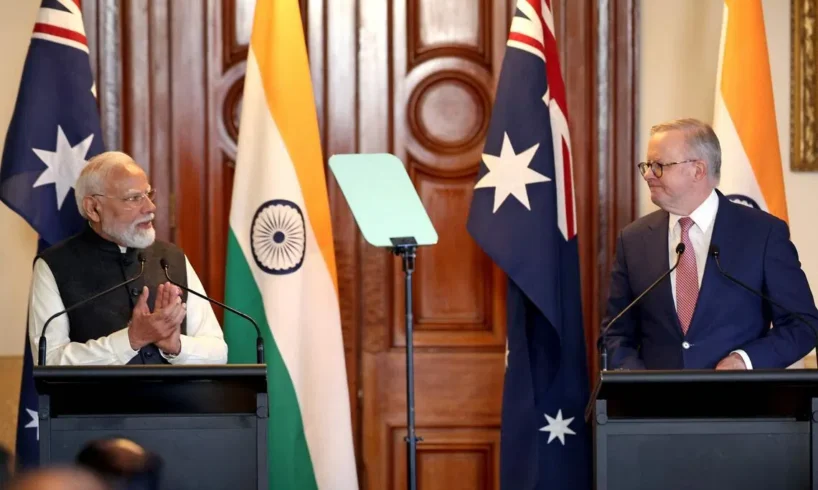
Australian PM Anthony Albanese (right) and Indian PM Narendra Modi attend a community event at Docklands Stadium in Melbourne, on July 9.
PHOTO: AFP
Taneja said Australia’s potential role as a vital supplier of uranium to India would further strengthen ties between the countries. While Modi and Albanese did not specifically mention China during their public appearance on Thursday, Taneja said China was “the elephant in the room”.
“Uranium is a strategic commodity – if India is reliant on Australia as a source for uranium, it will help in building trust in the relationship,” he said.
“China has brought Australia and India much closer, the United States and India much closer, Japan and India much closer. India has been seen as a natural counterweight to China, and India needs to work with like-minded countries.”