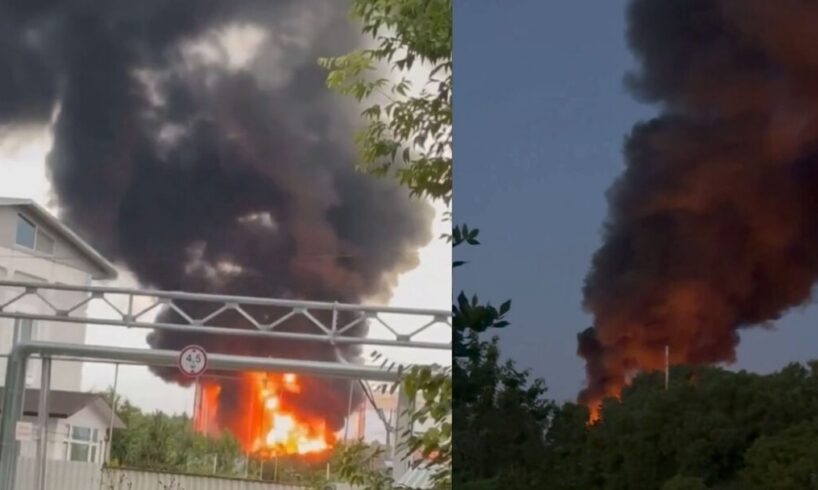
Ukrainian drones struck oil depots in Russia’s Tver Oblast and Stavropol Krai overnight on 9 July, setting fuel tanks ablaze at both, regional officials and OSINT analysts reported. Ukraine’s SBU security service confirmed the strikes, and monitors separately reported a hit on one of Russia’s three largest refineries. Ukrainian President Volodymyr Zelenskyy called the attacks part of Ukraine’s “long-range sanctions plan.”
Ukraine’s deep-strike campaign targets Russian fuel to choke the army’s logistics and the oil revenue funding the invasion. The General Staff said earlier that the campaign has knocked out 42% of Russia’s refining and cost the industry $13.5 billion since August 2025, pushing fuel rationing into most Russian regions.
Tver depot burns despite anti-drone nets
Tver Oblast head Vitaly Korolyov confirmed a fire in one reservoir of the “Tver oil depot” after what he called the repelling of a drone attack. Astra analyzed eyewitness footage and identified the burning site as the main depot of Tverneftprodukt, a subsidiary of Surgutneftegaz. The company stores and dispenses gasoline and diesel, supplying its own network of 52 filling stations and wholesale buyers across Tver Oblast.
Pre-strike satellite image shows protective nets over the fuel reservoirs of the Tverneftprodukt oil depot in Tver, Russia. Photo: Astra
Satellite images taken before the attack show protective nets over part of the reservoirs, Astra noted. The netting did not save the depot: at least one tank burned in its southwestern section. Monitoring channel Supernova+ also tracked the fire, and Exilenova+ published footage of thick black smoke over both struck depots.
Stavropol fire reaches the fuel tanks
In Stavropol Krai, southern Russia, Astra’s initial analysis pointed to the Lukoil-Yugnefteprodukt depot in Mikhaylovsk. The outlet then refined its conclusion: the burning site is a separate, larger depot in the hamlet of Vyazniki, 1.3 km away — a major rear hub for receiving, storing, and shipping diesel and gasoline, built around a tank farm with a loading rack.
Governor Vladimir Vladimirov confirmed the strike on Vyazniki. The fire intensified by around seven in the morning and reached reservoirs holding flammable materials, he said, prompting the evacuation of residents from an adjacent street to temporary shelters.
Black smoke rises over the oil depot in Vyazniki, Stavropol Krai, Russia, after a Ukrainian drone strike, 9 July 2026. Photo: Exilenova+
Kirishi refinery reportedly hit
Supernova+ reported a strike on the Kirishinefteorgsintez (KINEF) refinery in Kirishi, Leningrad Oblast, citing local accounts. KINEF ranks among Russia’s three largest refineries, processing 20–21 million tons of oil a year — over 6% of the country’s total refining. Governor Aleksandr Drozdenko claimed air defenses downed one drone and denied casualties or damage. Russia’s defense ministry claimed to have intercepted 73 drones over 11 regions and occupied Crimea overnight.
Oil depot near Stavropol, southern Russia, is burning after a Ukrainian attack
Last night, Ukrainian forces struck several more fuel facilities across Russia.
📹 Exilenova+ pic.twitter.com/auygcE4wjX
— Euromaidan Press (@EuromaidanPress) July 9, 2026
SBU and Zelenskyy confirm the depot strikes
The SBU confirmed that it hit two Russian oil infrastructure sites: the Krasnaya Zarya depot in Tver Oblast, 520 km from Ukraine’s border, and the Stavropolskaya depot in Stavropol Krai, over 500 km out. Both handle gasoline and diesel. The agency called the operation part of its systematic work against the Russian oil sector, a key source of war financing.
Explore further
Russia’s refinery in Saratov, two in Tatarstan, a pumping station in Bashkortostan — one night’s oil target list
Zelenskyy confirmed the strikes.
“Our warriors are carrying out the long-range sanctions plan in response to Russia dragging out the war and continuing its attacks,” he said.
Explore further
Three days, 21 ships: Russia’s Azov Sea fuel run to occupied Crimea is turning into a shooting gallery
He added that Ukraine’s Defense Forces also hit a reserve fuel storage site about 800 km from the front, an oil loading terminal in Rostov Oblast, and the pumping station near Ufa struck a day earlier.
“We offered Russia a way to end this war long ago, and every day it chooses to prolong it should bring the reality of war back to where it began – to Russia,” Zelenskyy said.