2026-07-10T05:44:47+00:00
font
Enable Reading Mode
A-
A
A+
Shafaq News- Najaf/ Karbala
The funeral processions held for Iran’s late
Supreme Leader Ayatollah Ali Khamenei in the Iraqi holy cities of Najaf and
Karbala on Wednesday carried political as well as religious messages, Iraqi
analysts told Shafaq News.
On the same day, Communications Minister Mustafa
Sanad ordered the issuance of a postal stamp commemorating the funeral, a
formal state gesture memorializing the late Iranian leader on official
government issue.
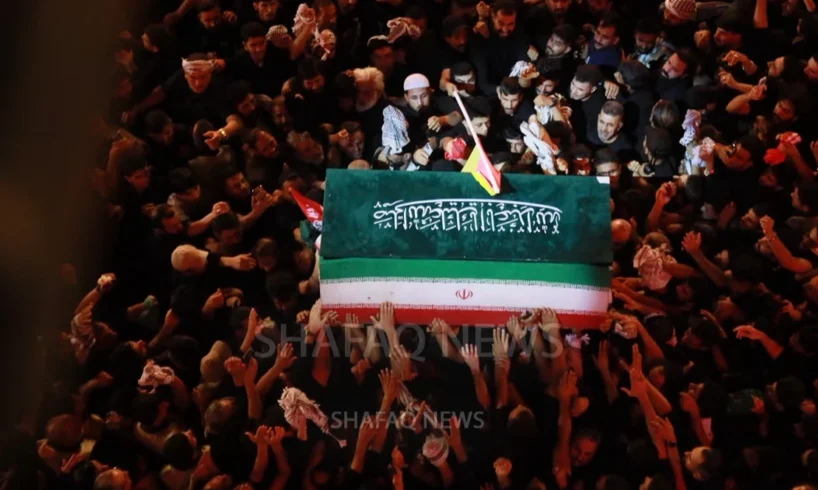
The scale of the turnout was itself the message.
Ihsan al-Awadi, director of the Iraqi Prime Minister’s Office and chair of the
committee overseeing the funeral, said preliminary unofficial estimates placed
attendance above 10 million across the two cities. The Popular Mobilization
Forces (PMF), a state-linked umbrella of predominantly Shiite armed factions,
put participation in Najaf alone at more than 3.8 million and said it had
deployed over 25,000 personnel along the route.
Iran’s supreme leader holds both religious and
political authority, which made the funeral a significant political event as
much as a religious one, said Kadhim Yawar, a researcher specializing in Iraqi
and regional strategic affairs. Staging the ceremonies in Najaf and Karbala,
two of Shiite Islam’s holiest cities, was intended to show that “Iran
continues to enjoy support among Shiite communities across the region,”
sending a message to the United States, Europe, Gulf states and regional audiences,
he said.
Yawar added that the choice of the two cities
was critical to generating the turnout, given their religious standing and the
millions of pilgrims they draw each year, and argued that comparable crowds
could not have been produced elsewhere in Iraq. He also noted that images of
the crowds served a domestic purpose, “reinforcing the Iranian government’s
narrative of public unity during a period of heightened regional tension, and
said there was no precedent in Sunni or Shiite jurisprudence for funeral
ceremonies of this scale held months after a death.
The breadth of official Iraqi attendance
projected cross-sectarian reach, drawing former Prime Ministers Mohammed Shia
al-Sudani and Nouri al-Maliki, leader of the State of Law coalition, alongside
Ammar al-Hakim, leader of the al-Hikma Movement, a Shiite political party, and
Mohamed al-Halbousi, a Sunni former speaker of parliament. Yet the government
also set limits: it barred senior commanders of Iran’s Islamic Revolutionary
Guard Corps (IRGC), including Quds Force commander Esmail Qaani, from the
official ceremonies and confined the official program to Najaf and Karbala.
Grand Ayatollah Ali al-Sistani, Iraq’s highest
Shiite religious authority, was absent due to health concerns. His
representative, Sheikh Abdul Mahdi al-Karbalaei, led the prayers in Karbala,
while his Baghdad representative had earlier encouraged followers to attend as
a gesture of “respect for a leading religious figure” rather than an expression
of political alignment with Tehran.
According to Mohammed al-Talqani, an Islamic
researcher, the ceremonies carried two principal messages: that Khamenei
embodied both political leadership and religious authority, and that the
turnout was meant to demonstrate continued public backing for Iran’s leadership
despite pressure from the United States, days before Ali al-Zaidi is scheduled
to travel to Washington, his first visit as prime minister.
Read more: Iraq’s al-Zaidi rebalances Iran ties before Washington visit