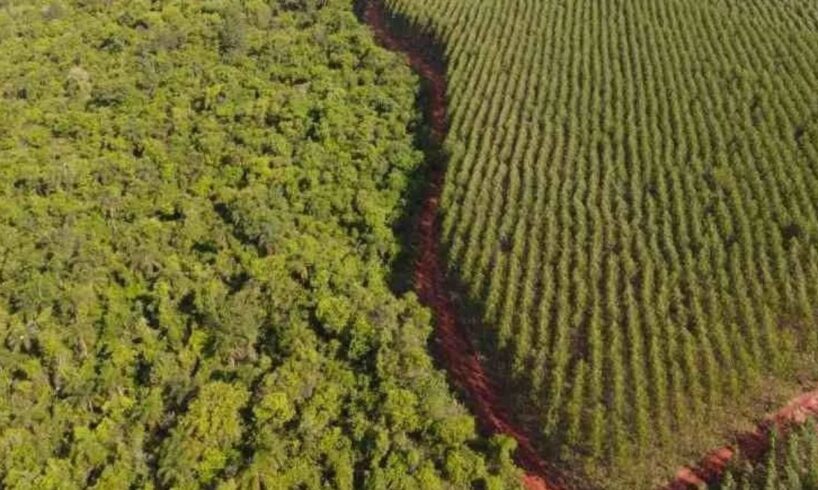
Driven by the high productivity of eucalyptus and billion-dollar investments, Brazil’s planted forest sector broke records in the production of pulp, paper, and wood panels, generated hundreds of thousands of direct jobs, and established itself as a silent powerhouse of the national economy and industry
When talking about wealth that comes from the land, almost no one thinks of trees planted in rows, but they drive a fortune in Brazil. The planted forest sector has become an economic giant. According to CNN Brasil, Brazil’s planted forest sector generated a gross revenue of 240 billion reais, breaking historical records and establishing itself as one of the engines of the national economy. It’s money that literally grows from planted trees.
And the base of this business is a planting area that keeps growing. According to Mais Floresta, Brazil reached 10.52 million hectares of trees cultivated for industrial purposes in 2024, an increase of 2.8% compared to the previous year. It’s a vast territory covered by planted forests from end to end of the country.
Eucalyptus and pine: the trees that sustain the sector
Two species dominate this sea of planted trees in Brazil. One of them reigns supreme. According to Mais Floresta, eucalyptus occupies the majority of the area, with about 8.1 million hectares planted, while pine appears as the second main crop, with 1.9 million hectares. Together, these two trees form the backbone of the country’s planted forests.
ARTICLE CONTINUES BELOW
See also
He bought a Bugatti Veyron Grand Sport for a price well below market value and, instead of leaving it in the garage, drove 4,000 kilometers to uncover all hidden defects; the inspection found issues that could result in a budget exceeding $200,000, but his decision surprised even Bugatti specialists.
The truck market hit the brakes in Brazil: sales of the road giants plummeted by almost 20% in 2025 and ended the year at just over 71,000 units, contrasting with the rest of the automotive sector.
A mother of seven children had only $5 to feed the family, bought ingredients for cupcakes, accepted an order for 600 units, and turned the kitchen improvisation into a multimillion-dollar brand in the USA.
A woman transformed a degraded area of just 4 hectares into a reference for family farming, diversified production with fruits, vegetables, cassava, and annatto, created an agribusiness to supply schools, and won the Sebrae Business Woman Award by proving that a small property can also thrive in agribusiness.
And Brazilian eucalyptus has an advantage that is the envy of the entire world. According to CNN Brasil, eucalyptus cultivated in Brazil achieves an average productivity of 34.4 cubic meters per hectare per year, one of the highest growth rates in the world. Here, the tree grows faster than almost anywhere else, which lowers the cost of wood and gives the sector a competitive edge.
What planted forests produce in Brazil
All this wood turns into high-value products, and Brazil is a champion in one of them. According to CNN Brasil, pulp production reached 25.5 million tons, an absolute historical record that keeps Brazil in second place worldwide in the production of this input. It’s the raw material for the world’s paper coming, in large part, from Brazilian planted forests, and it’s also what drives the sector’s economy the most.
But cellulose is not the only highlight of this industry. According to CNN Brasil, the sector also produced 11.3 million tons of paper and 9.7 million cubic meters of wood panels, numbers that reinforce the industrial strength of planted forests in Brazil. From the notebook paper to the furniture panel, much of everyday life begins with one of these trees.
This production chain transforms trees into exports and domestic consumption at the same time. Brazilian cellulose supplies paper factories worldwide, while wood panels feed the furniture and construction industries within the country. It is a sector that unites the external and internal markets with the same renewable raw material from planted forests.
How many jobs do planted forests generate
Besides revenue, the planted forest sector is a job-generating machine throughout the interior of Brazil. And the numbers are impressive. According to CNN Brasil, the sector generated 717.9 thousand direct jobs, and, adding direct and indirect positions, this total jumps to about 2.8 million jobs in the country. Millions of people live, in one way or another, from planted trees.
This volume of jobs has a special impact in the interior, where many cities revolve around cellulose factories and eucalyptus plantations. Where the planted forest sector is established, income, infrastructure, and development usually follow, transforming the economy of entire regions. It is one of the cases where industry and agriculture walk together.
And the future promises even more money in the sector. According to CNN Brasil, Brazil’s planted forest sector foresees investments of around 61.9 billion reais by 2028, which should expand production capacity and the economic weight of the activity. It is a sign that planted trees will increasingly impact the Brazilian economy.
Why planted forests are strategic for Brazil
The size of this sector makes planted forests a strategic asset for the country. They generate revenue, jobs, and exports, all from a renewable raw material that can be planted and harvested repeatedly. Few businesses can combine industrial scale and continuous production like the cultivated wood chain in Brazil.
In the end, the numbers show that planted forests are a powerhouse that goes unnoticed in daily life. With 240 billion reais in revenue, over 10 million hectares, and global leadership in cellulose, Brazil has turned eucalyptus and pine into one of its biggest businesses. As long as the world consumes paper, furniture, and packaging, Brazilian planted trees will continue to move billions and sustain jobs across the country. Tell us in the comments: did you imagine that planting trees generated so much money in Brazil?