(July 17, 2026 / JNS)
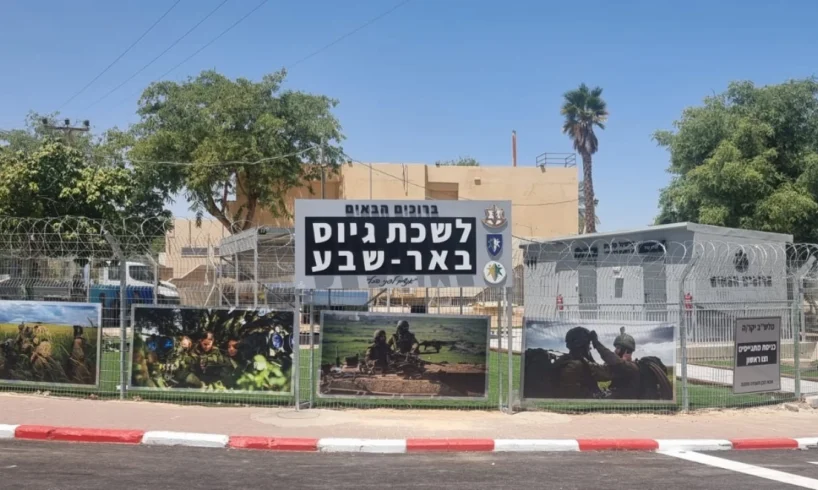
For Israelis who enlist in the military, the journey from civilian life to becoming an IDF soldier begins at a recruitment office. On Wednesday, IDF Maj. Shani Goldis, deputy commander of the Beersheva IDF Recruitment Office, gave JNS a behind-the-scenes look at how recruits are screened, evaluated and assigned roles in the military.
The recruitment office is part of the Meitav unit, the IDF body responsible for managing the recruitment process, from a recruit’s initial screening and assessments to placement in military service. Meitav serves as the primary point of contact between prospective soldiers and the army throughout the enlistment process.
Goldis explained that the process begins with the Tzav Rishon (“first summons”), during which recruits undergo medical and cognitive assessments, evaluations and interviews. She said the process helps the army understand each candidate’s abilities, interests and potential.
“Our goal is not simply to evaluate young people but to get to know them and ensure they are matched with a role where they can contribute to the IDF while also developing their own strengths,” she said.
The process includes a computerized cognitive and intelligence test known as DAPAR, which measures a recruit’s analytical ability, problem-solving skills and cognitive adaptability, along with a medical assessment to determine whether the candidate meets the standards for combat service.
The Tzav Rishon is followed by Yom HaMe’ah, a seven-hour pre-enlistment assessment day designed to evaluate recruits’ interpersonal skills, teamwork, creativity, data processing and management abilities. The results help the IDF determine which roles and tracks best suit each candidate.
The next step for some recruits is Yom HaSayarot (“Special Forces Selection Day”), an intensive physical assessment designed to screen candidates seeking placement in elite combat units, including Sayeret Matkal (General Staff Reconnaissance Unit), Shayetet 13 (Navy Commando Unit), Shaldag (Air Force Commando Unit) and Unit 669 (Air Force Combat Rescue Unit).
Goldis warned that candidates should not arrive for Yom HaSayarot without serious physical training beforehand.
Following these stages, recruits’ scores are compiled and they are given the opportunity to complete a questionnaire called the She’elon HaHadafot, in which they rank their top three preferred military positions.
Goldis cautioned that the IDF cannot always guarantee candidates their preferred roles, but said their preferences are given serious consideration during the next stage of the process: Shibutz (“military placement”). During this stage, recruits are assigned to roles, units or positions based on their profile, assessments, the army’s needs and their submitted preferences.
She stressed that her role, along with that of her unit, is to support candidates every step of the way.
“This is, of course, one of our highest priorities,” she said.
Goldis added that her unit provides information and guidance through its recruitment offices, call centers, online resources, and community and high school outreach programs.
“I understand that joining the military is a major life event, so we do everything we can to make the process clear and supportive,” she said.
Goldis explained that the final stage of the process is Yom Giyus (“enlistment day”), when recruits officially enlist in the IDF and begin their military service. She said it is a very emotional day for both the soldiers and their families, adding that it remains a special moment for her as well, even after taking part in many enlistment days over the years.
She said soldiers arrive at their designated reporting location, sign the necessary forms, receive their IDF uniforms and are transferred to their assigned units.
“It’s a day filled with emotion, excitement, and pride. It’s the start of a journey as an Israeli soldier. But most importantly, they are not alone. We are here to guide, explain, and support through every step of this process,” she said.
Goldis recently returned from visiting several cities in the United States as part of an IDF delegation whose mission was to strengthen the connection between American Jews and the State of Israel.
She said the conversations that stayed with her most were with people who expressed that simply knowing there is a Jewish state gave them strength—even those who do not call Israel home.
“Israel represents hope, security and continuity for Jewish communities around the world. As someone who served in the IDF and works every day with young people beginning their own journey of service, these conversations reminded me never to take that privilege for granted,” she said.
Goldis concluded: “I arrived in the United States hoping to inspire young people about Israel. Instead, they reminded me why serving Israel is such a privilege.”