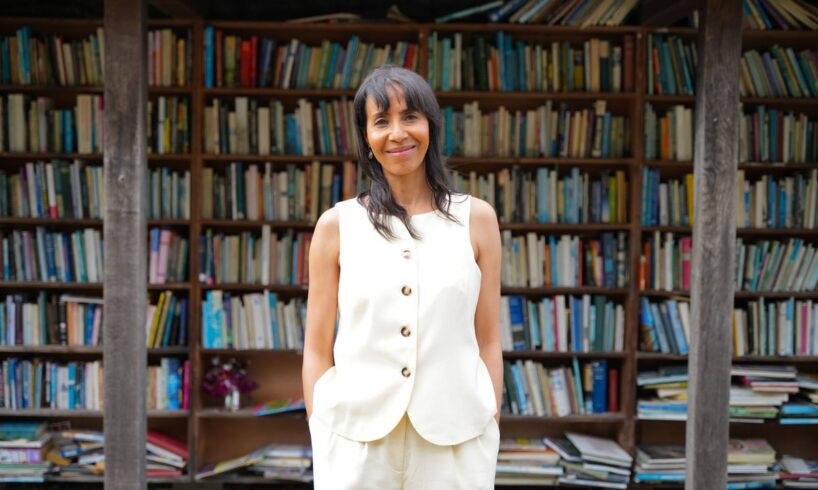
Michelle Ogundehin will appear at Fringe By The Sea in August. | CREDIT LINE:BBC/DSP/Georgina Vin
It’s not about how your house looks, but how it makes you feel, says the interior design guru who wants to make Scottish homes healthier and happier
How does your home make you feel? Stressed and sad or uplifted and relaxed?
Are you lounging all day long on your chaise longue or waging a war with the wallpaper? And could the way we live be having more significant effects on our wellbeing? According to interior design guru Michelle Ogundehin your home could be harmful to your health and it’s not just the colour and style choices that are crucial.
As she prepares to head to Fringe By The Sea in North Berwick next month Ogundehin takes time out from renovating her new home in Kent to urge us to look at our houses with fresh eyes, not necessarily fresh paint, as she focuses on the intersection between the spaces we live in and our wellbeing.
“Interior designers have spent decades asking how should a home look but I’m much more interested in how it should make us feel,” she says.
“I’m really excited to come to North Berwick. It’s a wonderful opportunity to share my expertise beyond what people might know of me from the television. I’m hoping people will never look at their home in the same way again.”
Yellow paint, stripes, romantic minimalism or modern medieval, Ogundehin couldn’t care less. Trend-led decor is not what the TV interior designer – a familiar face on our screens from BBC Interior Design Masters with Alan Carr, Grand Designs: House of the Year, The Great Interior Design Challenge, Chelsea Flower Show and Inside Out Homes – is about. For her it’s about improving our homes based on a belief that healthy living starts with the home.
Michelle Ogundehin’s bestselling books, Happy Inside and forthcoming title, Your Powerful Home which is due out next year, are backed by her research into how our living spaces affect our wellbeing. | CREDIT LINE:BBC/Darlow Smithson
“People talk about juices and fasting and running and yoga and drinking lots of water,” she says. “No one talks about the home. That’s my thing.”
“What if your home could become your greatest source of health? If you start from the idea that everything around you has an effect, it changes the way you see it.”
Born in Manchester and raised in London, Ogundehin trained as an architect before becoming editor of Elle Decoration for 13 years. During this time she went behind the closed doors of thousands of homes and her home therapy philosophy is summed up in her bestselling book Happy Inside while her forthcoming title Your Powerful Home (March 2027) sees her ramping up her campaign for clean, green, toxin‑free living.
“I want to empower people. Our health system only kicks in when you’re already sick. We as individuals have so much power to better protect ourselves and it’s all about prevention. We have overlooked the power of the home.
“The assumption is that home is just somewhere you live. My argument is that home is an active participant in your health. We spend about 90% of our time indoors, yet when we think about wellbeing we think about diet, exercise, sleep and don’t consider enough the environments in which those things happen.”
By its very nature television is a visual medium but Ogundehin wants to reach beyond the screen.
“Something could look brilliant on television but the viewers are not in the room. They can’t tell how it feels, and your nervous system – how you process the world and respond – reacts to your environment quicker than your conscious brain. Your body will already be tensing or relaxing, flexing or sweating, in response to your environment before you can make any opinion about whether you like a room or not.
“It’s a huge mistake to think your environment does not affect your body. And it’s not about the latest wallpaper, must-have colours. Trends are just marketing and have nothing to do with what you might like.
“As a magazine editor my job was to put the new in front of people, but so you can make up your own mind. My first book, to enable people to work out what they like is underpinned by science and in my second book, Your Powerful Home, I put it all in so it’s not just me saying it’d be lovely to paint your walls yellow, it’ll make you happy. It’s about a lot more than that.”
Michelle Ogundehin with Alan Carr and Laurence Llewelyn-Bowen and series seven finalists Lia Gold and Sophie Newlands on Interior Design Masters with Alan Carr. She is currently filming a new series. | CREDIT LINE:BBC/DSP/Georgina Vin
Would she say that that having healthier homes saves lives?
“Yes. I would. The science is there but I don’t think it’s been applied to our domestic environments. For example, one in eight cases of childhood asthma can be linked to gas hobs. It’s like living with a smoker. The data is there yet we’re not paying attention.”
Smiling and enthusiastic, but not prescriptive and judgy, Ogundehin expounds on home therapy.
“Your home shouldn’t just be somewhere you store your life. It should actively support it. Home therapy is about intentionally using your environment to improve how you think, feel and function. I’m not going to tell you which sofa to buy, but I am going to help you get your home to feel how you want, depending on who you want to become.”
“I see it in my own life and the lives of people I help. I’m not saying I can cure cancer, but I am saying I can help you be happier.”
Ok, what sort of things make us unhappy in our homes?
“Visual clutter is one thing. It has a cognitive load. Mess makes stress. I always bang on about clutter and clearing. And by clutter, I don’t mean stuff. I have lots. Things are fundamental to tell your story. But I do mean things that don’t work, gifts you don’t love, that are broken, that you’re not sure why you have or have excess of. We need a lot less than we think. And the things that are really good for us – clean air, light – are generally free.”
“We often think wellbeing comes from adding stuff in but clarity usually comes from taking something away and creating less visual noise. It’s about encouraging people to be more considered and intentional about what surrounds them.”
Ogundehin also says light in the home is fundamental.
“One of the immediate things everyone could do today is use two or three smaller lamps instead of one big light. Layering softer lighting is probably the quickest way to change how a room feels, because light is one of the strongest signals you send to your nervous system.”
OK, as someone whose bedroom is full of clutter, what would Ogundehin’s home therapy advise?
“I always start with a bedroom because that’s where you restore, where your body reboots itself every night. Get a large box and take all the sh** out so there’s nothing in your bedroom not about sleep. All you need is a bed, side tables, lighting and wherever you store your clothes. Can you imagine walking into that bedroom?”
Just thinking about it makes my shoulders drop and I smile.
“Exactly!” says Ogundehin, spotting my body language.
“That’s what I’m talking about! That thing your body does automatically. But we say ‘I don’t have time’ and ‘don’t know where to put it’. Did I say she’s also a mind reader.
“Do it and feel the difference. Thinking about it made you sit back and smile. Just do it.”
I will. Ogundehin’s enthusiasm is infectious.
“Deal with sorting it later. But sleep underpins everything so start there.”
In my defence I tell Ogundehin I have just decorated my daughter’s bedroom, while mine is a shaming clutterfest.
“It’s what women, and mothers, do. When I started renovating I moved my son into the spare room with his little cuddlies and put pictures on the wall, because I wanted to make a lovely space for him. While I slept on the sofa, and the work took longer than I thought. I was absolutely ragged. It didn’t occur to me to put myself in the spare room. It’s like put your own oxygen mask on first.
“So get boxes, all the same, and put the stuff in. Don’t overthink it, don’t sort it, then store it behind something like the sofa. Even if it becomes a side table for the telly. But it needs to come out of your bedroom.”
“Promise me, make a statement now that you will do that this weekend.”
I will do that this weekend.
You’ll be radiant. So much sleep.’
Michelle Ogundehin in Edinburgh. The designer says Scottish homes reflect the environment with natural materials and craftmanship. | BBC/DSP/Georgina Vin
If our living space is crucial to wellbeing, what are the worst effects of unhealthy homes?
“Heat’s one, but also air quality. You are what you breathe and most homes are more polluted inside than a busy road because of everything that’s gassing in there, from gas hobs leaking potential carcinogens, even when off, to fire retardants mandated by law to be on upholstery and VOCs [Volatile Organic Compounds – carbon-based chemicals that evaporate at room temperature] in paint because cheap paint is full of it although it won’t say on the tin. That’s not our fault because we choose paint by colour, don’t we?”
Ogundehin is at pains to stress no-one is to blame for their unhealthy home.
“We assume if we buy something it’s not going to be hazardous yet even fabric conditioner is full of synthetic fragrance designed to withstand a hot wash. What the hell is in there? We’ve got data to say synthetic fragrance is extremely harmful to your endocrine system, your hormones yet we’re surrounded by the stuff. It’s advertised so why would you think it’s bad?”
“My job is to tell people, but I don’t want to scare them and go ‘everything surrounding you is going to kill you or give you cancer’. I want to gently say let’s think about alternatives? You can buy an induction hob in IKEA. It’s not about having a lot of money or complete renovation because the age of consumption has to stop. We are a planet of finite resources yet that penny doesn’t seem to have fully dropped. It starts with us, because we could buy less.”
“But it’s not about pointing fingers at anyone. The tricky bit is how to frame it so you don’t freak out but feel empowered. Like you feel, I hope, empowered to go ‘I’m going to clear out my bedroom.”
She laughs. “I tend to do this, boss you to do this because I know that you will feel better for it.”
“More ‘boss you’ than bossy, because I feel very passionate about it and know it makes a difference. Sometimes people need a little push, don’t they? Because they’re ‘oh, I’m busy or too tired’, but please, just try it.”
Does she practise what she preaches? Is her bedroom a clutter-free oasis of tranquility?
“Absolutely. My bedroom is my favorite room in the house. I’ve just moved from Brighton and my son’s and my bedroom were the first two rooms we renovated. It’s a very old house with bits dating from the 16th century to the 18th, timber framed and I needed to take out the old plasterboard and insulation so that it’s a fully healthy, breathable home.”
“I’m stripping out the old gypsum plasterboard because it should never have been in a house this old because it’s not breathable, neither is the paint. I’m painfully reinsulating my house with something that looks like Weetabix, wood fibre insulation, then lime plaster. It’s hugely invasive because I’ve got to rip everything apart from the inside because the outside must stay exactly as it is.”
The interior design guru says our homes can either support us or sabotage us. | CREDIT LINE:BBC/DSP/Georgina Vin
Ogundehin’s new village home is her passion project but she admits doing things the healthy way isn’t always the cheapest.
“There’s a reason plasterboard was invented. It’s quick and cheap, but it’s not good for you. So it took ages and cost twice as much. The whole thing has been a bit of a nightmare to be perfectly honest. I put insulation in to be cosy in winter to offset heating costs and knew it was also supposed to keep your house cool, but I wasn’t that bothered until the temperature hit 36 degrees. The difference was tangible. In the rooms that aren’t done, it’s like walking into a sauna.
“If we’re going to have this hot weather, we need to think about that. We should all have solar panels too.
“There’s no point making a beautifully decorated home if it’s unhealthy because it’s too cold or too hot. These conversations have to come first, and I’m tired of constantly seeing the narrative being about decoration. Your home can either support you or sabotage you.”
Ogundehin loves old houses and was drawn to Kent with its greenery, oast houses and tile hung buildings.
“This house has been standing for hundreds of years and my job is to look after it so it will continue to stand for that long again.”
“There’s a level of detail and texture I love, exposed beams, brick, flagstones, tiles and quirky bits you don’t get built in standard box houses. I love it. It’s also a nightmare.”
What about Alan Carr’s recently acquired Ayton castle, now cleared of clutter sold at auction – maybe he heard Ogundehin was heading north. Will she visit when in Scotland?
“Absolutely, are you kidding me? I want to see it and it’s just down the coast. I’ve already invited myself. We’ll see how far our friendship goes if he’s like, ‘oh, I’m not there, I won’t be in that weekend.’ She laughs
With filming of season eight of BBC Interior Design Masters with Alan Carr, could the contestants head to Ayton?
“He’s become a custodian of a piece of history. He probably needs a little bit more expert help. I’m very proud of him. I admire his ambition.”
Michelle Ogundehin appears at Fringe By The Sea in August. | Contributed
What about the Scottish angle, are our interiors different to those in the rest of the UK?
“I’m loath to say there’s a specific Scottish interior design style but I do think there’s a love and respect for natural materials and craftsmanship from your environment, and those are things research suggests our nervous systems respond to.
“Every time I come to Scotland I think it’s extraordinary how you don’t have to go far out of the cities to see amazing vistas. It’s just gorgeous. And the colours…
Speaking of colours, what about green for a clutter-free bedroom?
“I can advise down to the specifics of colour, but first I want to have the conversation about ‘who do you want to be? What do you need your home to do for you?’ Then you put in place the scaffolding to create that. It’s about helping you work out what is the colour for you? Not just saying green is relaxing therefore paint the walls green. From racing green to palest celadon, it’s too broad.”
OK, I want the shade of the leaves outside my window right now, and also in an old painting that makes me happy but is stashed under the bed.
“Put that painting on the wall where you’ll see it when you first wake up and paint the wall that color, because then that’s you telling your story and that’s starting to be powerful. Our homes are about our story. And that’s part of making us healthier and happier.”
Michelle Ogundehin, Fringe by the Sea, Wednesday 5 August 2026, Big Top, 11am-12pm, £14. Fringe by the Sea runs 31 July- 9 August in North Berwick, www.fringebythesea.com