LONDON — When thousands gathered in central London in late spring to protest against antisemitism, Fiyaz Mughal was among their number.
The founder of Muslims Against Antisemitism, Mughal was one of what he readily accepts as only a “handful” of British Muslims at the protest — and the only one to join politicians and community leaders in addressing attendees.
Mughal betrays no doubts about his decision to speak at the demonstration, nor his willingness to call out some fellow Muslims for their apparent public silence in the face of rising antisemitism in the UK.
In April, two Jews were stabbed in a terror attack in the heavily Jewish north London neighborhood of Golders Green — one of more than a dozen antisemitic attacks on synagogues and community centers in recent months, which follow the murder of two Jews at the Heaton Park synagogue in Manchester last October.
“I decided to attend and speak at that rally because I have been quite downcast about the way that some within my community have made no attempt to deeply empathize or stand with Jewish communities publicly when it is needed,” Mughal tells The Times of Israel.
“Some within my community will make calls to members of Jewish communities and give them sympathy over the phone, but they’re not willing to make that publicly available and to set a precedent,” he says. “They’ll quietly play both sides, and for me that is unacceptable. You either live by your values or you get called out for being a hypocrite — and living by your values means sometimes you need to do the right thing.”
Illustrative: Counter-protesters holding Israeli flags pose for the cameras as pro-Palestinian, anti-Israel student protesters wave flags and chant slogans outside King’s College London on October 7, 2025, the second anniversary of the deadly Hamas-led attack on Israel. (JUSTIN TALLIS / AFP)
Mughal is no late recruit to the cause. A former government adviser and local authority council member who has worked extensively in the community and charitable sectors, he has long been on the front line in the fight against extremism, hate crimes and antisemitism, and is a strong proponent of Muslim-Jewish interfaith work.
While Muslims Against Antisemitism works to support education within British Muslim communities around antisemitism and the Holocaust, another organization founded by Mughal, Tell MAMA, records and reports anti-Muslim hate crime and provides support to victims.
Time for a new textual interpretation
Mughal is sharply critical of what he terms the “weasel-wording” of some Muslim community leaders. Rote condemnations of antisemitism or refusing to accept that it is linked to radical anti-Israel activism are simply not enough, he says.
“I stand in complete unity and solidarity with the Jewish community [and] I stand firmly with my position that the wholesale denial of the State of Israel is a part of the antisemitic rhetoric and that needs to be challenged, including in some parts of my community,” Mughal says.
None of that means, he adds, that he doesn’t support the establishment of a Palestinian state or oppose some of the policies and rhetoric of the current Israeli government.
Demonstrators gather holding flags and placards as they attend a protest against antisemitism and extremism, in London, May 10, 2026. (AP Photo/Alberto Pezzali)
He attributes the reticence of other Muslim leaders to publicly stand with British Jews to an unwillingness to “ruffle feathers” and a desire to maintain their community support bases and social media following.
Mughal also points to a more fundamental challenge: the need for a “reinterpretation of Islamic scriptures.” Since the bloody Hamas-led invasion of Israel on October 7, 2023, too many mosques have had “preachers who have used some interpretations of the Hadith and some caricatures that have seeped in religiously to Islam as a way to support the actions of Hamas or support attacks on Jews,” Mughal says.
While 9/11 and the July 7, 2005, terror attacks in London should have brought about “a fundamental reinterpretation of scriptural text,” he says, the “vast and overwhelming majority” of imams in Britain have “done nothing about this.”
“If we don’t do it now, it’s never going to happen,” he says.
Jarring normalization of antisemitism
Mughal is not, however, the only prominent British Muslim to offer his support to British Jews. Earlier this month, he was joined by a handful of others, including the former government counterextremism commissioner, Sara Khan, in a public letter condemning the “weak and underwhelming” response to the “raucous and relentless” rise in antisemitism since the October 7 onslaught.
The letter highlighted how “legitimate protest” against the conflict in Gaza has been used by some to “normalize slogans, symbols and rhetoric that glorify violence.” It also contrasted the “silence and lack of condemnation” in the face of attacks against British Jews with the “widespread protests and solidarity demonstrations” in the UK following the murder of George Floyd by police in Minneapolis in 2020.
Demonstrators carry placards with slogans as they march in the road outside the US Embassy in London on May 31, 2020, to protest the death of George Floyd. (DANIEL LEAL-OLIVAS / AFP)
Why does Mughal believe Jews in Britain have not been afforded similar levels of solidarity by their compatriots? He blames “inbuilt perceptions” within antiracist movements that Israel is all-powerful and that Jews are wealthy and politically well-connected.
These perceptions, which “verge right on the edge of antisemitic rhetoric and tip over in many ways,” have become an excuse for “inaction,” Mughal says. There is something jarring, he continues, in the fact that an antiracist movement which claims to stand up for “minority communities” is ignoring the plight of British Jews, “a tiny minority community,” when it is under a sustained assault.
Mughal believes that efforts to separate the pro-Palestinian movement in the UK from antisemitism have been “very little, very late.”
Protesters gather near Downing Street during a ‘national emergency’ rally organized by the Campaign Against Antisemitism following a terror stabbing attack in Golders Green, London, April 30, 2026. (AP Photo/Alberto Pezzali)
“There is a significant problem with the movement being tainted with antisemitism,” he says. He calls instead for a strategy of “disassociation, exclusion and open challenge.”
“You cannot talk about a Palestinian state without dissociating from any element of any group that has a history of antisemitism,” Mughal says. “That’s a reality that nobody really wants to take on right now.”
Politicians stoke anti-Israel fire
Mughal believes the anti-Israel Green party now represents the most electorally significant and potent iteration of an alliance between the far-left and Islamists that has been growing in strength since the 2003 Iraq war. Under their new leader, Zack Polanski, a hard-left, Jewish anti-Zionist, the Greens made the issue of Gaza — and the Labour government’s “complicity” in Israel’s “genocide” — a centerpiece of their campaign in local government elections this past May. (UK local authorities play no role in British foreign policy.)
But the party’s strong performance in the elections was marred by accusations of antisemitic comments made by a number of its candidates. Mughal says the Green Party “made a strategic decision” to use its highly critical stance on Israel’s actions in Gaza to tap new sources of support.
Green Party leader Zack Polanski (C) and former Labour party leader Jeremy Corbyn (bottom L) join protesters holding placards and waving flags as they take part in a march against the far right, organized by the Together Alliance, in central London on March 28, 2026. (Photo by Henry Nicholls / AFP)
“They must have known that in doing so they were going to draw in people who have a very bad past,” says Mughal, who believes the party’s “hand-wringing” promises to tighten its selection procedures are “not good enough.”
Mughal is unimpressed by Labour’s response to the twin challenges of antisemitism and extremism since it took office in July 2024. He does credit some of its ministers with showing a good understanding of the impact on the Jewish community, and recognizes that the government has invested heavily in increased security measures.
Members of the Jewish community watch as forensic officers search the area after two people were stabbed in north London’s Golders Green neighborhood on April 29, 2026. (AP Photo/Kin Cheung)
But, he says, “I believe Jews don’t want to be sitting behind big walls … [with] cameras and security guards. This is not a life,” adding that fighting antisemitism requires “real societal change” and the government doesn’t have a plan to achieve it.
He also accuses the government of offering no “alternative solution … to dealing with Islamist extremism or Islamist extremist antisemitism.” There is a “distinct, stark” contrast between its “vacuous” approach and the efforts of the previous Conservative government to “grapple” with the issue, Mughal says. Labour fears that “if they start talking about Islamist extremism, it’ll lose them some political support,” he says.
Pro-Palestinian, anti-Israel protesters take part in a demonstration on Al Quds Day, in London, April 5, 2024 (AP Photo/Kin Cheung)
Those fears, he says, were exacerbated by the election of four “pro-Gaza” independents to parliament in the 2024 general election. “It created a sense of fear, and then it created a sense of apathy,” on the part of the government, Mughal believes.
However, Mughal argues that those within the Muslim community advising the government to avoid talking about Islamist extremism are providing ministers with “a really distorted view of British Muslim communities” and a “sometimes brittle, conservative view of Islam.”
Mughal is no stranger to racism. When he was a child, his family was thrown out of Uganda when then-president Idi Amin expelled the country’s Indian minority in 1972. Growing up in Britain in the 1980s, he also suffered racism. He believes that the attitudes underlying such racism are “exactly the same” as those displayed by Islamists.
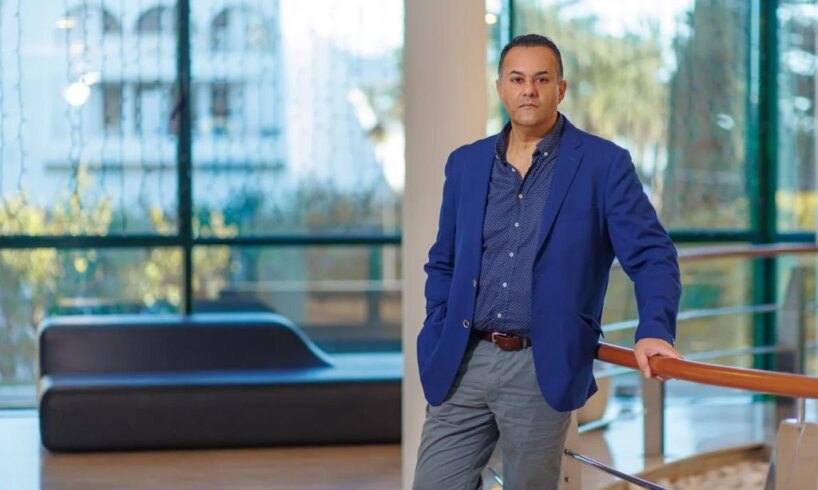
Fiyaz Mughal founder of Muslims Against Antisemitism. (Courtesy)
“People misuse my religion to enforce their brutality, enforce their superiority, enforce their sense of entitlement,” he says.
The struggle against antisemitism is, Mughal believes, “umbilically intertwined” with the defense of liberal democratic values.
“I feel that, over the last three decades, antisemitism [in Britain] has gotten significantly worse,” he says. “But it is also an indicator of the way that intolerance has taken root in our country as a whole. The reality is we are facing a national crisis of intolerance.”