
France is better known for football, cycling, tennis and skiing than weightlifting. But gym culture is on the rise, especially among young people – many of whom have been inspired by social media, with France’s most popular YouTuber building his audience around bodybuilding.
Guillaume and Benjamin, 23-year-old twins, work out most days of the week with their friend Mathis and a group of other young men at a gym near Angers, in western France.
“We spend more time at the gym than we do at home,” says Mathis.
The three have noticeably well-developed shoulder muscles. They used to play sports, but dropped them when they started going to the gym.
“We stopped doing judo because we would rather focus on weightlifting,” Benjamin says. “We prefer it to judo. It develops you more and teaches you more about the human body.”
More about France’s gym culture in the Spotlight on France podcast:
Spotlight on France, episode 148 © RFI
They are among the 7.7 million French people who are members of gyms or fitness clubs, according to an annual survey of the industry published by Union Sport & Cycle, France’s main sport and fitness trade association.
The report estimates 18 million people participate in fitness-related activities – a number that has doubled in the last 25 years.
Much of that growth has been driven by younger people, with nearly 60 percent of 18 to 34-year-olds doing fitness activities, whether in gyms, classes or at home.
Women gain ground in France as running clubs turn sport into community
Online influencers
For many, fitness has become more than just exercise – it’s a way of life. Mathis says his non-gym-going friends and family do not understand his lifestyle, particularly when it comes to food.
“When you bring your own food to the bar while everyone else is drinking a beer, it’s a bit strange,” he says.
He says his interest in fitness came from social media content creators. He and his friends are inspired by Tibo InShape, the best known French-speaking YouTuber.
“It was thanks to Tibo InShape that I started,” says Mathis. “His simple videos of things to do at home, without equipment, really motivated me.”
Tibo InShape – real name Thibaud Delapart – has nearly 27 million subscribers on YouTube. He first became known for his bodybuilding and fitness videos, before expanding into other subjects.
“If this guy has so many followers, it’s because he corresponds to the expectations of the young generation,” says Christophe Andanson, founder of Planet Fitness, which runs gyms, distributes fitness equipment and trains coaches. “Because of him, people want to be in shape.”
Frome niche to mainstream
Andanson competed as an Olympic wrestler at the 1980 Moscow games before leaving elite sport after he and his wife opened a gym in Paris in 1983, which he says was among the first modern fitness clubs in France.
Inspired by his experience training at the University of Wisconsin, he brought the methods and the equipment to France. For years, he says, going to the gym remained a niche activity.
The industry was hit hard during the Covid-19 pandemic, when gyms were shut down. But demand surged afterwards.
“There has been a big, big shift in the French mentality, among Generation Z and Millennials,” he says. “Young French people between 16 and 30 are more focused on [exercise].”
The fitness sector in France, while smaller than in the United Kingdom or the United States, is growing – and continues to diversify, with Pilates, functional fitness and hybrid disciplines such as CrossFit.
“There is more variety than before,” says Aurélien Broussal-Derval, who trains fitness coaches. Like many professions in France, fitness coaching is regulated and requires an official certification.
While the development of gym culture has occurred mostly outside official channels, the government has recognised a growth in the sector and has simplified the certification requirements.
Broussal-Derval says this has opened the door for more people to enter the industry, which counts 6,000 coaches, compared to 4,000 two years ago. Many of his students are older people who are changing careers.
“We have many fit people over 40 who tell themselves: ‘Wait, I’ve had enough of banking or policing or whatever. I want to do something different, and I actually know a lot more than my own coach, so why not do it myself?’”
Tour de France bans spectators from third stage as fire burns in French Pyrenees
‘Taking the first step’
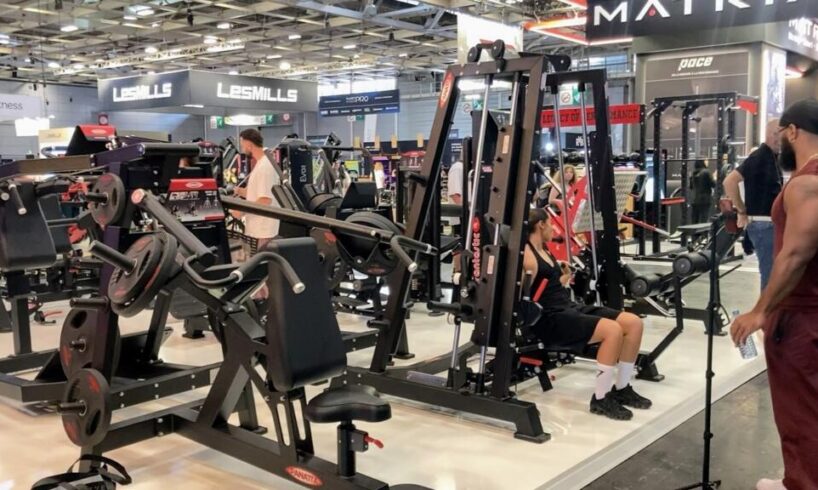
At the annual fitness industry trade show, Fitex, founded by Andansen, visitors in sportswear wandered through aisles of weights and exercise machines, dietary supplements and recovery products.
Corrine, 45, is a licensed fitness instructor who teaches Les Mills classes – “pre-choreographed group fitness sessions that combine science-backed movements with chart-topping music”, according to their website – twice a week, alongside her full time job as a biostatistician.
She says she finds like-minded people at the show, as many of her friends and family do not understand her enthusiasm for fitness.
“A lot of people around me say, ‘You are mad, completely mad!’” she says, laughing.
Her friend, Julie discovered fitness after starting swimming to help with back pain. She stopped that because she didn’t enjoy it, and started Les Mills classes after seeing an advert.
“I decided to try and I just kept going,” she says. The classes have become both exercise and a way of socialising, although her friends outside the gym still find it unusual.
“I work with artists, where people usually smoke and drink and don’t really do any [exercise] or physical activity,” she says.
Recently, though, some of them have become curious.
“They say ‘You seem to be doing well, and maybe we want to do it, but we still have trouble taking the first step’.”
For more on the Spotlight on France podcast, episode 148, listen here.