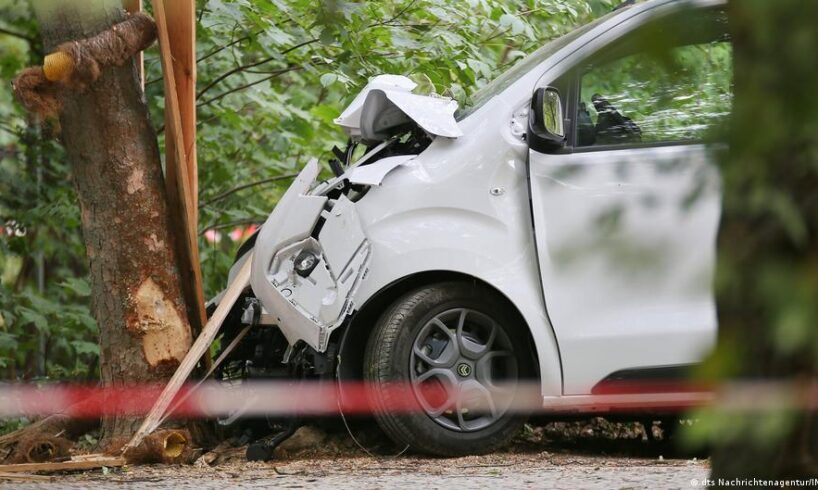
The deadly vehicle attack in Germany has once again raised concerns about vehicles being used as weapons, as it follows a series of similar attacks around the world.
In this latest incident, one person was killed and more than a dozen others were injured after a vehicle drove into a crowd near Berlin’s Christopher Street Day (CSD) Pride celebrations on Saturday evening. The attack occurred in the Tiergarten area close to the Brandenburg Gate, where hundreds of thousands of people had gathered for one of Europe’s largest LGBTQ+ events.
German authorities launched a large-scale manhunt and later identified a 21-year-old suspect known to police for alleged ties to Islamist circles. Investigators are continuing to examine the circumstances and motive behind the attack.
But regardless of the motive, the incident once again highlights a troubling question raised by similar attacks in recent years: Why are vehicles so often used as weapons?
Weaponized cars have a global footprint
Cars’ size, speed and maneuverability also make them potentially deadly.
In recent years they have been more frequently used to kill or maim people. Cars became prominent as a weapon in terrorist attacks during a series of incidents in Israel amid ongoing conflict with local militant groups there during the early 2010s.
The use of vehicles to ram public spaces was also encouraged by the so-called “Islamic State” group in the mid-2010s. In Europe, attacks in Nice — where 86 people were killed in a truck attack — Westminster Bridge in London, Barcelona and the 2016 Berlin Christmas market attack, which killed 13 people, have been among the most devastating incidents.
Cars have also been used in a series of attacks in China and in several high profile incidents in the US.
While many of these attacks had religious and political motivations, that isn’t always the case. Even those that occur close together may be unrelated.
A spate of attacks using cars in German towns sparked fears of copy-cat incidentsImage: Boris Roessler/dpa/picture alliance
That is true for a recent series of ramming incidents in Germany that had no common ideological thread.
The alleged perpetrator in December 2024’s Magdeburg attack was a Saudi national with anti-Islam beliefs.
In contrast, the suspect in February’s Munich killings may have had a pro-Islamist motivation, according to prosecutors.
And the suspect at the center of March’s Mannheim attack is believed to be a German-born individual with no history of extremist tendencies.
What they do have in common is the car.
Copycat attacks
In 2018, sociologist Vincent Miller of the UK’s Kent University and Keith Hayward, a professor of criminology at Copenhagen University, co-authored a study about the nature of car rammings as “imitative” events.
They argued such incidents work like “memes” offering a model for others to replicate rather than encouraging any specific ideological motivation.
Miller pointed to recent events in China, which have been described as “revenge on society” attacks and have resulted in perpetrators being given the death penalty.
“The people that are doing this are often quite aggrieved, there’s a sense of injustice there, a sense of anger,” Miller told DW.
In the aftermath of such attacks, there may be little definitive evidence of political or religious motives.
“Quite often they’re very spur-of-the-moment or very hastily put together forms of attack,” Miller said.
“They’re very diverse individuals. Some might be Muslim radicals, some might be American right-wing activists, some people have mental health problems. The profile of the perpetrator is very hard to define. The main thing they have in common is the act.”
Even several years on from writing their paper, Miller stands by the key argument that the biggest thing these attacks might have in common is exposure to the action. The psychology behind them is not as easy to pin down.
“It subconsciously becomes part of the repertoire of options for people to express their anger in some way and they get exposed to it through the vectors of the media and social media,” he says.
What can be done to prevent such attacks in future?
Pauline Paille, a specialist in international security at research organization, RAND Europe, was involved in a 2022 report for the European Commission exploring ways of preventing car ramming attacks.
“It’s a bit difficult to understand what the motivations are and if there is an actual pattern, or if it is just a collection of isolated events,” Paille told DW.
“I don’t think this is a threat that is unique to Europe and with regards to the psychology, I think it very much depends on the kind of motivations and political objective that those who attack have.”
RAND’s report investigated how access to vehicles through rental or peer-to-peer schemes, which were utilized by suspects in US attacks, in a New Orleans ramming and a Las Vegas explosion, could be restricted.
Raising barriers to rented vehicles could be a useful measure. Enforcing stronger identification requirements, financial deposits and background checks are also options.
Geofencing — a technology that uses location data, like that from a GPS system, to define virtual boundaries for cars around a certain area — could also be applied to smart vehicles by authorities and could hinder ramming attacks in the future. But for such technologies to work, the incident would have to be quickly identified to prevent loss of life.
Redesigned urban areas could be one of the simplest ways to prevent car ramming attacks.
Paille points to separating roads and footpaths as an example. “Things that make it more difficult for a vehicle to access certain spaces,” she explained. “I found that quite interesting in terms of thinking about public space and making sure it is usable by everyday citizens, but also can help their safety.”
Bollards are one option commonly used in built-up areas, though Paille said the effectiveness of physical barriers is unclear.
“Physical barriers … can be a deterrent, but it’s difficult to assess whether that’s the case, or whether people are going to move on to some other means to conduct violence.”
As investigators continue to examine the circumstances of the Berlin attack, authorities have pointed to the suspect’s alleged ties to Islamist circles as a significant line of inquiry. Yet regardless of the eventual findings on motive, the incident underscores the continuing challenge of protecting public spaces from attacks carried out with everyday vehicles.
Edited by: Jess Smee