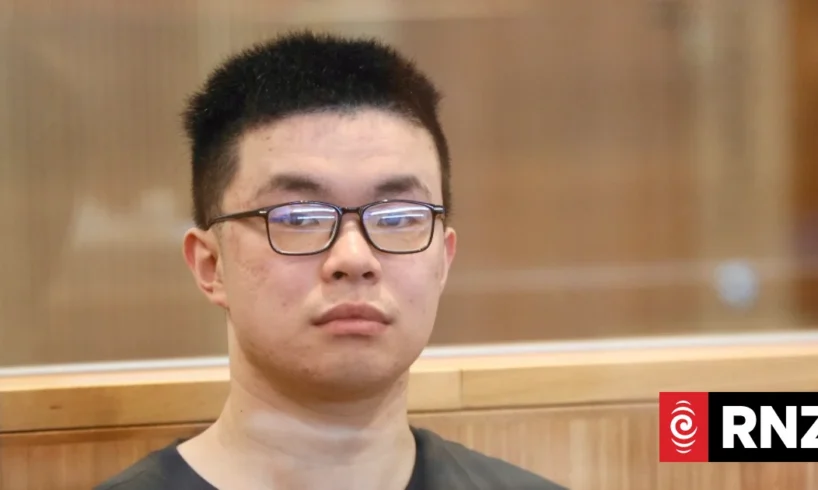
A man accused of threatening to carry out attacks on two Auckland schools and destroy public buildings allegedly said that he wanted to kill more people than the Christchurch mosque terrorist.
Tiedan Huo is on trial in the Manukau District Court, facing a raft of charges relating to a manifesto he allegedly distributed threatening to kill people at Waiuku and Rutherford colleges. He also allegedly threatened to destroy or damage two police stations and buildings at Parliament.
The man has also been charged with unlawful possession of a firearm, unlawful possession of explosives and possession of objectionable material.
Huo denies all the charges.
In his opening address to the jury, Crown prosecutor Gareth Kayes said that on 12 March last year, staff at Waiuku College woke to a chilling email that had been sent at 1:42am.
“It was titled ‘Important: Don’t come to school tomorrow’. And it started with the words ‘This is my manifesto’.”
Man accused of threatening to attack two Auckland schools
Checkpoint
The email spoke of being bullied and humiliated by teachers at the school, being unfairly treated by police and being made to feel like a second-class citizen for being Chinese.
“I am going to do something about this now. I have began [sic] preparing for doing something about this since February this year and have finished now.”
The email went on to set out in some detail the preparations the sender said they’d made to carry out attacks on Waiuku and Rutherford colleges, as well as damaging the Pukekohe and Te Atatu police stations and buildings at Parliament.
That included making firearms using a 3D printer and creating bullets and explosives to be used in an attack.
The sender said they wanted to kill more people than the Christchurch mosque terrorist, who murdered 51 innocent people on March 15, 2019.
“Do not assume that my guns will not work or are fake because they are 3D printed, that will be very bad.”
The email was purportedly sent by a female former Waiuku College student, but after she allowed police to examine her electronic devices, officers established this was not the case, and their inquiries led them to Huo.
The threatening email was sent via an encrypted service but police found a screenshot on Huo’s laptop captured just minutes after it was sent, showing the same username as the email.
“There were also a hundred used shotgun shells and a large knife,” Kayes told the jury.
“Mr Huo’s mother had a second address where Mr Huo would also stay … In Mr Huo’s bedroom at that address police found a loaded pump-action shotgun.”
DNA analysis of the firearm found it was 90 billion times more likely to have come from Huo than anyone else.
His mother held a valid firearms licence and a second shotgun was found locked up in a gun safe at her home. Huo has not been charged in relation to that weapon.
Kayes said police found numerous manifestos and videos from mass shooters and terrorists, including the video taken by the Christchurch terrorist.
“These are all what’s called, legally, ‘objectionable publications’,” Kayes told the jury.
“You might be relieved to hear you won’t need to view them as part of this trial. That’s because they’ve already all been classified as objectionable by the New Zealand Classifications Office.”
What the jury would have to determine, the prosecutor said, was whether Huo did have the publications in his possession. It was the same question they must ask regarding the firearms and explosives charges, he said.
“I suggest that once you have heard all the evidence you will be left in no doubt that it was Mr Huo who sent the manifesto.”
The Crown’s first witness, Waiuku College principal Stuart Kelly, was asked about the process of putting the school into lockdown after the email was received.
He said the school had taken the threat “very, very seriously”.
The trial before Judge Sanjay Patel is expected to take about two weeks.