To talk or not to talk with the far-right and right-wing populist Alternative for Germany (AfD)? That is the question that is dividing Germany’s business community right now.
The debate was sparked back in October when a business association named Die Familienunternehmer (The Family Entrepreneurs) invited representatives of the AfD to its parliamentary evening in Berlin for the first time.
In the words of its president, Marie-Christine Ostermann, the association thus lifted a national “contact ban” on the party that has been classified as “far-right and partially right-wing extremist” by Germany’s domestic intelligence agency.
“We family entrepreneurs do not want a government that includes the AfD,” the organization’s website stated last week, adding, however, that “engaging in discussion with someone who thinks differently is not the same as accepting their positions. Talking does not mean working together,” it continued.
Marie-Christine Ostermann first lifted the AfD contact ban and has now been forced to reverse the decisionImage: Kay Nietfeld/dpa/picture alliance
U-turn after pressure from members
Die Familienunternehmer represents 180,000 family businesses in Germany, which together employ around 8 million people.
On Sunday, the business group caved in to mounting pressure from its members and politics at large, with Marie-Christine Ostermann admitting on the association’s website that lifting the contact ban “turned out to be a mistake.”
“The opposite of what we wanted happened, she wrote, explaining that the invitation was intended to confront AfD lawmakers with the message that their economic policies are “hostile to business and harmful to Germany’s competitiveness.”
Instead, she said, the AfD statements created the impression that the association was legitimizing the party. “The opposite is true: We distance ourselves from extremists and will not allow ourselves to be co-opted.”
The association now plans to explore “other ways” to challenge the AfD while reaffirming its own values. “We will discuss this with our members in the coming weeks and months,” Ostermann said in the statement.
Last week, several members of the business group publicly objected to the association’s openness to talk with the AfD. Berlin entrepreneur Harald Christ, for example, quit the association. Last week, the drugstore chain Rossmann also announced its withdrawal.
The Rossmann drugstore chain has quit the business associationImage: Michael Piepgras/Zoonar/IMAGO
The household appliance manufacturer Vorwerk also said that it intended to end its membership, which has been dormant for some time, and to formally leave the association. “Vorwerk distances itself from the statements made by the association ‘Die Familienunternehmer’ regarding its dealings with the AfD.”
Others said they were considering leaving. The Melitta Group said it was “very surprised” by the association’s change in position. It supported dialogue with politicians, it said, but not with parties that have extremist elements.
Consumer pressure mounting on German firms
One of Germany’s leading companies in terms of employee friendliness, sustainability, and popularity with customers is the drugstore chain dm.
The company has not made a clear statement against the AfD. “dm rejects a polarizing firewall debate just as decisively as it rejects the positions of the AfD party, which call into question the free democratic basic order,” Christoph Werner, chairman of the dm management board, told the German daily Süddeutsche Zeitung newspaper.
“How the association wants to deal with certain parties is something it must decide with its members,” the company said, adding that it had left the association many months ago and was, therefore, no longer part of the internal discussion.
Earlier this year, dm was ranked number one in customer popularity by a survey, but now many customers are voicing dissatisfaction on Instagram. “It’s been nice so far, but from now on, we’re going our separate ways if you don’t take corrective action,” was just one of many complaints. Without a clear stance from dm, many say they will take their business to rival Rossmann in the future.
Leading companies that are not even connected to the business association are also feeling the heat. Users on Instagram have pressured Haribo to distance itself from the AfD amid pledges that they will not buy its products anymore. The candy manufacturer was quick to publicly clarify that it was not a member of the association.
Other companies, such as Henkel, best known as the maker of Persil, have also faced pressure on Instagram, amid calls such as, “Statement on the topic of the Family Entrepreneurs Association/AfD now, please!”
1930s comparisons amid criticism of the business group
The Green Party and the Christian Democrats (CDU) also voiced sharp criticism, while the Verdi and DGB trade unions have condemned the business association’s decision to invite AfD representatives to talks.
Verdi boss Frank Werneke called on employers’ and business associations to take a firm stance. “History warns us how important it is for the business community to clearly distance itself from right-wing extremists,” he told the Funke Media Group, referring to historical parallels with 1933, when industrialists supported Adolf Hitler’s Nazi Party.
Anja Piel, a member of the executive board of the German Trade Union Confederation (DGB), also called on Die Familienunternehmer’s members to clearly distance themselves from the AfD.
When asked by DW, the Federation of German Industries (BDI) stated that it had repeatedly voiced criticism of the AfD’s views, as well as those of other radical parties. “We do not proactively seek dialogue with representatives of radical parties such as the AfD.”
Germany’s biggest lender Deutsche Bank also took a clear stance by canceling a contract with the business group for a future eventImage: Florian Gaul/greatif/picture alliance
Bakers’ Guild sees itself unfairly pilloried
The Central Association of the German Bakery Trade said it felt misrepresented by a report published in the German tabloid newspaper Bild.
In response to questions from DW, press spokeswoman Meike Bennewitz emphasized that the bakers’ guild rejected any form of extremism. “We clearly condemn unconstitutional or extremist positions that divide society.”
She explained that, upon request, members of parliament would be provided with information or position papers regardless of their party affiliation, but that the association would “not proactively approach parties on the political fringe and will not invite members of parliament from these parties to association events.”
The German Farmers’ Association stated: “We […] limit our dealings [with the AfD – the ed.] to the minimum required by protocol. Our first points of contact are the governing parties at the federal and state levels.”
The Federal Association of Wholesale, Foreign Trade and Services (BGA) called on the AfD to draw a line in the sand against right-wing extremism and anti-European sentiment.
“Until that happens, there is no reason to talk to each other. The same applies to the opponents of the market economy in the Left Party and the BSW. Here, too, there is no common basis for exchange,” it said.
AfD enjoys the attention
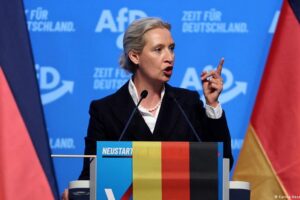
While the arguments raged, the AfD party was pleased about the overture from the business association. “It should be a matter of course for the business community and small and medium-sized enterprises to seek dialogue with representatives of the opposition, especially when they are the strongest political force in the country according to the polls,” said AfD leader Alice Weidel, adding that Die Familienunternehmer should be praised for their courage.
“Other representatives of business, finance, and small and medium-sized enterprises would also be well advised to follow the example,” she said.
This article was originally published in German. The article was first published on November 28 and updated on December 1 to include the policy reversal of Die Familienunternehmer business group.