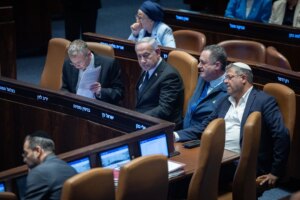
Prime Minister Benjamin Netanyahu officially requested a preemptive pardon from Israeli President Isaac Herzog on Sunday to end the ongoing trial in which he is a suspect.
In a letter to Herzog, Netanyahu argued that the trial has become a point of internal divisions in Israeli society. The prime minister insisted that the end of his trial would help heal the rift, increase unity in the country, and repair the public’s trust in government institutions.
Netanyahu stressed that he believes that if the trial proceeds, he will be found innocent on all charges. He additionally argued that he needed the trial to end so that he could devote his full energies to managing the country.
“The criminal investigations and the criminal proceedings in the Prime Minister’s case have been a source of frustration, difficulty, and a sense of injustice for many parts of the Israeli public,” the prime minister’s legal team stressed in the pardon request. “The criminal proceedings in the prime minister’s case harm the interests of the State of Israel, inflame the disputes between the various sections of the people, and divert public attention from the political and security issues on the national agenda.”
The request emphasized that a pardon would also “allow the prime minister to work to heal the rift in the nation, and even to deal with additional issues, such as the legal system and the media, issues that he is currently prevented from dealing with due to the ongoing trial in his case.”
Herzog addressed the pardon request on Monday, saying that he understands that the issue “unsettles a great many people in the country, in the various publics, and it provokes debate, but I have already clarified and said that it will be handled in the most correct and precise way. I will consider only the good of the Israeli state and society.”
“One thing is clear to me, violent discourse does not affect me; on the contrary, respectful discourse definitely provokes discussion and stimulates discourse, and I invite the Israeli public to the website of the President’s Residence, the House of the People, to express their opinion and respond accordingly,” Herzog said.
How did we get here?
For the past five years, Netanyahu has been at the center of three cases known as Cases 1000, 2000, and 4000. In November 2019, Netanyahu was indicted on charges of breach of trust, accepting bribes, and fraud. Since then, the proceedings have been repeatedly delayed, partially because of unusual events such as the COVID-19 pandemic, repeated cycles of elections, and several wars and military operations.
Case 1000 concerns allegations that Netanyahu received various gifts from businessmen Arnon Milchan and James Packer in exchange for various actions the prime minister took in favor of Milchan.
Case 2000 concerns allegations that Netanyahu worked to promote laws that would favor the Israel Hayom newspaper in exchange for favorable coverage by the publication.
Case 4000 concerns allegations that Netanyahu worked to benefit the Walla news website in exchange for positive coverage.
Protesters gather outside the Ministry of Defense as they demand early elections and Netanyahu’s resignation in Tel Aviv, Israel on February 17, 2024. (Photo by Mostafa Alkharouf/Anadolu via Getty Images)
Netanyahu pleaded not guilty to the charges filed against him and has accused the judiciary of targeting him maliciously in an attempt to illegitimately remove him from power.
In October, during an address to the Knesset, U.S. President Donald Trump called on Herzog to give Netanyahu a pardon.
“It just seems to make so much sense,” Trump said. “You know, whether we like it or not, this has been one of the greatest wartime presidents. This has been one of the greatest wartime presidents. And cigars and champagne — who the hell cares about that, right? Enough controversy for the day, right? It’s not actually — I don’t think it’s very controversial. You’re a very popular man. You know why? Because you know how to win.”
A few weeks later, Trump sent a letter to Herzog reiterating his stance. “Netanyahu has stood tall for Israel in the face of strong adversaries and long odds, and his attention cannot be unnecessarily diverted,” Trump wrote.
“While I absolutely respect the independence of the Israeli Justice System, and its requirements, I believe that this ‘case’ against Bibi (Netanyahu’s nickname), who has fought alongside me for a long time, including against the very tough adversary of Israel, Iran, is a political, unjustified prosecution,” he added.
Netanyahu’s request for a pardon also came at a particularly turbulent time in Israeli politics. The government has just relaunched efforts to promote a controversial bill concerning the conscription of Haredim, as well as a controversial bill changing regulations for media outlets in Israel.
The Communications Bill, currently being promoted by Communications Minister Shlomo Karhi, would establish a new regulatory council to handle the registration of media outlets and remove some safeguards that have been used to separate corporate owners and news agencies. Karhi has argued that the bill will increase competition by allowing new outlets to more easily enter the market. Critics argue it could give the government more power over the media and remove safeguards that prevent corporate and political corruption in media outlets.
The next steps
The process for considering a pardon request isn’t quick.
Now that the request has been received, it will be forwarded to the Pardons Department within the Justice Ministry. That department will gather information from the relevant authorities and formulate a legal opinion on the matter. This opinion will then be sent to Justice Minister Yariv Levin, who will then prepare his own opinion. If Levin is found to be in a conflict of interest as he’s in the same political party as Netanyahu, then a different minister will formulate the opinion.
The minister’s opinion will then be sent to the Legal Department of the President’s Office, which will review the file, complete any missing details, and forward it to the president’s legal advisor. The legal advisor will then formulate an opinion, which will be sent to the president along with all relevant information regarding the case. Herzog will then need to decide whether to issue a pardon or reject the request.
The legal hurdles
It’s unclear how exactly the president can pardon Netanyahu. The law on the issue is just one line: “The President of the State has the authority to pardon criminals and to mitigate sentences by reducing or commuting them.”
Netanyahu hasn’t been convicted, though, so does he count as a criminal? Can you pardon someone if it hasn’t been determined whether a crime was actually committed?
There’s only one case in Israel’s history in which a pardon was given before a conviction: the Bus 300 affair.
In the Bus 300 affair, two terrorists who hijacked the Egged No. 300 bus were killed after being captured alive and bound. Initially, the Shin Bet (Israel’s internal security and counterintelligence service) attempted to cover up the case, even giving false testimony. Soon after, however, whistleblowers stepped forward, and the case exploded. As the details emerged and the judicial system planned to launch an investigation, then-President Chaim Herzog (Isaac Herzog’s father) issued a pardon for the Shin Bet officers involved before any indictments were issued, making a trial irrelevant.
While the pardons in the Bus 300 affair were challenged in the Supreme Court, the court ruled that they were legal. The judges stressed, however, that such preemptive pardons should only be used in rare and extreme cases in which there was no other reasonable solution.
There are also some critical differences between the Bus 300 affair and Netanyahu’s case.
For one, the pardon in the Bus 300 affair was given after the Shin Bet officials involved worded their requests in a way that was accepted as an admission of guilt, and the head of the intelligence agency agreed to resign. However, Netanyahu has insisted he will not admit to any guilt in the cases against him.
Additionally, in his letter to Herzog, Netanyahu wrote that a pardon would allow him to focus on healing the divisions in Israeli society and addressing laws promoted by his government that would restrict the judiciary and certain media outlets. Many Israeli analysts read this as meaning Netanyahu would want to remain prime minister after receiving a pardon and would not consider resigning from politics.
The pardon in the Bus 300 affair was also issued before the officials were indicted. However, Netanyahu has already been indicted and is in the middle of a trial. Some analysts have expressed concerns that this would set a precedent of allowing the president to interfere in ongoing legal proceedings, a power that could easily be abused.
Pardon request enflames divisions in Israeli society
Israeli politicians and analysts were divided on the pardon request, with debates about whether the request should be accepted and whether Netanyahu even wanted it to be accepted.
Some analysts pointed to Netanyahu’s statement that a pardon would allow him to intervene in the development of controversial laws concerning the judiciary and certain media outlets. They argue that this is an implicit threat to advance these laws if a pardon is not received.
Several Israeli journalists have also raised the possibility that Herzog could agree to a pardon that wouldn’t include an admission of guilt if Netanyahu agreed to certain other concessions, such as early elections, halting efforts to pass laws affecting the judiciary, or the establishment of a State Commission of Inquiry into the failures surrounding the October 7 massacre.
Dr. Dana Blander, a research fellow at the Israel Democracy Institute, warned, however, that such agreements “could tarnish both the law enforcement officials whose protection was bought at the price of a pardon stew (a reference to the biblical story of the forefather Jacob buying the birthright from Esau in exchange for a lentil stew), and the State Commission of Inquiry when it is established.”
Environmental Affairs Minister Idit Silman pointed to Trump’s support for pardoning Netanyahu, warning that if Herzog doesn’t grant Netanyahu a pardon, “Trump may take additional steps and be forced to intervene [with] additional steps that could include sanctions on officials in the judicial branch.”
U.S. President Donald Trump poses with Israeli President Isaac Herzog and Israeli Prime Minister Benjamin Netanyahu at Ben Gurion International Airport before boarding his plane to Sharm El-Sheikh, on October 13, 2025 in Tel Aviv, Israel. (Photo by Chip Somodevilla/Getty Images)
National Security Minister Itamar Ben-Gvir called for Herzog to issue the pardon, writing, “The fabricated and disgraced indictments against Prime Minister Netanyahu have long since turned into an indictment against the prosecution, whose disgrace and crimes are exposed in the trial every day. A pardon in this case is the right and urgent thing to do. President Herzog, listen to President Trump!”
Prof. Uri Benoliel, in an op-ed on Israel’s Channel 14, argued that all Israelis should support the pardon request because it is the only way to end the trial in a way that would lead to societal reconciliation.
“Netanyahu’s ongoing trial has long since transformed from a question of guilt or innocence into an emotional focus for vast sections of the public,” Benoliel wrote. “It deepens the [societal] rift and creates a sense of persecution on one side and a war for moral purity on the other. Any legal outcome — conviction or acquittal — will be perceived by half of the public as illegitimate. This is what a dangerous erosion of public trust in democratic institutions looks like.”
Benoliel stressed that supporting a pardon wouldn’t mean identifying with Netanyahu or his policies, but would create room for Israeli society to lower the flames and heal. “A pardon will not solve all the problems, but it can signal a change of direction: a shift from endless conflict to a willingness to listen, from an identity war to an attempt to heal the rift. Precisely when each side is convinced of its rightness, leadership is needed that is willing to show generosity.”
Blander argued, however, that the pardon request only transfers the potential rift over the result of the trial from the courts to the president. She noted to The Media Line that “whatever decision the president takes, a large segment of the public will see it as illegitimate,” stressing that the president is supposed to serve as a stabilizing institution in Israeli politics, and this request jeopardizes that position.
Former prime minister Naftali Bennett announced that he would support Netanyahu receiving a pardon, on the condition that he also accept a “dignified withdrawal from political life.” Bennett added that this would allow the country to put the case behind them and increase national unity.
Efrat Rayten, a member of the Israeli Democrats Party, argued that the pardon request doesn’t meet the legal standards required because “There is no acknowledgment, no remorse, and no willingness to leave public life.”
“A pardon at this stage would tell the public that some people stand above the law,” Rayten told The Media Line.
Opposition leader Yair Lapid said he wouldn’t be opposed to Netanyahu receiving a pardon as long as the prime minister also pleaded guilty, expressed remorse, and left political life. “This is what is best for the country, if Netanyahu leaves our lives — we will be able to embark on a new path,” Lapid told N12.
“Do you want there to be no rifts in the nation? Remove from the State of Israel the number one cause of rifts and division and rift, which is Netanyahu and his poison machine, who brought all this upon us,” Lapid said.
The opposition leader criticized Herzog, questioning, “Why does he need weeks to seriously consider this?” Lapid argued that this was the only issue on Herzog’s desk and that the president should have responded, “This is not a pardon request — this is a brazen request. Do you want a pardon from me? Submit a sheet that says, ‘I admit guilt, I express remorse, and I understand that I will be disgraced for at least seven years because these are serious offenses.’”
Blue and White party leader Benny Gantz called Netanyahu’s request a “complete fake,” arguing it was “intended to divert the public’s eyes from the exemption from conscription law that he is promoting at the expense of our children.”
“He acts like a firefighter who ignites a fire and then demands protection in order to extinguish it,” Gantz said. “Netanyahu, instead of fanning the flames, extinguish the fire you created in Israeli society, stop the harm to democracy, go to elections, and only then request a plea bargain or pardon.
Israeli journalist Yaara Shapira argued that the pardon request was actually intended to launch negotiations between Netanyahu and Herzog on a plea deal to end the trial, rather than a pardon.
Shapira noted that the request wasn’t written like a typical pardon request and focused more on highlighting Netanyahu’s merits than expressing any remorse or guilt.
“The reason, apparently, that Netanyahu does not admit guilt or even bother to cover himself with any humility in the body of the request is that, for him, this is only the beginning of the game, and the stage of entering into negotiations is certainly not the stage for agreeing to compromises,” Shapira wrote. “From the Prime Minister’s perspective, if he is going to provide an admission or apology, there will have to be a pre-agreed return for it.”
Shapira argued that the president and the prosecution would likely request that Netanyahu either admit to some form of guilt or retire from political life in exchange for a plea deal. While Netanyahu is unlikely to agree to the second condition, he could agree to admit some amount of guilt in exchange for an end to the trial. Shapira noted that Netanyahu and the coalition presented the pardon request as against the prime minister’s interest, but in the national interest. “Tomorrow, he will be able to explain that he is even willing to admit to a crime he did not commit for the benefit of the state. Anyone who believed the first explanation will also believe the second,” Shapira wrote.
Meanwhile, a poll conducted shortly after Netanyahu requested a pardon found that Israelis are divided over whether or not the president should grant the pardon.
A poll by Israel’s national broadcaster KAN found that 38% of Israelis support giving Netanyahu a pardon, while 43% are opposed and 19% are unsure.