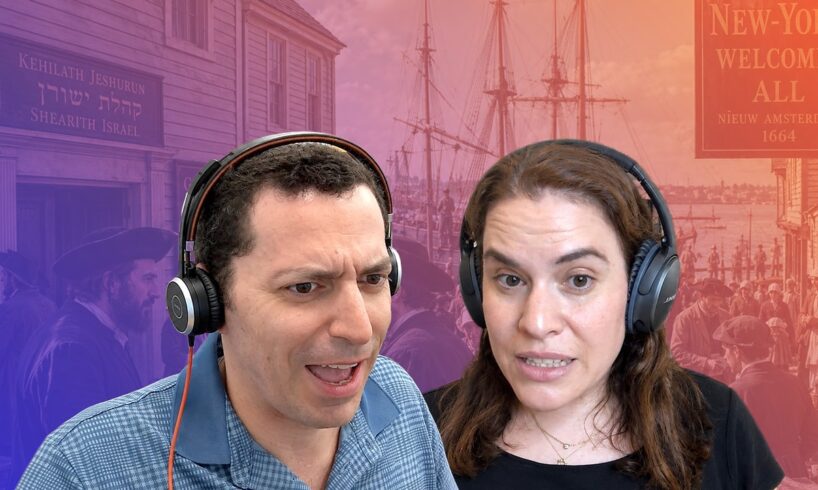
Schwab: I’m picturing Asser Levy as like the guy. We all know this guy, right? Who like in your commun right, like
Yael: He’s got five beepers.
Schwab: he just like knows how to get everything done. You know? Asser Levy’s that guy. Yeah. The original Yeah.
Yael: Yes, yes. He was he was a macher. To use to use a Yiddishism, because he was an Ashkenazi among Sephardim, he was a macher.
From Unpacked, this is Jewish History Nerds, the podcast where we nerd out on awesome stories in Jewish history. I’m Yael Steiner.
Schwab: And I’m Jonathan Schwab. We’re continuing our series on Jews in America or in the Americas. So, Yael, what are we gonna be talking about today?
Yael: Well, in our last two episodes, you very intriguingly spoke to us about the Jews of Recife, Brazil, who were refugees from the Spanish expulsion. And we will continue to see as we talk about Jews in what will ultimately come become the 13 British colonies that precede the United States, that Spain’s influence is felt for quite quite some time. And the residual trauma that Jewish communities feel from Spanish and Portuguese persecution leads them to make some interesting decisions all the way through the time of the American Revolution when
Schwab: Hmm.
Yael: religious freedom was afforded to them in a more expansive manner than it ever had been before in Jewish history. So there’s a lot to talk about. In this episode we have a chronological hard stop of seventeen seventy-six. We are going to be talking almost exclusively about the time period from sixteen fifty-four to seventeen seventy-six. Do you want to remind everyone what happened in sixteen fifty-four?
Schwab: Mm-hmm. Sixteen fifty-four is the year that the Portuguese take Brazil back from the Dutch and then very politely or not so politely make all of the Dutch leave the colony and all Jews, which includes both like Dutch Jews who had moved there during the decade or so that it had been under Dutch rule, and Portuguese Jews who had moved there, or Portuguese crypto-Jews who had moved there as Portuguese and then had sort of come out or rejudaized or been more public, which they could not do in Portugal. Sixteen fifty-four then all of the Jews have to leave Recife. And most of them go to the to the Caribbean or to Europe, but one boat makes its way to New Amsterdam and starts a synagogue there.
Yael: That that’s where we pick up here. The 23 Jews from Recife who arrive in Manhattan in 1654 arrive on this boat, the St. Catherine. And they are often referred to as the original Jewish settlers of what is now New York, the state, what was previously New York, the colony, and was what was in 1654 the colony, the Dutch colony of New Amsterdam.
Schwab: Mm-hmm. Yeah. Mm-hmm. Yeah. Although we mention in that episode, like where while they are referred to as the first Jewish settlers, they are helped there by Jews who predated like there were a couple of Jews who were already there.
Yael: Yes. There were at least two, probably three, and maybe even more Jews who were there before these twenty-three arrived. As we mentioned, these twenty-three are mainly Sephardic Jews. But we do know that when these 23 arrive in Manhattan, they are assisted in some way, represented before the Dutch municipality and the governor Peter Stuyvesant by an Ashkenazi Jew named Solomon Peterson, an Ashkenazi Jew named Asser Levy, and we’ll talk a little bit more about him later. And Jacob Barsimon, but I’ve also seen him called Jacob Bar Simson. We’ll call him Jacob B for our purposes, to you know, distinguish him from all the other Jacobs in the class. So these Jews arrive on the island of Manhattan, which is then a Dutch colony governed by one fairly famous governor, Peter Stuyvesant. What I
Schwab: Mm-hmm. Mm-hmm.
Yael: didn’t know until you taught it to me in our previous episodes is that Peter Stuyvesant was not a fan of the Jews. Fairly virulent antisemite. Peter Stuyvesant initially did not want these twenty-three Jews, and writes to, you know, his overlords across the ocean, and says, you know, can I get rid of them, please? And the response that he gets from the Dutch government is no, you have to let them stay as long as they do not become a burden to the state or wards of the state. We can attribute that position to benevolence, religious tolerance, or we can attribute it to the fact that Jews were four percent of the shareholders of, I believe it’s the Dutch West India Company at that point. Commerce was the most important thing at that point in time to many of these imperial powers. And so it is likely that the permission
Schwab: Mm-hmm. Yeah.
Yael: to stay was motivated by commercial concerns. That being said, the 23 individuals who arrived on the St. Catherine were not a commercial boon initially to the colony. They they had no money. And in fact, they were debtors to the people running the St. Catherine for their fare to arrive in New Amsterdam. And they ultimately had to litigate and settle
Schwab: Right. Mm-hmm.
Yael: a case allowing them to be relieved of these particular debts. And that’s where Solomon Peterson, one of the Jews who was already there, becomes a big helper to them in that case. I mentioned earlier a gentleman named Asser Levy who becomes really, I would say, a Jewish American icon in that he is the first Jew
Schwab: Mm-hmm.
Yael: to own real estate in the thirteen colonies. And you know, in particular, New Amsterdam, which becomes New York. And, you know, Jewish real estate ownership in New York is a culture unto itself, certainly has developed into a stereotype and trope, not always a good one. But
Schwab: No. Mm-hmm. Mm-hmm.
Yael: you know, the first ever Jewish landowner in the
Schwab: It’s been but we’ve been doing it for three hundred and fifty years.
Yael: So a big a big deal. He does incrementally start to own more and more real estate including I believe the lot that becomes the first synagogue
Schwab: Mm-hmm. Mm.
Yael: edifice of a synagogue. There is a park in lower Manhattan named for him. Like he is certainly a known figure in the early days of colonial New York. So the Jews are allowed to stay. It’s because they are not permitted to become wards of the state that they band together and seek out resources from both within and without
Schwab: Hm.
Yael: the colony from other Jews to make sure that they can sustain themselves as a community because they have to be certain that their permission to stay is not withdrawn, that they don’t become a burden.
Schwab: Mm-hmm. Yeah. Like not just like, Jews care about each other and are interested in mutual aid and stuff, but like, no, we’re actually like they’re we we have to provide for these people because they there there isn’t another option.
Yael: And the mutual aid societies crop up fairly quickly. I can only speak to my own familial experience in New York. Jewish mutual aid societies are the foundation of Jewish life in this city and have been for a long time. The Hebrew Immigrant
Schwab: Mm, that’s
Yael: Aid Society still br still supports immigrants to this day of all nationalities and ethnicities, but was tr was responsible for bringing over thousands of refugees and supporting them once they got here financially and with so various social services. The Young Men’s Hebrew Association, the Jewish, which is the Jewish version of the YMCA, all of these societies have their roots in these mutual aid societies that cropped up fairly quickly in New Amsterdam and New York, because of this edict.
Schwab: Like by necessity. Not just ’cause like yeah, interesting. Like not just like because this is like a a held cultural value that Jews do this, but like this this needed to be the case.
Yael: And and I don’t want to say that it is not a held cultural value because it’s certainly it it certainly is, but I do think that
Schwab: Right. It’s also a po it’s also right.
Yael: there is a disproportionate number of mutual aid societies and a disproportionate amount of social support within the community compared to elsewhere, probably stemming from the fact that there was very much a fear that they would have to leave if they became a burden to the state.
Schwab: Mm-hmm. Yeah. Mm-hmm. Yeah. Yeah. Like this is I we don’t have to always respond to every antisemitic idea like in the world. But when people are like, why is there why are there so many like Jewish hospitals in New York? You know, like why Jews just like take care of their own and without worrying about anybody else? I’m like, why historically, why do you think there were Jewish hospitals? Is it ’cause we don’t care about other people or it’s because the other hospitals wouldn’t take Jews like we, you know, by necessity needed to set up these things.
Yael: So this Peter Stai Peter Stuyvesant maybe gave us a gift in that sense.
Schwab: Interesting, right? Like Peter s Peter Stuyvesant’s created a v a very powerful cultural part of the Jewish American experience and and like the global, yeah. Hm.
Yael: An a and a a lesson. Yeah. So Asser Levy becomes, as I mentioned, becomes one of the notable members of the community. Most of what we know about him we know from court records. He seemed to have been a very perpetual litigant.
Schwab: He yeah, he like what am I say he sued for the right to do guard duty? Yeah. Like
Yael: Yes. Yes. So he he actually the first time we ever hear about him, he is suing one of the women who came over with him on the St. Catherine for money that he had apparently advanced her for her passage back in Recife. He didn’t necessarily object to suing his own either.
Schwab: Mm-hmm. He just loved the court system.
Yael: Yeah. Asser Levy sues for his right to serve guard duty for the Dutch. There comes a point in time, a few years after these 23 arrive, that there is an outside threat of some kind to the people in the Dutch colony and Stuyvesant enlists, you know, I’m assuming all the men of a certain age and certain fitness to serve some sort of guard duty. And he doesn’t want the Jews. But he wasn’t gonna let them off the hook. So he fined them a certain amount of money and Asser Levy was like, oh no. I am ready, willing, and able to serve. I’m not paying you. And he sued for his right to serve, which Stuyvesant fought and again was overruled
Schwab: I’ll do guard duty. Not paying. Yeah.
Yael: by the leadership back in the Netherlands.
Schwab: Who I imagine like I’m just trying to imagine like his bosses receiving these letters and being like, Peter, please. This is like two dozen people. You have other like this is not what you need to be spending your time on as the governor of the colony.
Yael: Get over it. So through, you know, one way or another, Levy, who appears to have been a very strong character on and entrepreneurial, he eventually purchases real estate. He sued for the right to be a burgher, which was one of the castes of people in the Dutch system. Yes.
Schwab: Mm-hmm. Yeah. To like be a real citizen. Like he was like, hi, I’m like I the same the guard duty same thing. I think you can like read it as he didn’t want to pay the fine, but he also was like, this is what being a member of this society looks like and I I demand to be included and recognized, right?
Yael: Right. I guess we don’t know we don’t know his personality, but yeah, but I hear you. So he bec he becomes a butcher, and they needed Jews to become part of this mercantile class, because they needed everyone. I think in addition to the financial
Schwab: We don’t know his motivations exactly. Yeah. He didn’t like being excluded. Mm-hmm.
Yael: incentive that the people in the Netherlands had to keep Jews in Manhattan, there was a need in addition to capital, there was a need for warm bodies. They need people who trade. They need they need to build it up.
Schwab: Yeah. I always like f I don’t know, I think we always sort of like forget that in thinking about American history. Like in the pre-revolutionary times, in the colonial times, like how tenuous so many of these things are. So often the story ended in like the colony wasn’t successful and the people who didn’t die like went back. Like it was actually very hard to keep this going.
Yael: So I just want to say one more thing about Asser Levy becoming a butcher. When he initially becomes a butcher, I didn’t see any indication that there was any kashrut or Jewish element to it. But there was. But there was. And it it is clear that in the initial community that
Schwab: intr I just assumed that it was it. Like he he’s do he’s a butcher and he’s doing like kosher meat. Mm-hmm.
Yael: grows out of these twenty-three people and more who arrive, ultimately, that kosher meat was made available to the community by the synagogue. And we’ll get to the synagogue in one second.
Schwab: Mm-hmm. I’m just I’m picturing Asser Levy as like the guy. We all know this guy, right? Who like in your commun right, like
Yael: He’s got five beepers.
Schwab: he just like knows how to get everything done. You know? Asser Levy’s that guy. Yeah. The original Yeah.
Yael: Yes, yes. He was he was a macher. To use to use a Yiddishism, because he was an Ashkenazi among Sephardim, he was a macher. The commun you know, the Jews do form a community, a kehillah. The kehillah model where everything was very much lay-led came from Europe and
Schwab: Mm-hmm.
Yael: the community in Manhattan tried to impose it, where the kehillah or the community body, in Europe, the community had the power to punish those who did not fully participate, those who weren’t observant, who didn’t come to synagogue. In the new world, that was harder. The kehillah found in New York that it did not have the power to impose levies on those who did not appropriately participate. And some argue that that lack of power is ultimately what led this initial community to dissipate and and somewhat disappear.
Schwab: Mm-hmm. Mm-hmm.
Yael: They did, I believe, so they arrived 1654. I think by 1656 or six by 1656, they were really considered an organized community. And in 1656 or 1657, they bought land for a Jewish cemetery. They, in addition to not being allowed to become a burden on the municipality, they were not allowed to have a synagogue, which was not a problem because
Schwab: Mm-hmm. Mm-hmm.
Yael: they could pray in private homes, which is what they did until until seventeen tw yeah, until seventeen thirty. I’m assuming somebody died.
Schwab: Mm-hmm. Right. Like you need a cemetery before you need it. Can always yeah, you can always just get together and pray in someone’s home. Yeah. You can’t do that with a dead
Yael: Right. And also I I heard in the British take over New Amsterdam in sixteen sixty-four, so a mere ten years later, and they overtake it pretty bloodlessly. So as you mentioned earlier, like
Schwab: Mm-hmm. Mm-hmm.
Yael: these colonies were tenuous and the Dutch hold on the colony was not strong. It was immediately pushed over when the British decided that they wanted it and became New York. At that time, it was still not ideal for Jews to be living under British rule. If you’ll recall, Jews had been expelled from England
Schwab: Mm-hmm.
Yael: in around, I wanna say, twelve ninety.
Schwab: I was gonna say twelve ninety, so I assume that’s right.
Yael: They were starting to be allowed back into England in the sixteen sixties. Menasseh Ben Israel petitioned Oliver Cromwell for the Jews to return to England. The official answer was no, but it seemed like it was a wink wink, nod nod situation, and Jews did start coming back to England.
Schwab: Yeah. Mm-hmm.
Yael: In fact, the Jewish subjects in New York had more rights than Jewish subjects in actual York. Like the colonists were living more f more freely religiously than the subjects back in Europe. But but the British required allegiance to the crown. And these Jews did not want to swear allegiance to the crown. Swearing
Schwab: Right. Mm-hmm. Mm. And look what happened.
Yael: back then required, you know, an affirmation that you are a subject of Christ.
Schwab: I’m guessing that Asser Levy was like, I’m fine with the British crown, just not with the Christ part.
Yael: He does swear allegiance. He does, and one other person does, and everyone else scatters. And I think we don’t really know what becomes of them. I assume most of them assimilate or intermarry.
Schwab: Mm-hmm.
Yael: But Asser Levy does remain. The Jewish community, which was organized as Shearith Israel, the remnant of Israel, which is a congregation that still exists today on 70th Street in Central Park West. In fact, you and I went there to watch a film about Edgardo Mortara. And they
Schwab: Yes. Mm-hmm. Yeah.
Yael: they are in a a beautiful, beautiful building that they’ve had for over a hundred years. The congregation has steadily moved uptown. They received a Torah from Amsterdam in those early years. But once the community scatters, that Torah is sent back to Amsterdam.
Schwab: So sixteen sixty-four we’re down to two Jews or two Jewish men at least in on Manhattan.
Yael: In in New York, the colony of New York. And and it is tempting for me and I think in general to talk too much about New York in this conversation because New York is the place in the world with the most Jews outside the state of Israel.
Schwab: Right, now New York. Mm-hmm.
Yael: But New York was not the most important Jewish community. Certainly, the communities in the Caribbean were flourishing significantly more than New York was.
Schwab: No, yeah. I say this as a as a lifelong New Yorker who has great love for the city. In understanding the history of of New York, New York City does not really have many desirable natural resources.
Yael: This is a good entree for me to talk about the other cities in the British colonies that did become important Jewish communities in the pre-Revolutionary War era. And and the 18th century were Newport, Rhode Island; Savannah, Georgia; Charleston, South Carolina; and Philadelphia. Philadelphia, to my understanding, grew as a Jewish community as the community in New York became more commercially successful and affluent. And some of those business people began to extend their businesses outside of New York. And I I don’t have
Schwab: When do the the other communities do they start around the same time as New York or also after?
Yael: So great question. As we mentioned, the the 23 individuals came to Manhattan in 1654. Solomon Peterson at the very least had only been there for about a month before like he arrived in August, the others arrived in September just before Rosh Hashanah. And that’s I think sort of when they organized.
Schwab: He was there for right, he’d like just gotten there, right? Mm-hmm. Right. And then it was the chagim. Mm-hmm.
Yael: But in 1658, 15 Jewish families arrive from the Caribbean in Newport, Rhode Island. And there were a few reasons why Newport was an attractive destination. And one was obviously it was a port, a Newport. So and and Jews, the Jews that became successful everywhere in the colonies, by and large, with one exception that I can think of in South Carolina that we’ll get to a little bit later, were tradesmen. They in the mercantile ex, you know, in the mercantile business. They were import-export. That is how they made their money. So that’s why we’re talking about port cities here mostly. So Newport was attractive as a port, but it was also attractive because Rhode Island was the colony most associated with religious tolerance and religious freedom. Rhode Island
Schwab: I know. Rhode Island was my state for the state fair. I built a model of the Touro Synagogue. It was the most religiously free of the colonies.
Yael: Was it? So tell us a little bit about Rhode Island. Roger Williams founded Rhode Island in response to what he felt was some fairly strong religious intolerance in the Massachusetts Bay Colony. Even though the pilgrims fled Europe seeking tolerance, they themselves, the Puritans in Massachusetts, were not particularly tolerant of everyone else. So Roger Williams, who was a theologian, I believe, a
Schwab: Mm-hmm.
Yael: a minister or preacher, founded Rhode Island as a much more free society. And that’s actually why we don’t hear so much about Boston as being a flourishing Jewish community, though also a very important city in the rev in revolutionary times and a port. There I think was one Jew who went to Boston and he was told to get the heck out.
Schwab: Mm. Mm.
Yael: His name was Solomon Franco. So, 15 Jewish families arrive in 1658 in Newport, and they create a community known as Yeshuat Israel. That community dwindles. I don’t know if it’s mostly due to intermarriage or people returning to wherever it was that they came from. But they do send their Torahs and other things to Shearith Israel for safekeeping, both when they become defunct and also during the Revolutionary War, which ends up causing a huge amount of litigation between the Touro Synagogue and Shearith Israel that only ended five years ago, ten years ago.
Schwab: Mm. Interesting. My god, really?
Yael: Yeah, it’s it’s not a pretty story because they are the two oldest extant communities, they have a lot of cooperation, but there’s also, you know, siblings fight over money.
Schwab: Some rivalry there.
Yael: So the current building of the Touro Synagogue, which is the oldest standing synagogue building, because the original Shearith Israel building, which was built in 1729 and consecrated in 1730 on a piece of property owned by Asser Levy on Mill Street in Lower Manhattan, that building is no longer standing. The building of the Touro Synagogue in Newport, Rhode Island is the oldest standing synagogue in
Schwab: Mm-hmm. I know. That’s why I built a model of it out of Lego for the state fair.
Yael: So the Touro Synagogue
Schwab: The oldest standing synagogue in North America, because the the synagogue in Curacao that we talked about last week is older.
Yael: Yes, yes, yes, yes. That is a very good point. The Touro Synagogue, which was dedicated in seventeen sixty-three, is the oldest synagogue building still standing in what is now the United States. You can still pray there. We can go there for a long weekend this summer, if anyone wants to sponsor that and do an event.
Schwab: Mm-hmm. Go to Newport, then Philadelphia, then a long drive to Charleston.
Yael: Yes. Touro Synagogue was named for Rabbi Isaac Touro, who was a a leader in that community. I don’t know if he was actually really a rabbi because I’ve heard elsewhere that the first rabbi did not arrive in the United States until eighteen twenty-five. It’s a long time. And that actually a lot of people talk about that because they say that one of the reasons that these communities were so fleeting and kept becoming defunct. He left Amsterdam for Jamaica in 1758, and in 1760, he arrived in Newport to serve as the chazan and spiritual leader of Yeshuat Israel, which was the community that became the Touro Synagogue, obviously named for him.
Schwab: A long time. Mm-hmm.
Yael: His son became very financially successful and subsidized much of the community. Isaac Touro, though, interestingly enough, was loyal to the British Crown when the revolution came around. And he ultimately had to flee and died mostly penniless in Jamaica. So you know,
Schwab: Whoa. Mm.
Yael: he obviously was very important for the development of the Jewish community in this country. But, you know, are we allowed elevate someone who remained a loyalist to the British Crown? So an interesting question there. So Newport, Rhode Island was again one of these very important communities that developed and during the Revolutionary War, its Torahs were sent to New York for safekeeping. Interestingly enough, a lot of the Jews fled New York during the Revolutionary War because New York was a British stronghold for much of the war. So and the Jews were mainly on aside from Isaac Touro, obviously, mainly on the side of the colonists. I think mostly because they were enjoying significant rights there that they did not enjoy in Europe, though a law was passed in England called the Jews’ law.
Schwab: Mm-hmm.
Yael: It extended rights that had been granted in the colonies to Jews in England. So that was that’s you don’t usually think about the colonies importing
Schwab: Hm, interesting. Right. Right. Like we’re gonna treat you as well as we treat the colonists. People who were so unhappy with the way they were treated in general that they first threw a lot of tea in the water and then started a whole war.
Yael: Yes. So we’ve talked about New York, we’ve talked about Newport, we talked a little bit about Philly, which became a bigger community around seventeen seventy-six and after seventeen seventy-six by Jews fleeing the British. The other two major communities, which I think a lot of people don’t know about because they are not as fulsome Jewish communities today, are Savannah, Georgia and Charleston, South Carolina. Savannah, Georgia was founded by Jews who came from London once the London Jewish community began to take off again after the Jews were readmitted to England. And they had a somewhat flourishing community. Again, they were mostly involved in trade. Originally the person who founded Georgia didn’t want Jews there because he wanted it to be an agricultural colony and Jews were not known for their agricultural prowess. You can’t take the land with you.
Schwab: Yeah. Jews Jews have never yeah. Jews have never farmed and they’re not good at it, and we’re not gonna let them do it here, so
Yael: Right, exactly. So an interesting thing about the Savannah community, which, you know, sort of got smaller but then flourished again once the rev after the revolution when there were a lot of really flourishing southern Jewish communities in the eighteen hundreds and early nineteen hundreds that a lot of people from the northeast don’t necessarily know about. The community in Savannah was mostly Sephardic with some Ashkenaz. And the reason why the community got smaller is that word was spreading that the Spanish were coming north from Florida to try to reconquer Georgia. And when the Sephardim heard that the Spanish were coming, they immediately thought, oh, we have to get out of here because of the Inquisition.
Schwab: Uh-huh.
Yael: Residual trauma, immediate fear, but the Ashkenazim stayed. The Ashkenazim were a much smaller piece of the community, so the community did get smaller. Charleston was founded by a lot of the people fleeing Savannah, and also by a bunch of people coming from London. Their community was the biggest Jewish community in the late colonial period, significantly bigger
Schwab: Mm-hmm.
Yael: than New York. Significantly, you know, Newport was bigger than New York, but I feel like I have to say it maybe because I’m New York centric or because I think other people think New York think of New York as the hub for Jewish life in America.
Schwab: Mm-hmm. And and Charleston also has a historic synagogue.
Yael: Their building burnt down in the early eighteen hundreds, so they’re in a new building. The Kahal Kadosh Beth Elohim in Charleston. It was founded in 1749. I actually visited that synagogue about a year ago. They have a lot of really interesting artifacts from the community. It functions now as a reform synagogue. It is continually f I think I think it’s the oldest continually functioning. Because Touro didn’t function during the revolution, and I don’t know when else it might not have functioned. But I believe
Schwab: Mm. Yeah.
Yael: it is the second oldest synagogue building in the United States and the oldest in continuous use. They had a tremendous amount of successful trade going on in Charleston, again, a port city. Charleston remained a fairly sizable Jewish community for some time. Charleston was also the first place where a Jew was elected to a municipal position.
Schwab: Mm.
Yael: A Jew named Francis Salvador, who came from an English family that had that had moved to Charleston. He was elected to a local municipal position, but he tragically was killed in seventeen seventy-six by Indians who were fighting on behalf of the British. And I believe he was actually scalped as well. And he is said to be the first Jew killed in the American Revolution. I know there were others, but because we will be doing an entire episode on the American Revolution.
Schwab: An episode just on the
Yael: I did not get that far. So we talked about how Massachusetts didn’t have Jews because of the Puritans. Maryland, which becomes a a fairly strong Jewish community in and of itself, both today and a hundred years ago in different ways, was founded for the Catholics. And ultimately, you know, there was tension there between the Catholics and the Protestants, but because of that tension, it never really became a hospitable place for the Jews. Richmond, Virginia starts to have a Jewish community around seventeen seventy, so pre-revolution, but we’re gonna talk about it less because it started to prosper mostly after the revolution. So that’s basically an overview of what Jewish life was like in the 13 colonies, just to give you a geographical overview. And as I mentioned, the Jews, you know, the people who really ran the colonies were the individual governors. So the reason why Jews were able to get
Schwab: Mm-hmm.
Yael: more rights in the colonies was because they only had to go to the governor. They didn’t have to go to the crown.
Schwab: And most of the time the like local governor w was like, I don’t know, less of a Peter Stuyvesant type and more of like a pragmatic, you know, what what’s gonna work, what’s in the best interests of the colony.
Yael: Right. And and who and who knows what his personal allegiances were either for commercial purposes or just, you know, somebody was a neighbor or somebody did a favor or whatever it was. But I also want to talk a little bit about what Jewish life was actually like for the people in these colonies. As I mentioned, mutual aid societies were very important and started cropping up very quickly. The synagogue building itself was not something that was really prioritized. So for a community like New York we have records of different Hebrew teachers, what what it means if it’s more than Hebrew language, if it’s some kind of Jewish studies as well. We have records of those type of lessons existing. But the building for the synagogue was not completed in New York until 1730. They acquired Asser Levy acqui they acquired land from Asser Levy on Mill Street for the synagogue. They acquired it for 100 pounds plus a loaf of sugar and a pound of Bohea tea.
Schwab: Mm-hmm. Hm.
Yael: And the funds for it were raised both by locals and Jews abroad, including in Suriname and Barbados and Amsterdam. And as I mentioned earlier, there were no rabbis in the colonies. Whether or not Isaac Touro is a r was a rabbi remains an open
Schwab: Yeah, I that part stuck with me of like
Yael: remains an open question.
Schwab: Yeah. Well like you’re telling me the first Jewish community started in sixteen fifty-four and the first like real rabbi in America isn’t until eighteen twenty-five. So Jews have been in America in America for in what we now call America for three hundred and seventy years and only about half of that time have or a little more than half have like the rabbis been involved.
Yael: Mm. So when they had halachic questions or questions about Jewish law or how they should live, they were really subject to getting answers when rabbis would pass through. And often it was said that these rabbis were passing through to raise funds for poor Jews in Palestine.
Schwab: Hm.
Yael: One of the lectures that I listened to said it was likely that there was not even a complete set of the Talmud on the continent until the eighteen hundreds. Prayers were led by a chazan, which was an official position in the community, but the chazan was usually someone simply who knew Hebrew or knew enough Hebrew to lead the prayers. It was not a clergyman in the sense that we speak of today or a a scholar in particular. By the time of the American Revolution, the Shearith Israel community was comprised of a property, you know had a property that was comprised of a an actual synagogue, a place to pray, a community center, a home for the chazan, a home for the caretaker and a mikvah. So from 1730 when the building was purchased until 1776, which is a relatively short time, resources were poured into the community and it did grow. I don’t know if that’s because of the financial impact that Jews had. We will at we’ll get to Jews being highly involved in financing the revolution in the next episode, but it it they weren’t they weren’t laying low per se. But they didn’t have the same type of leadership that Jewish communities mostly have today, which was a rabbi. And because of that, some say th a lot of members of the community often disappeared. And by disappeared I think they mean assimilated or intermarried.
Schwab: Mm. I’m hearing you say that a lot of Jews were assimilating or intermarried because there weren’t enough speeches from rabbis in the synagogues.
Yael: Yes, that is what keeps us that is what keeps us as a people. What is interesting and is a real reversal of today is that the Jews of Sephardic descent were much more prone to intermarry than the Jews of Ashkenazi descent. Right? Isn’t that interesting? Because
Schwab: Interesting. That is interesting. I feel like that’s that’s like not the stereotype now.
Yael: I also maybe surmised that some of the Sephardim were more divorced from Jewish ritual because of the years that they had to live, their families had to live as crypto-Jews. So it may just have been easier for them to give up
Schwab: Mm-hmm. Interesting.
Yael: on ritual. I do want to talk a little bit about how these Jews practiced. Shearith Israel was founded as a Spanish Portuguese synagogue. They they exist until today in the Sephardic tradition, even though back then, even at its founding, it was a mixed congregation and remains a mixed congregation. Maybe even at this point, majority. But there are traditions that are upheld today in the Spanish Portuguese synagogue that hearken back to the rituals that were brought in by the actual Portuguese, Spanish and Portuguese refugees who founded that synagogue. When the twenty-three initially came from Recife, New Amsterdam was still very much developing. It was the developing world. There were still conflicts with the indigenous populations. It was a very small space where people were actually living at the southern tip of Manhattan. Trade was developing but was not particularly developed. The 23 people who left Recife and didn’t go back to Amsterdam and didn’t go to more flourishing Jewish communities in the Caribbean were kind of going to a from a from both a Jewish and commercial perspective, we’re kind of going to a no man’s land. But as the decades went on and after the British took over and as the colonies really developed and were on the verge of becoming independent, it was a more desirable place to live. New synagogues don’t really come on the scene in New York until the eight around the eighteen thirties. And obviously we know that the major waves of Jewish immigration don’t start until the 1880s. So, you know, New York wasn’t the de facto, wasn’t the de facto choice. And yet there was significant Jewish life happening. And the way that we know about most of it from the 1730s, 1740s is from the letters of
Schwab: Mm-hmm.
Yael: a woman named Abigail Levy Franks, who was descended from a an English family that came to New York subsequent to the 23. And she also she married an English Jew as well in New York. And she was fairly high society and had Protestant friends in addition to Jewish friends, and she was involved in the synagogue. Her husband became the president of the synagogue in seventeen thirty. And the way that we know about her is that we have thirty some odd letters that she wrote to her son Naftali when he went to London to find a wife. Of her children. That’s
Schwab: Mm-hmm. Mm-hmm. Because there weren’t yeah, there weren’t adequate prospects in New York.
Yael: There weren’t so many. Both one of her sisters and one of her daughters intermarried, and in the letters we can see that that caused her a tremendous amount of pain. Two of her sons who did go back to London married Jewish women, but her grandchildren did not and I think so sp by her great-grandchildren, none were either halachically or choosing to identify as Jewish, which was a great, great fear that she had. The letters that she sent to her son, she tells him in his travels to only eat bread and butter, because she was worried about his kashrut. She encouraged him to be very vigilant and strict with his daily devotions, which is probably one of the earliest in earliest written indications we have of a mother nudging her son to put on tefillin in the morning. It’s it’s an age-old
Schwab: Mm-hmm. Yes. Mm-hmm.
Yael: it’s an age-old pastime for Jewish mothers.
Schwab: Mm-hmm. History is preserved by women writing letters, women keeping like that’s like a an idea that has come up so many times, interestingly.
Yael: Very, she was also fairly representative of the community. I don’t know if it’s that there weren’t enough Jews for to make endogamy or marrying in more some more religious sources say that not having a rabbi was a big factor. But I think that is the reason why these communities both wax and wane in size and importance because
Schwab: The problem.
Yael: it is so easy to disappear off the grid. The records that we do have of those Jews seem to indicate that their families did not stay Jewish. But over time there is growth in in these all of these port cities, and the Jews become financially stable enough to become a force more than just a thorn in Peter Stuyvesant’s side. And they
Schwab: Mm-hmm.
Yael: become relevant to both the fighting and financing of the r American Revolution. And a lot of the growth of Jews in the early colonies is based on the fact that they were perceived to be white. Jews do have some ability to be part of the governance, the local governance in the colonies, but at the end of the day they were still perceived as Jews and therefore could not rise to the level of being in the Continental Congress, for example. And a as we approach July fourth, twenty twenty-six, we will also narratively approach July fourth, seventeen seventy-six. So you can you can put your hot dogs on the grill.
Schwab: Finally getting to the American Revolution.
Thanks for listening to Jewish History Nerds, brought to you by Unpacked, an open-door media brand.
Yael
If you like this show, subscribe wherever you get your podcasts and please give us a rating and review. It really helps new listeners find the show.
Schwab
Check out unpacked.media for everything unpacked related and go to Spotify or YouTube to watch our latest videos.
Yael
Most importantly, be in touch. Write to us at nerds at unpacked.media. We really love to hear from you. Jewish History Nerds is hosted by me, Jael Steiner.
Schwab
and by me, Jonathan Schwab. Our education lead is Dr. Henry Abramson, and our editors are Rob Perra and Ari Schlacht.
Yael
We’re produced by Jenny Falcon. Thanks for listening.