There will be “challenges”, possibly including legal challenges, to the Government’s plans to reform when and how people can take judicial reviews against infrastructure projects.
Minister for Public Expenditure Jack Chambers said the Government “cannot shirk from doing the right thing because of the risk of litigation”. There is “always a risk” of litigation against new legislation, he said.
“We need to confront this. We need a rebalancing of rights and do the right thing to make infrastructure happen and get it done,” Mr Chambers said.
The Minister was speaking at the official launch of Government’s report to accelerate the building of vital infrastructure and housing, which includes plans to limit legal challenges such as judicial reviews that delay projects.
The other main recommendations include “targeted” deregulation to cut delays to big projects, more coordination and oversight of big projects in the Department of Public Expenditure and the development of a new “national narrative” to persuade communities of the national importance of big projects planned in their area.
A judicial review is a form of legal challenge where the High Court considers decisions by lower courts, tribunals and other administrative bodies, such as An Coimisiún Pleanála, to ensure decisions are reached properly, fairly and legally.
A review, which is separate to the planning process and comes after planning is granted or denied, assesses the legal validity, not the merits, of the decision.
Taoiseach Micheál Martin said the Government is not “willingly” entering an extensive period of litigation with people or entities who may wish to challenge the reforms, but he anticipates there will be challenges.
“I think the Critical Infrastructure Bill will be legislation that will become law, as will the emergency powers legislation. In many of the areas, it may not necessarily meet with agreement, but (that) doesn’t necessarily mean that all of it will end up in courts. There will be challenges, yes.”
[ Promises were made before about clearing blocks to big projects – what’s different this time?Opens in new window ]
He and Mr Chambers were speaking as a new “accelerating infrastructure” report, published by the Government on Wednesday morning, warned of an “ever-increasing number of judicial reviews” and a complex regulatory system that could mean Ireland’s infrastructure will not keep up with economic and population growth.
The report said the “practical consequences” of Ireland’s infrastructure deficit will have “real-world consequences for all of society”. This will include poor water and electricity supply, an inability to build enough houses, energy poverty, and inaction on climate justice, “more congestion on our roads, higher bills and more wasted time.”
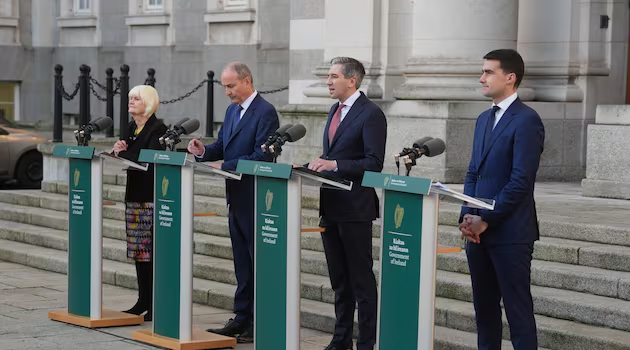
Taoiseach Micheál Martin, Tánaiste Simon Harris, Minister for Public Expenditure Jack Chambers and Minister of State Marian Harkin at the launch of Accelerating Infrastructure – Report and Action Plan. Photograph: Brian Lawless/PA Wire
The Taoiseach and the Tánaiste warned that failing to deliver housing will damage “social cohesion”.
Tánaiste Simon Harris said that, despite Ireland being a “wealthy country”, there are “so many people around our country who are yearning to access public services that often require capital investment, often around the enabling infrastructure and water, around wastewater, around energy”.
“I do think that damages social cohesion. And I think those of us who believe in the politics of the centre — and for the centre to hold — need to show an ability to accelerate delivery,” Mr Harris said.
The Tánaiste said there cannot be an “open chequebook” funded the exchequer for people who want to take legal challenges against projects.
[ Can we afford a divisive national debate over judicial reviews?Opens in new window ]
The main recommendations include reforms to limit legal challenges to infrastructure projects like judicial reviews, “targeted” deregulation to cut delays to big projects, more co-ordination and oversight of big projects in the Department of Public Expenditure, and a new “national narrative” to persuade communities of the national importance of big projects planned in their area.
The new action plan contains 30 different measures designed to reduce the cost and time it takes to build big projects in Ireland. Each action is assigned to a Government department or state agency, which will be responsible for making sure it is delivered within a certain timeframe.
Asked if he felt it had been easy for some State agencies to “shirk” their responsibilities to deliver big infrastructure projects, the Taoiseach said: “In some instances, yes. And I think transparency is extremely important here.”
“In some instances, we’ve had to engage with agencies, particularly in the housing front, to get disposal of land and so forth,” Mr Martin said.
“And that is something that shouldn’t have to happen. It shouldn’ take the intervention of a Taoiseach or a Tánaiste or Ministers to get agencies to do what Government has provided for.”
The report comes as Minister for Culture Patrick O’Donovan described those using judicial reviews against infrastructure projects as “nasty”.
Speaking on RTÉ Radio’s Today with David McCullagh show, Mr O’Donovan said it is “nasty” when somebody in Leinster” could “decide to lob in a judicial review” when there is “sewage and urine excrement flowing through your front door in Co Cork.”
“That in my estimation is nasty. To keep water and sewage and filth and dirt out of somebody’s house is a basic prerequisite of any local authority and the State. And we need to get to a situation where the abuse of the courts and the abuse of objections and the abuse of nimbyism has to be set aside because to be quite honest about it,” Mr O’Donovan said.
[ Judicial reviews blocking vital infrastructure and housing to be restrictedOpens in new window ]